
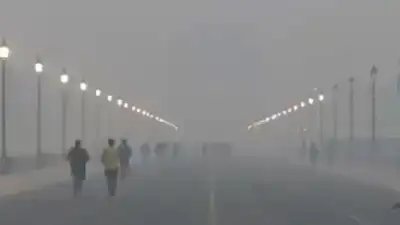
Morning walkers at India Gate said they could barely see the iconic monument through the haze.
NEW DELHI: Delhi’s air quality remained in the ‘very poor’ category for the second consecutive day on Tuesday, with the Air Quality Index (AQI) settling at 350 as a thick layer of smog engulfed the national capital. Ten monitoring stations recorded ‘severe’ pollution levels, while the city registered its worst air quality in 287 days. An AQI between zero and 50 is classified as ‘good’, 51 and 100 as ‘satisfactory’, 101 and 200 as ‘moderate’, 201 and 300 as ‘poor’, 301 and 400 as ‘very poor’, and 401 and 500 as ‘severe’, according to the Central Pollution Control Board (CPCB). The maximum temperature at Safdarjung, Delhi’s base weather station, settled at 29.1 degrees Celsius, 1.4 degrees below the season’s average. The minimum temperature was recorded at 16.4 degrees Celsius, 1.1 degrees above normal. Among other weather stations, Palam recorded a maximum temperature of 27.4 degrees Celsius, 3.4 degrees below normal, while its minimum settled at 16.2 degrees Celsius, near normal. Lodhi Road recorded a maximum of 29.1 degrees Celsius, 0.9 degrees below normal, and a minimum of 16.2 degrees Celsius, 3.2 degrees above normal. The Ridge recorded a maximum temperature of 28.2 degrees Celsius, 1.7 degrees below normal, and a minimum of 17.7 degrees Celsius, 0.6 degrees above normal. At Ayanagar, the maximum temperature was 29 degrees Celsius, 1.5 degrees below normal, while the minimum stood at 17.2 degrees Celsius, one degree above normal.
The Air Quality Early Warning System for Delhi has forecast that the city’s air quality is likely to remain in the ‘very poor’ category from November 4 to 6. The Decision Support System (DSS) estimated that stubble burning accounted for 15.3% of Delhi’s pollution, while transport emissions contributed 15.8%. Other local sources included energy production (1.2%), industries in Delhi and the periphery (3%), waste burning (1.4%), construction activities (2.2%), road dust (1.2%), residential sources (3.9%) and other sectors (1%). Satellites detected 219 farm fire incidents across six states on November 2, including 98 in Punjab, 67 in Rajasthan, 48 in Madhya Pradesh, four in Uttar Pradesh and two in Haryana.
No residue-burning events were detected in Delhi or Uttarakhand, according to data from the Consortium for Research on Agroecosystem Monitoring and Modelling from Space (CREAMS) Lab, Division of Agricultural Physics, ICAR-Indian Agricultural Research Institute. The outlook for the next six days suggests that pollution levels could remain in the ‘very poor’ to ‘severe’ category.