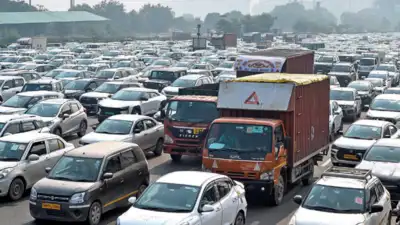
(Photo credit: Vinay Gupta/TNN) Delhi is set to implement restrictions on older vehicles that fail to meet BS6 emission standards from entering the city
With potentially more than 10 lakh vehicles from neighboring NCR cities affected, the success of the move will depend less on the rule itself, and more on how effectively authorities are able to identify, intercept and turn away vehicles at Delhi’s numerous entry points. 1 to Jan. 31.
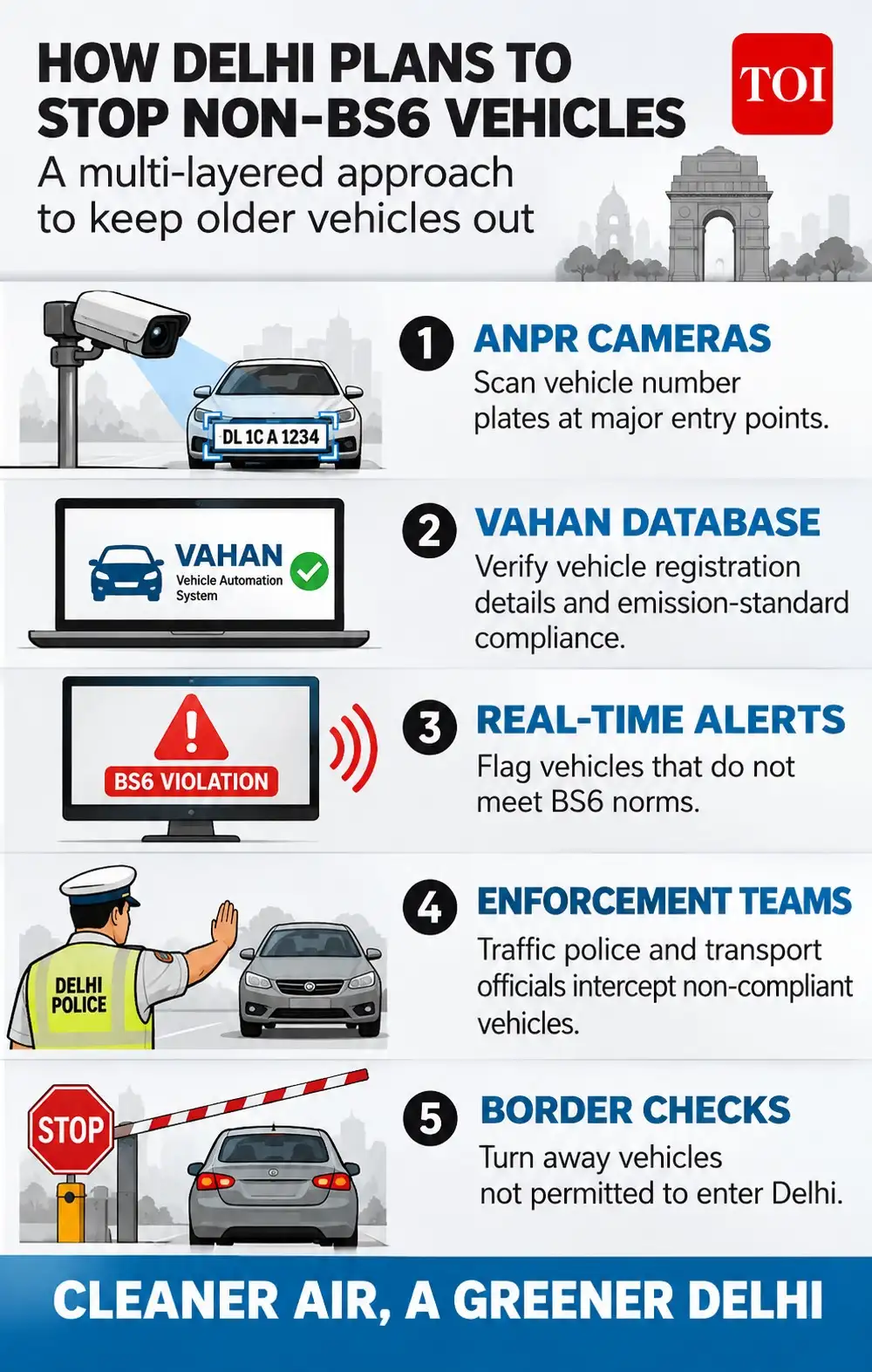
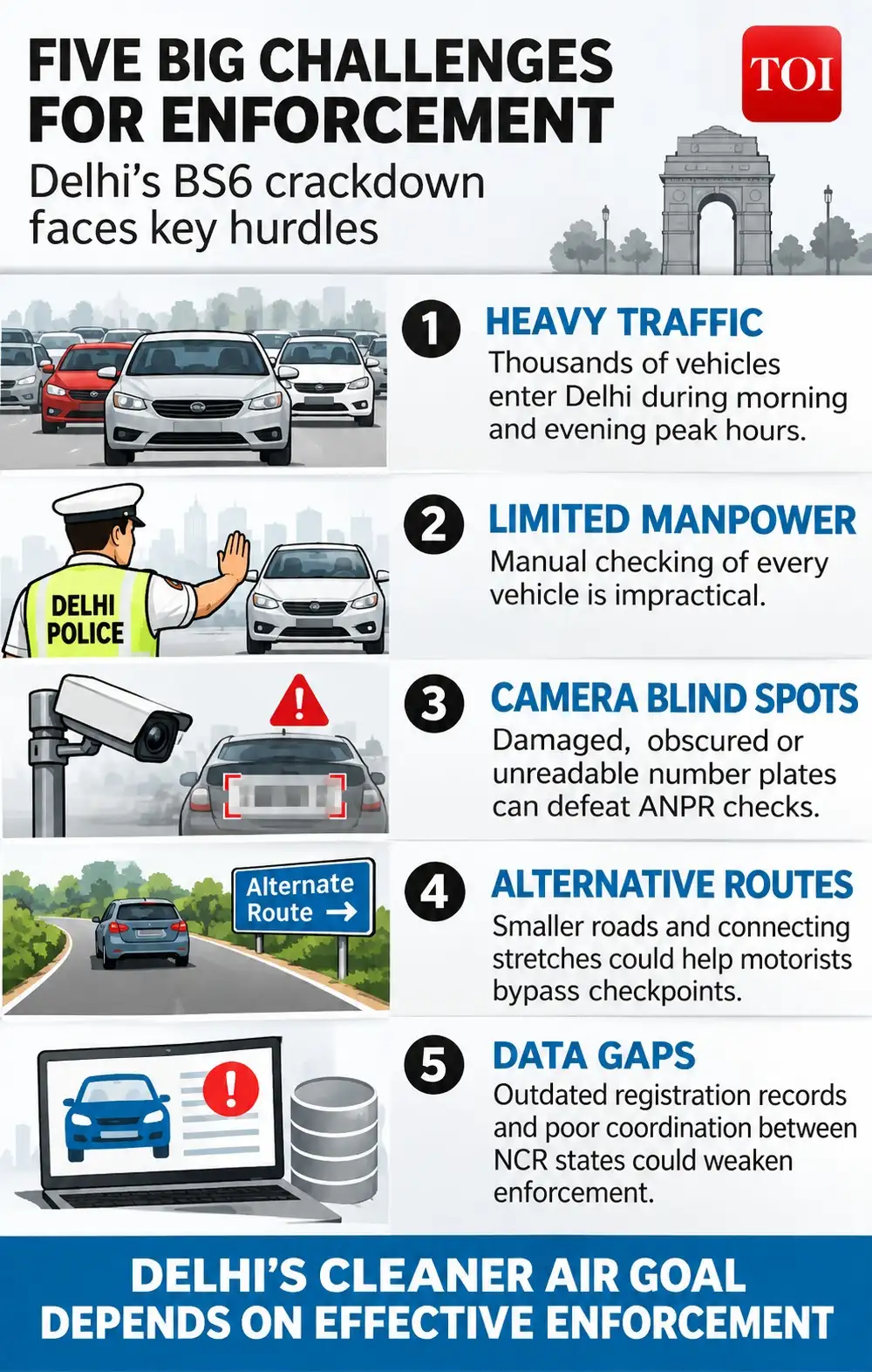
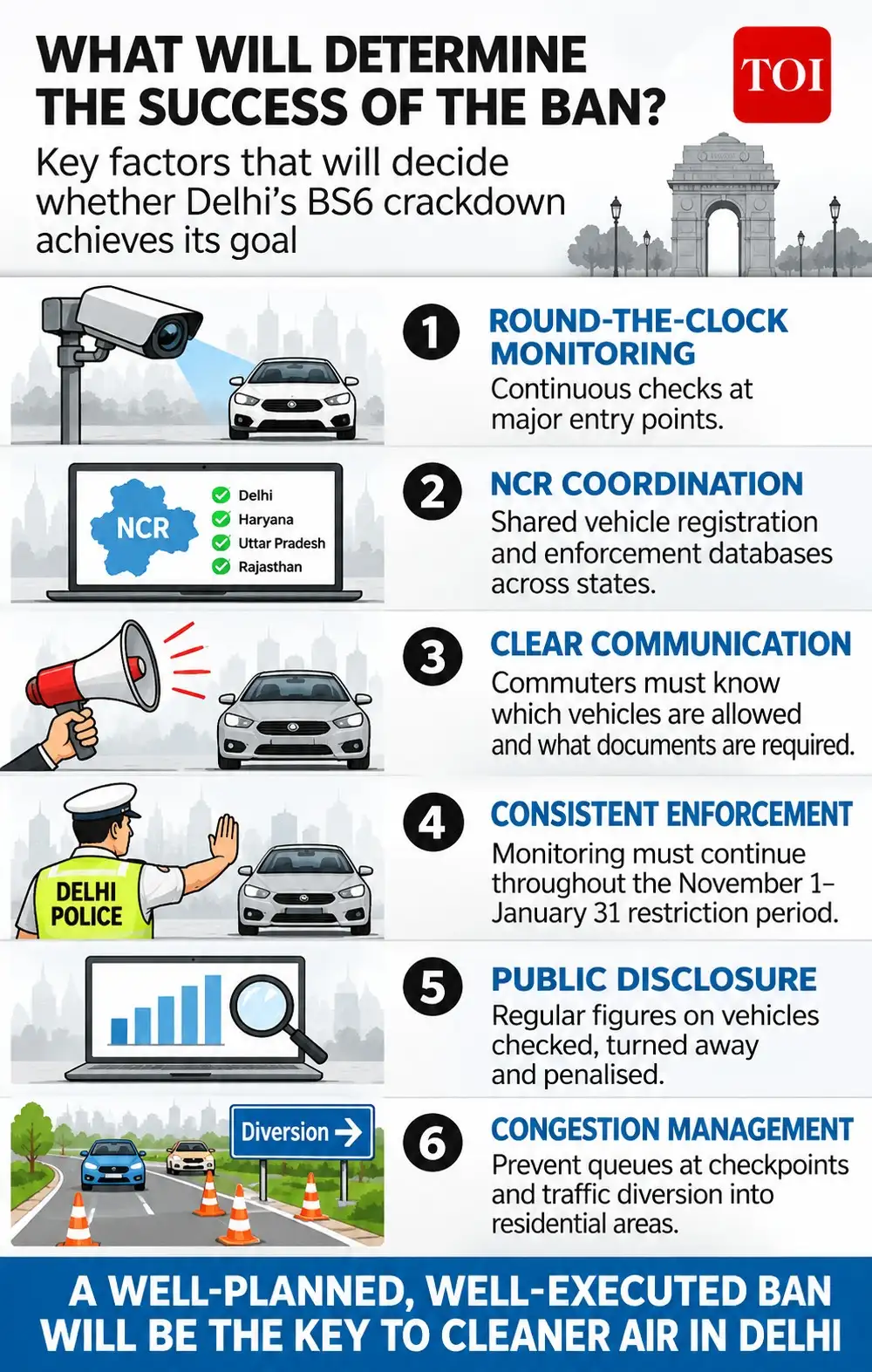
How Delhi plans to stop non-BS6 vehicles The tech test Technology will be important in enforcement, therefore. You Can Also Check: Gold Rate in Delhi | Silver Rate in Delhi | Bank Holidays in Delhi | Public Holidays in Delhi | Delhi AQI | Weather in Delhi | Petrol Price in Delhi | Diesel Price in Delhi | CNG Price in Delhi | LPG Price in Delhi Stay updated with the latest Delhi news. Delhi’s decision to stop older vehicles not meeting BS6 norms from entering the capital brings the focus back to a challenge that is more than announcing restrictions, that of implementing them. The exercise is on scale. Vehicles from Gurgaon, Faridabad, Noida, Greater Noida and Ghaziabad enter Delhi through a number of busy roads, many of which witness heavy traffic during morning and evening peak hours. It’s neither practical nor sustainable to check each vehicle manually. Even if teams from the traffic police and the transport department are deployed at major entry points, the volume of traffic could quickly overwhelm available manpower. Cameras using automatic number plate recognition, linked to vehicle registration databases, can help to identify vehicles that do not meet prescribed emission standards. But the system will only work if the cameras cover key entry points, registration records are up to date and enforcement teams can act on the alerts as they happen. Practical complications also exist. Damaged, obscured or hard to read number plates can affect camera-based identification. Records of vehicles registered outside of Delhi may be incomplete or outdated. Authorities need to have a reliable way of checking these vehicles without increasing the level of congestion at the checkpoints. The gaps along the border Another challenge is the sheer number of ways in you can watch the major highways and arterial roads, but smaller roads and connecting stretches may be opportunities to get around the checkpoints. If the enforcement is focused on some high-profile spots, motorists could just find alternative routes into the city. It would also put traffic into residential areas and smaller roads, creating new congestion problems. Five big challenges for enforcement Delhi and neighboring NCR authorities will have to coordinate equally. Data on vehicle registrations, emission certificates and enforcement should be accessible across the states. Without smooth coordination, vehicles turned away at one checkpoint might try to enter via another route. The exercise would be more effective if there is a common enforcement mechanism across the NCR. Commuters need to know The restrictions also have the potential to confuse daily commuters, especially those who travel to Delhi for work, education and business. Authorities will need to clearly communicate which vehicles are allowed, what documents drivers need to carry and how exemptions, if any, will be handled. It is equally important to ensure that enforcement is not arbitrary and that motorists do not face unnecessary delays or disputes at the checkpoints. Beyond the first crackdown The larger question is whether enforcement can be maintained for the three-month restriction period, from Nov. There will be a lot of activity at the initial deployment and checks but the real test will be to see if the monitoring continues at the same intensity after the first few weeks. What will determine the success of the ban? Authorities should also regularly publish data on the number of vehicles checked, turned away and penalized and details of enforcement at different entry points. Such disclosures would help to ascertain whether the restrictions are being uniformly applied, or whether there are any gaps. In the end, Delhi’s vehicle ban is only as good as its enforcement network. A rule that appears strict on paper will be of little use if thousands of vehicles continue to pass through the borders. The administration will need more than checkpoints and occasional drives, already stressed by winter pollution. It will require a coordinated, technology-enabled system that functions every day at every major point of entry. Download the TOI App.