

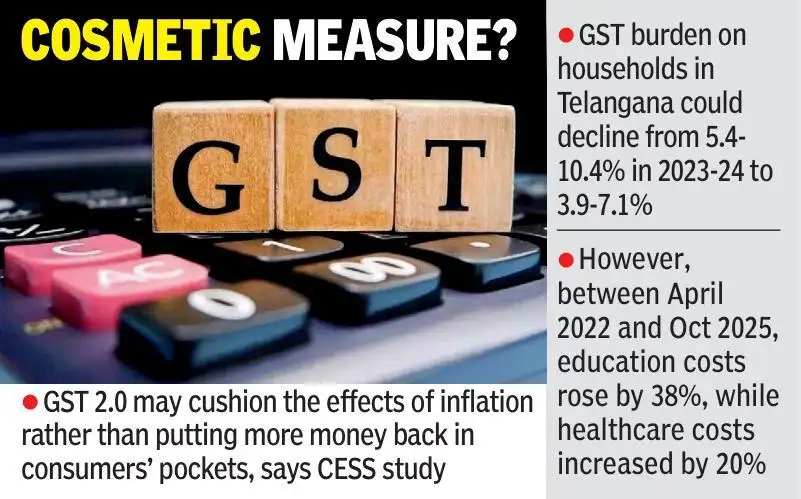
Hyderabad : While GST 2.0 is projected to lower the tax burden on Telangana households across income groups, its biggest impact may be in cushioning the effects of inflation rather than putting more money back in consumers’ pockets, according to a study by the Centre for Economic and Social Studies (CESS).
The study estimates that the effective GST burden on households in Telangana could decline from 5.4-10.4% in 2023-24 to 3.9-7.1% under GST 2.0. But with food prices having risen by nearly 17%, the tax reduction would mainly soften the impact of inflation rather than completely offset it. Consumers may still end up paying more than they did in 2022, though less than they would have without the proposed tax cuts, according to the authors, including CESS director Professor E Revathi. Its estimates are based on National Sample Survey Office household consumption data for 2022-23 and 2023-24 and assume that the entire tax reduction is passed on to consumers. Their effective GST burden could decline from 4.9-9.5% in 2023-24 to 3.3-6.1% under GST 2.0. GST on sports goods could fall from 12% to 5%, while rates on medical equipment could decline from 9-10% to 4-5%. Recreational goods could see GST rates fall from 24-26% to 16-21%. However, the top GST slab on personal transport equipment could increase to 30%. Across states, the study estimates that GST 2.0 could lower the effective household tax burden by about 1.5% to 4%, with some groups expected to gain more than others.
The study therefore views GST relief as a partial buffer against inflation rather than a guaranteed reduction in the cost of living. You Can Also Check: Gold Rate in Hyderabad | Silver Rate in Hyderabad | Bank Holidays in Hyderabad | Public Holidays in Hyderabad | Hyderabad AQI | Weather in Hyderabad | Petrol Price in Hyderabad | Diesel Price in Hyderabad | CNG Price in Hyderabad | LPG Price in Hyderabad Stay updated with the latest Hyderabad news. However, the actual benefit to families will depend on consumption patterns and price movements across sectors. Food is expected to see the biggest relief. The study estimates that the effective GST rate on food could fall by around four percentage points. The analysis is limited to household consumption and does not cover the broader GST base, including business-to-business transactions and capital goods. Female-headed households are also expected to benefit. The study identifies this as the lowest projected tax burden range among female-headed households in the states covered by the analysis. Several other product categories are also likely to see lower tax rates. Download the TOI App.
The effective GST rate on food in Telangana could fall from 2.2-7.4% in 2023-24 to 0.9-3.4% under GST 2.0. Processed food is expected to witness a particularly steep reduction, with its average GST rate dropping from around 13% to 4-5%. In rural Telangana, the effective GST rate for the lowest-spending households could decline from 5.4-10.4% to 4-7.2%, while the rate for the highest-spending households could fall from 5.5-11% to 4.1-7.5%. In urban Telangana, the GST burden for the lowest spending households could reduce from 4.8-9.5% to 3.4-6.3%. For the highest-spending households, it is projected to drop from 6-10.5% to 4.4-7.2%.
Among major spending categories, food is projected to receive the largest tax relief. The benefits are projected across income groups as well.