
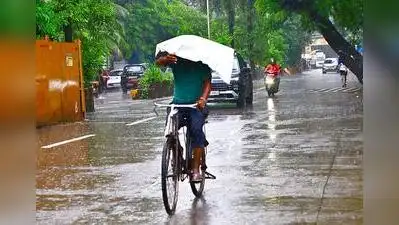
The IMD has issued an orange alert for Mumbai, Thane, and Palghar for Monday, indicating heavy to very heavy rainfall at isolated places.
The average rainfall recorded by IMD’s Colaba and Santacruz observatories in the 24-hour period ending 8.30am Sunday were 30mm and 80mm, respectively. As per the weather bureau’s rainfall categorisation, the Santacruz observatory recorded heavy rainfall. (64.5mm-115.5mm), while the Colaba observatory recorded moderate rain (15.6mm up to 64.4mm). July was the wettest month, recording 1,769.8mm rainfall, followed by June at 549.1 mm. In contrast, rainfall dropped sharply in August to 176.8mm, while September has so far recorded just 142.1 mm, against the month’s normal of 359.6mm. September has received only about 40% of its normal average rainfall quota so far, underscoring how sharply the monsoon tapered off after the intense July spell. Weather experts said rainfall had dropped to single-digit levels after August 18, with several days recording little or no rain. Rajesh Kapadia, founder of Vagaries of the Weather, said this is the first significant spell of rain Mumbai has experienced since Aug 15. Rainfall is likely to ease from Monday, with Mumbai expected to receive around 20-40mm on Monday,” he said.
A low-pressure area from the Bay of Bengal moved across Vidarbha and south Madhya Pradesh, according to Kapadia. The India Meteorological Department (IMD) has issued an orange alert for Mumbai, Thane, and Palghar, for Monday, indicating heavy to very heavy rainfall at isolated places. “A trough extending southwestwards from the low-pressure area towards north Maharashtra and Gujarat has also contributed to the current spell. However, these systems are not expected to persist for long.
Mumbai: The overnight downpour pushed the city’s rain gauges into triple digits at several locations on Sunday, marking a sharp change from the relatively dry weather conditions since mid-August. Rainfall recordings from automatic weather stations between 1am and 10am on Sunday showed that Bandra-Kurla Complex (BKC) recorded the highest rainfall at 147mm, followed by Magathane at 133mm, Chembur at 127mm, Govandi at 121mm, Sewri at 106mm and Dadar at 98mm.