
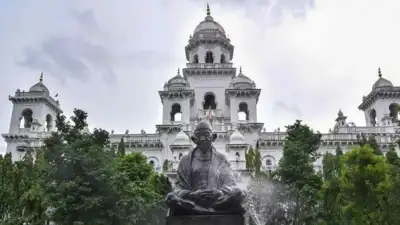
Telangana Assembly
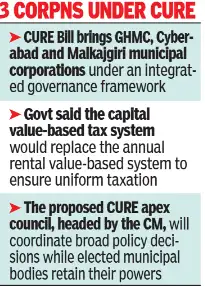
Legislative affairs minister D Sridhar Babu, who introduced the Bill on behalf of chief minister A Revanth Reddy, who holds the municipal administration and urban development portfolio, clarified that only affluent sections would face a maximum property tax increase of 10%, and that too not in all cases, as the tax would be assessed based on the value of the property. “For the poor, the tax rate is Rs 101 per annum for a 375-square-foot property and 0.15% for middle-class sections. The tax on commercial properties will be at the rate of 0.75%. The capital value-based tax assessment is being brought into the three municipal corporations — GHMC, Cyberabad and Malkajgiri Municipal Corporations — replacing the annual rental value-based tax assessment as envisaged in the Municipal Corporation Act of 1955, to bring a uniform taxation method,” Sridhar Babu said.
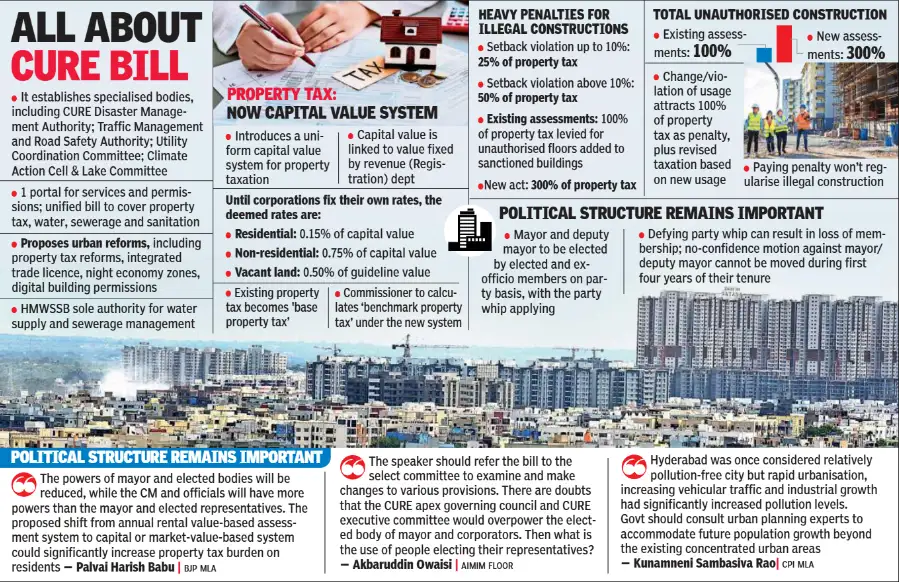
Legislative affairs minister D Sridhar Babu, who introduced the Core Urban Region (Integrated Governance) Bill, 2026, on behalf of chief minister A Revanth Reddy, in the legislative assembly on Saturday said that the CURE apex governing council, which would be headed by the chief minister, would function only as an advisory body. Sridhar Babu said the CURE Bill would not only replace the GHMC Act of 1955 but would also provide a comprehensive framework for creating a modern, coordinated and technology-enabled governance system suited to the scale and future needs of Hyderabad’s metropolitan region. “Today, the CURE, comprising Greater Hyderabad, Cyberabad and Malkajgiri Corporations, has a population of approximately 1.30 crore, more than 12 times the population envisaged when the law was enacted. It accounts for nearly one-third of the state’s population and a major share of the state’s 17.82 lakh crore GSDP in 2025-26. Under Telangana Rising: Vision 2047, CURE is envisaged as a principal engine for achieving a $3 trillion economy by 2047,” Sridhar said.
The capital value-based tax assessment is already being implemented in municipalities and municipal corporations elsewhere in the state, Sridhar Babu said, clarifying that the system had been introduced by the previous BRS govt.The minister assured BJP, AIMIM and CPI members that the govt would examine all the issues, concerns, objections and suggestions raised by them regarding the Bill.
In fact, the CURE Bill is strengthening the powers of the mayor,” he said. He said the Bill adopts a wide governance approach, retaining decentralised ward-level administration in each of the three corporations while creating statutory mechanisms for coordination among corporations, govt departments and other authorities. Meanwhile, the BJP opposed the CURE Bill, 2026, terming it a “harming bill instead of a cure” for citizens living within the CURE area and urged the speaker to withdraw the Bill in its entirety.
“It is not going to take away the powers of mayors and corporators. It will set only broad policy decisions in the CURE area. He added that the proposed tax structure was significantly lower than the rates being levied in Mumbai and Chennai. AIMIM floor leader Akbaruddin Owaisi also urged the speaker to refer the Bill to the Select Committee of the Assembly.