
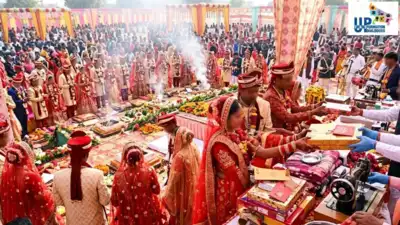
(AI Image) In October 2026, the state has set a target of 72,540 marriages for 2026–27.
Hardoi has emerged as the leading district in Uttar Pradesh under the Mukhyamantri Samuhik Vivah Yojana, with 1,385 couples solemnising their marriages during the 2026-27 financial year so far. Sitapur follows with 1,335 marriages, while Pilibhit has recorded 1,271 and Azamgarh 1,242. Across the state, 28,833 couples have married under the scheme, reflecting its continuing reach among economically weaker families. Under Chief Minister Yogi Adityanath , the scheme has expanded from an initiative providing modest financial assistance into a programme offering Rs 1 lakh per couple, alongside organised ceremonies and measures intended to ensure transparent delivery of benefits.
The district-wise figures highlight the role of local administrations in implementing a welfare programme designed to reduce the financial burden of marriage.
The state has set a target of 72,540 marriages for 2026-27, according to figures released by the Social Welfare Department in October 2026. Against this target, 28,833 marriages have already been solemnised. The department has received 1,16,668 applications, of which 34,845 have been approved, while 11,679 applicants were found ineligible during scrutiny. Hardoi’s 1,385 marriages place it at the forefront of the current financial year’s district-level performance. Sitapur’s 1,335 marriages demonstrate a similarly substantial reach, while the figures for Pilibhit and Azamgarh show that the scheme is supporting families across different parts of Uttar Pradesh. The current assistance structure provides Rs 1 lakh per couple, comprising Rs 64,000 transferred to the bride’s bank account, Rs 21,000 earmarked for wedding gifts and Rs 15,000 allocated for ceremony-related arrangements. When the scheme was launched in October 2017, assistance stood at Rs 35,000 per couple. It was subsequently increased to Rs 51,000 before being raised to the present level of Rs 1 lakh. Since its launch in 2017, the Mukhyamantri Samuhik Vivah Yojana has grown considerably in scale. By March 2025, it had facilitated 4,76,207 marriages. A subsequent report in June 2026 placed the cumulative total at 5,54,202 marriages. The additional marriages recorded during 2026-27 further demonstrate that the scheme continues to attract applications from eligible families. The way forward is to ensure that the remaining annual target of 43,707 marriages is pursued through effective district-level coordination, wider awareness and timely scrutiny of applications. From its initial assistance of Rs 35,000 to the current provision of Rs 1 lakh per couple, the Mukhyamantri Samuhik Vivah Yojana has undergone a substantial expansion in financial support.
Because of the number of marriages conducted but also because they represent families receiving institutional support at an important stage of their lives, the cumulative figures are significant not only. At the same time, applicants must receive clear guidance on documentation and eligibility so that procedural difficulties do not unnecessarily prevent deserving families from accessing assistance. These figures, reported at different points in time, indicate the programme’s expansion over nearly nine years. You Can Also Check: Gold Rate in Lucknow | Silver Rate in Lucknow | Bank Holidays in Lucknow | Public Holidays in Lucknow | Lucknow AQI | Weather in Lucknow | Petrol Price in Lucknow | Diesel Price in Lucknow | CNG Price in Lucknow | LPG Price in Lucknow Stay updated with the latest Lucknow news.
Collective ceremonies provide an organised platform for eligible couples from different communities, with marriages conducted according to the customs and traditions applicable to participants. The underlying objective is to help families conduct marriages with dignity without being forced to borrow heavily, exhaust their savings or compromise essential household needs. By combining financial support with collective marriage ceremonies, the government seeks to make an important family occasion more accessible to households with limited resources. The figures underline both the demand for assistance and the importance of verification before benefits are extended. Applications received, cases approved and marriages completed represent different stages of implementation, with ceremonies organised in phases across districts. District administrations play a critical role in publicising the scheme, helping applicants understand eligibility requirements, checking documents and coordinating ceremonies. The latest figures also offer an opportunity to identify administrative practices that can help other districts improve outreach and process applications more efficiently. A major development in the scheme has been the increase in financial assistance. This structure addresses several immediate needs associated with marriage. The direct financial transfer is intended to strengthen the bride’s financial security as she begins a new phase of life, while the provision for gifts and ceremony arrangements helps reduce the expenditure that participating families would otherwise have to bear. The expansion represents a substantial increase in the support available to eligible families and reflects the scheme’s evolving financial framework. For low-income households, marriage expenses can compete with spending on education, healthcare, housing and livelihoods. By sharing these costs, the programme seeks to reduce financial pressure and help families avoid excessive borrowing for social obligations. Its development reflects two parallel changes: an increase in the number of beneficiaries and a substantial rise in the assistance available to each couple. The programme has also established collective ceremonies as a means of organising marriages in a structured setting, reducing the need for individual families to arrange every aspect independently. The long-term impact, however, depends on timely payments, fair beneficiary selection and the effective implementation of the scheme across all districts. The government has emphasised digital verification and direct benefit transfers to strengthen the delivery system. The process includes e-KYC for applicant verification and digital verification of income and caste certificates through the e-District portal. Aadhaar-based payment mechanisms are used to facilitate transfers to the linked bank accounts of eligible beneficiaries. These measures are intended to improve record accuracy, strengthen accountability and reduce the possibility of irregularities. Beyond financial assistance, the scheme seeks to promote social inclusion and reduce the pressure associated with expensive weddings. The programme’s significance lies in recognising that economic hardship should not prevent families from arranging marriages with dignity. Financial assistance to the bride, support for ceremony arrangements and a structured application process together seek to make the occasion less burdensome for low-income households. Hardoi, Sitapur, Pilibhit and Azamgarh illustrate the scheme’s current reach, while further progress will depend on ensuring that eligible families throughout Uttar Pradesh can access its benefits. Its record of more than five lakh marriages since its launch demonstrates the scale of its implementation. Ultimately, its success will be measured by whether the programme consistently provides timely assistance, safeguards the dignity of beneficiaries and helps families begin a new chapter without avoidable financial distress. Download the TOI App.