
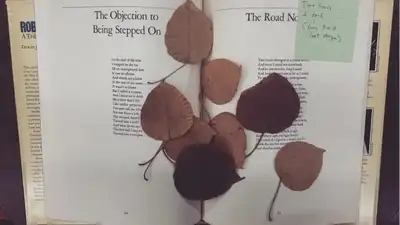
This teacher from Oklahoma City looks for forgotten mementos in used books and helps people reclaim lost memoriesImage courtesy: Emma Smreker
As CNN reported in 2020, all of it started with a French-language book her husband gave her. After Emma’s story broke over half a decade back, in August 2020, the astonishing response made sense. At a flea market, she uncovered a poem dated June 1893, handwritten by Ed Ruffner for the Lancaster Gazette.
Because you’d think most people would toss the slip without a second thought, but for Emma, that small find sparked a treasure hunt, it’s funny,. Sometimes the outcome is pure joy: a family reunited with a memory lost for years; a poem finally published in the newspaper its author hoped for. After digging around, she found a descendant who confirmed Ed’s past as a poet.
Picture this: a faded photograph tucked between the pages of a second-hand novel, a handwritten love letter that never reached its recipient, or even a century-old poem forgotten inside a book of verse! All these are the unexpected treasures that can turn an ordinary trip to a used-book shop into a journey through someone else’s past. For most readers, such discoveries might be little more than curious scraps of paper, destined for the bin — but not for Emma Smreker! Inside, she discovered a crumpled café receipt from Montreal. That tiny scrap conjured up the image of another reader, someone who once sat in that café and left a trace of themselves inside the book. Emma’s mind flooded with questions: Who bought the book? What led them to that café? Was there a story hidden in the receipt’s worn ink? She began scouring second-hand bookstores, thrift shops, and flea markets, looking for forgotten mementoes and the hidden narratives tucked behind them. In a world pushed ever deeper into digital connections, here was someone who was tracking down unexpected connections: real, tangible proof that books don’t just hold stories written by authors, but stories left behind by readers. Her Instagram project, ‘In Used Books’, documents these finds, and sometimes she actually tracks down the original owners. It’s a little reminder that books carry the fingerprints of their past travelers, sometimes literally. But it’s not always about families and reunions. Sometimes Emma’s discoveries reach further back, even into literary history. Then she reached out to the paper, which is still around, now called the Lancaster Eagle-Gazette, and got the poem published, over a century after Ruffner wrote it. Imagine that: a thread of ambition finally completed, years after the author is gone. First of all, used books, unlike new ones, always come with echoes: think dog-eared corners, scribbled margins, bookmarks pressed with flowers or notes. Each item hints at the book’s own journey. A boarding pass means someone was traveling with the story; a grocery list flashes a mundane snapshot of somebody’s day; a poem or letter implies love, loss, or longing. Without context, these are puzzles… little bits that push readers to imagine what happened. Emma believes in this magic, that unexpected connections can spark between strangers simply by holding the same book. Her project fits into a bigger tradition, too: libraries like Oakland’s, where Sharon McKellar started documenting found objects in returned books, have proven that these scraps are more than trash; they’re pieces of everyday history. Of course, not every mystery gets solved. Sometimes Emma traces clues to a dead end; sometimes the artefacts are too vague, or maybe intentionally left behind, and the story stays unfinished. Not every photograph finds its home, and plenty of letters never reveal their true meaning. But that’s part of the appeal. The hunt itself matters: it urges us to look closer, to not dismiss those odd slips found between pages but to wonder about the life behind them.
A high school French teacher from Oklahoma City isn’t just a teacher; she’s something of a detective for lost memories. For Emma, every found object is a clue, and every clue pulls her into another person’s history. She’s not satisfied with just flipping through pages; she’s chasing the stories that slip between them. Emma’s hunt has led to some incredible moments. Once, she stumbled upon an old photo-booth strip showing a father and young daughter pulled inside silly faces against the camera’s lens. She found it tucked inside a copy of ‘We Don’t Die: George Anderson’s Conversations With the Other Side’. The photo, the book, the nostalgia — they all lined up, but there wasn’t a single clue as to who the pair were. Emma posted the image all over Instagram, Facebook, Reddit, and even delved into the golf shirt the dad was wearing, hoping it might lead her somewhere. For over a year, the mystery just sat there. But then, local news aired the story and Maria Meagher, living in San Antonio but watching Oklahoma TV, suddenly recognized her husband Tom and their daughter Sofia. The photos had been taken way back during a trip to California when Sofia was just four years old. Tom, who didn’t remember taking the pictures, got to relive a slice of family history during a time (the pandemic, no less) when happiness was rare and precious. The family made new photos for Emma and hoped to meet her. This single, forgotten photo, found in a random book, had sent them back into their own timeline, which is a bridge between then and now. Emma’s story reminds us, in a fast-paced world hung up on speed and hustle, to think twice before tossing out a ticket stub or a scribbled note inside a book. To her, and maybe to plenty of us, these little things are the last surviving pieces of a moment that mattered, even if only to one person. In her hands, second-hand book shopping goes way beyond hunting for cheap reads. It becomes an adventure of memory, chance, and real human connection. And sometimes the wildest story a book holds isn’t printed at all, but tucked in by someone who never knew it’d matter. You use AI every day. Now get your AI Quotient. Take the AIQ test Get the latest Lifestyle News and more. Download the TOI app.