
Image: AI
A 2025 feasibility study with children aged 10 to 16 in childcare centres in Kerala found improvements in emotional and behavioural measures and self‑esteem after a structured 10‑week art therapy programme.
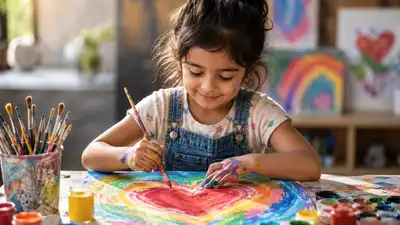
Of starting with a direct question such as “What is bothering you?” a therapist may begin by talking about something the child has created. For children this can be especially meaningful. Words require a level of emotional vocabulary. A child may know they feel angry, lonely confused or frightened. Explaining why is often harder. Drawing, painting, clay or other creative activities let the child begin to communicate before they’re ready to put everything into speech. The process itself is also valuable. Making art encourages children to choose, experiment and express themselves without needing a correct” answer. For a child going through a time having a space where they can create without judgment can be reassuring. Research in India is making this conversation more relevant. Studies with children in childcare centres in Goa have also examined art therapy as a way to support mental health, emotional regulation and resilience. These studies are still small so they should be seen as promising evidence than proof that art therapy works in every situation. Art can also make conversations less intimidating. That can provide a natural start for communication.
28 Jul 2026 | 16:22 In India children grow up in different families and schools.. There are feelings that are hard to describe especially when a child is still learning how to talk about emotions. A child might sense that something is wrong but not know how to put it into words. Sometimes the child has no words for what they feel. This is where art becomes a kind of language. I have spent years with art and young people who make it. I notice that a drawing can sometimes say what a conversation cannot. A quiet child may fill a sheet with colours, shapes and pictures. The art that the child creates gives adults another way to see what the child is struggling to express. T he pressure to do well in school can make talking about feelings hard. A child may feel comfortable talking about marks, competitions or future plans.. The child may find it difficult to explain feelings of being overwhelmed, lonely or anxious. Creative expression can be an intimidating entry point. A drawing does not give an explanation but it can open the door to a conversation that might never start otherwise. This is one of the ideas that drives art therapy. Art therapy is not just giving a child paints. Asking them to draw. It is a practice where trained therapists use art‑making and creative work with psychological techniques to support emotional and mental well‑being. The artwork is not a test to be decoded for the thoughts of a child. Rather the process helps a child explore and share experiences that’re hard to put into words.
For a child who cannot yet say, “This is how I feel ” a blank page can sometimes be the place where that conversation begins. At the time it is important not to romanticise art as a cure for every emotional problem. A picture cannot diagnose a child and adults should be careful about assigning fixed meanings to colours, shapes or drawings. Children should not be labelled based on their artwork. The value lies in the relationship, between the child, the creative process and a qualified professional who understands the context. Perhaps that is what makes art such a powerful language. It does not replace words, therapy or human connection. It can simply create another door into them. Krish Nawal, Co-Founder, Children’s Art Museum of India (CAMI) Looking for trusted parenting advice? Follow TOI Parenting Circle on Instagram for expert guidance, relatable stories, and practical tips delivered every day.