
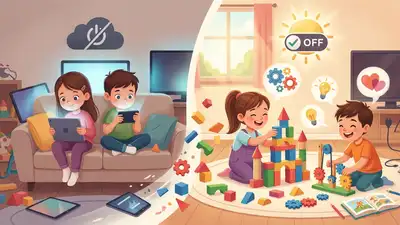
Can the right toys help reduce screen time in kids? Hear what an expert has to say (Image: AI)
8 Sept 2026 | 15:33 Shobhit Singh, Managing Director & Chief Executive Officer, The Stone Sapphire India Pvt.
Ltd., says the way children play with toys can help create a more balanced approach to screen use. Toys that encourage “building, creating, experimenting and problem-solving” can give children an opportunity to engage with something beyond a screen, according to Singh. A puzzle on the floor, a box of building blocks on the table or a science kit waiting to be opened may look like ordinary play. But for a child reaching for a phone out of boredom, that toy can offer something a screen often does not: the chance to make a choice, get something wrong and try again. As parents struggle to make screen-free time feel interesting rather than restrictive, toys are increasingly being considered as part of the solution. The idea is not to replace technology completely, but to create alternatives compelling enough for children to move naturally between digital entertainment and hands-on play. Not every toy is equally suited to pulling a child away from a screen. Toys that require children to build, create, experiment or solve a problem demand active participation rather than passive watching. That distinction matters. A toy that simply entertains a child for a few minutes may not hold the same appeal as one that gives them something to figure out. A building set can become a house, a bridge or an imaginary city. A puzzle can become progressively more challenging. A science kit can turn curiosity into an experiment. Art materials can give a child an entirely open-ended task with no single correct answer. This kind of open-ended play also gives children room to make decisions and explore possibilities at their own pace.
Because children can lose interest when play becomes predictable, this matters. Because one product can provide multiple kinds of play rather than being discarded as soon as the novelty wears off, that approach may also make educational toys more sustainable from a family-budget perspective,. The goal is to make play part of the everyday environment rather than something introduced only after a parent announces that screen time is over.
Singh says this shift is also influencing what parents are looking for when buying toys, with greater attention being paid to products that combine entertainment and learning. That small change can alter the experience from “I’m taking your screen away” to “Here are a few other things you can do. The idea is therefore less about finding a magical “screen-time reducing toy” and more about choosing toys that encourage active play. The most useful toys, according to this approach, are those that invite children to create rather than simply consume.
One of the less obvious ways toys can compete with screens is by giving children control over what happens next. A child interested in construction might happily spend an hour creating different structures. Another might prefer drawing, puzzles or experiments. Rather than directing every activity, parents can offer a few options and allow the child to choose. That choice can make play feel less like another instruction from an adult and more like something the child has discovered independently. Educational activity-based toys and STEM toys for children, for example, can introduce concepts through hands-on experiences. Building sets, puzzles and science kits can encourage children to test ideas, make mistakes and look for their own solutions. There is another trick hidden in plain sight: familiar toys can feel new when the challenge changes. A building set does not have to be used the same way every time. Parents can suggest a new structure to design or introduce a small challenge. A puzzle can become more difficult over time, while a creative activity can be approached in a completely different way. Keeping the experience fresh does not necessarily mean constantly buying new toys. Instead, parents can change the way a toy is used. Sometimes the barrier is surprisingly simple: the alternative is not within reach. A phone is usually visible, charged and immediately available. A puzzle hidden in a cupboard or art supplies kept out of reach have to compete with that convenience. Singh suggests making books, puzzles, building sets, art materials and activity kits accessible so children can choose them when they want something to do. Toys by themselves are unlikely to solve the entire problem of excessive screen use. Children live in a digital world, and screens can have legitimate roles in learning, communication and entertainment. The bigger opportunity is creating a routine in which technology is not the only source of stimulation. Reading, drawing, building, outdoor play, imaginative games and hands-on activities can give children different ways to spend their time. Over time, that variety may make the constant pull of a screen less dominant. A strong toy can ask a child to build something, solve a problem, test an idea, invent a story or experiment with what happens next. It can leave room for imagination instead of prescribing every move. That is why STEM toys, building toys, creative activity kits, puzzles and open-ended toys are increasingly attractive to parents looking for screen-free activities for children. The larger lesson is perhaps simpler than the debate around screen time suggests: children may not always need another rule telling them to put the phone down. They may need something genuinely interesting to pick up instead. And sometimes, that something can be sitting quietly in a box on the floor, waiting to be built. Looking for trusted parenting advice? Follow TOI Parenting Circle on Instagram for expert guidance, relatable stories, and practical tips delivered every day.