
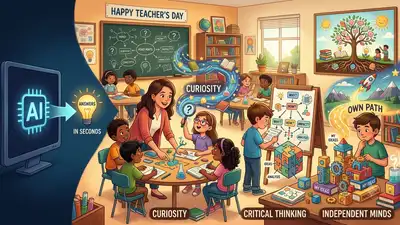
Teacher’s Day in India is a reminder of something easy to overlook in an age when a child can find an answer in seconds: the most important thing a teacher does may have nothing to do with giving an answer at all.
28 Jul 2026 | 16:22 As India observes Teacher’s Day, celebrated every year on September 5 to mark the birth anniversary of former President and philosopher Dr Sarvepalli Radhakrishnan, the changing role of educators offers a larger question: when knowledge is everywhere, what exactly should a teacher teach? A screen can explain a difficult formula, correct a sentence, generate an essay or instantly produce information on almost any subject. But it cannot always notice the hesitation behind a student’s question, understand why a seemingly wrong answer matters, or recognise the precise moment a child stops memorising and starts thinking independently. That quieter work has always been at the heart of teaching and technology may be making it even more important. The answer may lie not in adding more information, but in developing the ability to question, evaluate and make sense of it. For generations, the classroom operated around a relatively simple equation: the teacher knew, and the student learned. Textbooks, lectures, blackboards and examinations were built around the transfer and retention of knowledge.
A child needs to know not only what information says, but whether it is credible, how different claims compare, what assumptions lie behind an answer and when the answer itself needs to be questioned. Education has always been about more than remembering facts. A history lesson can teach dates, but it can also teach a child to examine evidence. A literature class can introduce a poem, but it can also teach empathy by asking students to inhabit another person’s perspective. A science experiment can produce an answer, but its greater lesson may be that failure is part of finding one. These are habits of mind. And unlike a textbook, they can travel with a person for decades. Why the teacher still matters The classroom of the future may look very different from the classroom many parents remember. AI tools may become commonplace. Digital resources may supplement textbooks. Students may increasingly learn through personalised platforms. Yet the more abundant information becomes, the more valuable judgment becomes. Those are not merely academic skills. They shape how people navigate an increasingly complicated world. This is why Teacher’s Day can be viewed as more than a celebration of a profession. It is also an opportunity to reconsider what society expects from teachers. The teacher may no longer be the person standing between a student and information. In many cases, information is already sitting inside the student’s phone or computer. The teacher’s job is becoming something more demanding: standing beside the student while they learn what to do with all that information. And perhaps that is the part of education that technology cannot replace, the human ability to notice when a child is not merely answering a question, but beginning to ask better ones. Looking for trusted parenting advice? Follow TOI Parenting Circle on Instagram for expert guidance, relatable stories, and practical tips delivered every day.
Because students do not all make mistakes for the same reason, and that human attention can be particularly important.
Now that technology can answer almost anything instantly, a teacher’s value lies in what a screen cannot offer noticing the doubt behind a question, the reasoning behind a wrong answer, the exact moment a student begins to think for themselves rather than repeat what they’ve been told. Search engines, educational platforms and artificial intelligence can provide information almost instantly. But access to information does not automatically translate into understanding. That is where the teacher’s role becomes more nuanced. Lakshata Gianani, English Coordinator, The Green Acres Academy, Chembur, puts the shift in perspective: “Teaching was never simply about passing on knowledge; it has always been about teaching a mind how to use it. Those are not things an exam measures. They are the habits, to question, to examine, to stay curious, that a student keeps long after they’ve forgotten the lesson itself. The more technology enters the classroom, the more essential this human part of teaching becomes, not less. It is a subtle distinction, but an important one. Knowing an answer and knowing how to arrive at one are not the same skill. A student can use AI to produce an answer, but a teacher can ask: Why do you believe this? What evidence supports it? What happens if the assumption changes? Could there be another explanation? Those questions turn information into learning. There is an apparent paradox at the centre of the AI-powered classroom. The technology that appears capable of making teachers less necessary could instead push educators towards the parts of teaching that require the most human judgment. Rohan Parikh, Co-Founder & Chairperson, The Acres Foundation, describes this transformation as an inversion of the traditional classroom: “The teacher’s role has inverted. That is a harder, more human job, part coach, part mentor, part role model, and no teacher walks into it ready. So teacher development is the most important thing we do: coaching inside the classroom, week on week, not a seminar once a year. Technology and AI are the surrounding layer, they strip away the marking and the admin so the teacher can do what no platform can: know a child, and guide them. The teacher of the future is not replaced by the screen. She is freed by it. That final idea changes the way technology in education can be viewed. If AI can help with repetitive administrative work, marking or routine information delivery, the potential benefit is not simply efficiency. It is time. Time that can be redirected towards observing students, giving feedback, having conversations and understanding how individual children learn. Two children may give the same incorrect answer while arriving there through completely different lines of thought. One may have misunderstood a concept. Another may have understood it but misapplied a rule. A third may simply be afraid to take a risk. The answer alone does not reveal that difference. A teacher watching the learning process can. What survives after the lesson is forgotten? There is another way to measure the value of teaching: not by what students remember immediately after an examination, but by what they carry into adulthood. Bonny Bhansali, Principal, The Green Acres Academy, Chembur, describes that longer-lasting impact: “A classroom has always been more than a place where knowledge changes hands. It is where students learn to question, think, listen and make knowledge their own. Years after they leave school, they may not remember every formula, date or definition. What stays is how they learnt to approach the world: Did they learn to ask questions rather than simply seek answers? To listen to different perspectives? To examine rather than assume, learn from mistakes and think independently? In a world where information is instantly accessible and technology can answer almost any question, the teacher’s role is evolving. It is less about delivering knowledge and more about helping students make sense of it by developing critical thinking, curiosity, empathy and the confidence to think independently. The true measure of education is not what a child remembers, but how they continue to think and learn long after the lesson is forgotten. That idea reaches beyond technology.
A student today does not necessarily have to wait for the next class to find an explanation. For a century, the teacher was the source of knowledge; today, knowledge is abundant and instant, and the teacher has become the architect of a child’s ability to think, question, and adapt.