
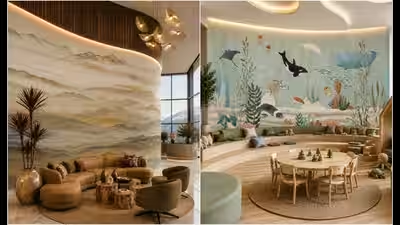
Curves add movement, depth and elegance, giving them a timeless quality,” says Imran Khan “After years of harsh, straight lines, homeowners are looking for spaces that feel softer and cosier.
“Traditional straight walls create a flat and cold ambience, missing the warmth, care and closeness,” she says. “Our approach went beyond just choosing furniture with rounded edges; we also had to consider the architecture of the space,” he says. They are seeing more clients choosing curved walls now than they did three years ago, according to experts. “Luxury today is about creating something that feels personal and artistic,” says Neha Jain, co-founder of Space of Joy. In an open-plan living area, for instance, it can gently separate the seating zone from the rest of the space without making the layout feel closed off, according to interior experts. “The beauty lies in knowing where to use curves and allowing them to enhance the emotion of a space,” says Jain. He says, “For artwork, a single large statement piece can have greater impact than a collection of smaller framed works.” – However, not everything around a curved wall needs to follow the same shape. “The finish is what makes the curve look seamless and sophisticated,” says Purva Gokhale. “I use two different techniques depending on the curve,” explains Gokhale, including cutting tiles into smaller sections or using wooden skirting painted to match the floor. “Achieving this level of finesse requires skilled craftsmen, particularly when working with complex curves and premium materials,” says Gokhale. “A curved wall stops being a boundary and instead becomes art, making the room feel genuinely more luxurious” – Purva Gokhale, concept designer and founder of an interior design studio “In one of our projects, we introduced a curved wall to soften the geometry of the space and create a more fluid transition between areas.
Curves have already found their way into sofas, kitchen islands, arches, and furniture. Now, the curve is moving beyond individual pieces and becoming part of the architecture itself. Designers are using curved walls to soften hard lines and improve movement. For concept designer and D20 Elements founder Purva Gokhale, this approach has recently taken shape in living rooms and passageways. To create a more restful home, she has used smooth, flowing walls made with aluminium framing, flexi-ply and MDF, finished with painted textures, stone or vertical rafters. The reasoning can be equally practical. In one of concept designer Imran Khan’s projects, the clients had young twins and wanted to minimise sharp edges around the home. Curved walls and softer forms allowed the design to feel cohesive while making the home safer and more child-friendly. artwork or decorative finishes, achieving a perfect curve is far more bespoke While a straight wall can be easily elevated with luxury wallpaper. It demands precision and skilled craftsmanship, giving the finished wall a more expressive and artistic quality. “Curves bring softness, movement and a sense of imperfection, just like a beautiful piece of art that makes you pause and discover something new every time. Curved walls allow homeowners to create spaces that don’t look like everyone else’s. The trend also reflects a wider shift in luxury towards craftsmanship, individuality and the skill behind the design. Beyond aesthetics, curves can influence how a room is experienced. Unlike a sharp corner or straight partition that creates an abrupt visual stop, a curved wall encourages the eye to move along its form, creating a gentler transition between spaces. A curved wall works best when it serves a purpose in the way a space is planned. In corridors and entrances, a curve can soften movement, guide the eye, and create a more gradual transition between spaces. However, curves may not work well when furniture needs to be placed close to the wall or when every inch of space needs to be used. The key is to use them to improve circulation, define zones or soften transitions rather than adding a curve simply as a decorative feature. – The surrounding décor should support rather than compete with it. Soft furnishings, sculptural lighting, and rounded furniture can echo the geometry of the wall without making the room feel overly themed. – Imran Khan, concept designer and gold-leafing artist at The Gold Leafing Studio, suggests pairing curved walls with rustic gold-leafed curved armchairs, oval tables with gold-leafed legs, sculptural lights, and sofas. If the wall is already a strong feature, straight-lined furniture, angular lights or rectangular artwork can add contrast and keep the space from looking too uniform. Pairing soft curves with sharper forms can create a more balanced and interesting look. – Organic-shaped mirrors, textured materials, and minimalist décor can further enhance the wall while keeping the overall scheme visually calm. Using too many curves: A few intentional curves can create softness and movement; too many can make a space feel over-designed. Choosing an unsuitable radius: Extremely tight curves can look forced and make furniture placement difficult. The radius should work with the room’s proportions. Compromising on the finish: The base needs to be properly constructed, typically with an aluminium framework and flexi-ply, followed by careful joint finishing. Ignoring the skirting: Standard skirting tiles rarely work naturally around curves. Underestimating craftsmanship: Visible joints, uneven surfaces and poorly finished edges can undermine an otherwise luxurious design. Overdoing the décor: Pairing a sculptural wall with too many textures, patterns, or rounded elements can overwhelm the room. Let the curve remain the focal point. It allowed us to achieve the desired finish while maintaining a seamless, continuous form” – Imran Khan, a concept designer Looking for trusted parenting advice? Follow TOI Parenting Circle on Instagram for expert guidance, relatable stories, and practical tips delivered every day. Get the latest Lifestyle News and more. Download the TOI app.