
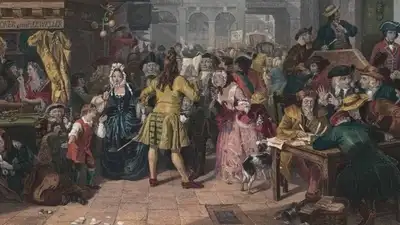
In 1720, Britain went crazy for one company’s shares: Why even Isaac Newton lost money in the bubble.
In 1720, Britain found itself at the heart of one of history’s wildest get-rich-quick bubbles. The company’s stock skyrocketed: prices shot from about £100 up to a staggering £1,000 in just a few months.
The South Sea Company wasn’t some scrappy startup; it sat at the center of British finance, according to The History of Parliament. Yet, people across the country became obsessed with its shares practically overnight. From London’s wealthiest landowners to shopkeepers, coaches, and even servants, everyone wanted in. Behind that surge was a heady mix of political maneuvering, savvy PR, easy loans, and widespread wishful thinking. People convinced themselves the South Sea Company would open doors to unimaginable profits. But there was always a catch. The fantasy unraveled as fast as it took hold. Fortunes that looked solid on paper evaporated almost in an instant.
It started in 1711 as a government project, meant to help Britain manage a mountain of debt after long, expensive wars. Things changed in 1720. Prices climbed from £350 in April, to £600 in May, to right around £1,050 in June. By the end of the summer of 1720, confidence cracked. Shares tumbled from their high to £300 in just a few months. By December, they bottomed out at about £124. Unlike later crashes, like 1929 or 2008, the South Sea debacle didn’t break the economy for good.
He lost thousands. Thousands lost their savings; many had borrowed heavily, leaving whole families wiped out. The bubble’s legacy is less about lost money and more about lost innocence: a warning against chasing riches everyone else promises are right around the corner.
In practice, Britain was at war with Spain, and any “lucrative” trade was more or less a pipe dream. It was a spectacle: crowds swarmed brokers with cash in hand, swept up in something new and addictive, according to records from the Newton Project. But at some point, “investing” simply became betting that the next person would pay even more. Reports later revealed that some bigwigs, including Parliament members, were secretly gifted shares or “thank-you” payouts to smooth the debt deal. The Newton Project in Oxford confirms that he invested in South Sea shares and lost a significant sum: the famous “£20,000” figure gets repeated a lot, but historians aren’t sure about the exact amount.
It may sound almost unbelievable, but as per Royal Society Publishing, even Isaac Newton, the genius who explained gravity, got pulled into the madness. He actually made money at first, selling his shares for a profit. But as the frenzy pushed prices even higher, Newton let FOMO get the better of him and bought back in, this time at the very top. The bubble burst. His story has become a symbol of just how powerless human nature feels in the grip of a crowd chasing easy money. No amount of genius can outsmart mass delusion. One has to wonder: what made everyone, experts and amateurs alike, genuinely believe South Sea stock could only ever go up? The Company got a great deal: in exchange for taking on chunks of government IOUs, it received exclusive rights to trade with Spanish-controlled South America. On paper, shipping British goods to those markets looked like the next big thing. Profits never matched expectations. The government struck a new deal: the South Sea Company would absorb even more state debt, and in return, it could swap government bonds for shiny new shares in itself. As confidence snowballed, investors tripped over themselves to buy in, convinced they’d beat inflation, finance Britain’s future, and get rich all at once. Every jump in price drew new buyers, which sent prices even higher. It was a classic positive feedback loop, a perfect setup for disaster. How did Britain get swept up in the frenzy? The mania wasn’t limited to professionals in wigs and frock coats. Change Alley, down near London’s Royal Exchange, morphed into a circus. Coffeehouses overflowed with schemers, dreamers, and gossips. Newspapers splashed daily updates about who was making it big. It didn’t matter if you were a noble, a housemaid, or a minor government clerk; social lines blurred as everyone wanted a piece of the action. At first, the numbers seemed to confirm the hype. People treated South Sea shares like lottery tickets with no losing numbers. Oversubscription was rampant: for every share available, two buyers lined up. Nobody was asking what the company actually did; it was pure speculation, detached from reality. That’s the textbook bubble. The company played its cards well. It had direct ties to top politicians. The whole setup looked official — even safe. In the background, the French economy was in the grip of its own share craze, the Mississippi Bubble. The air was thick with stories of overnight millionaires, and the line between calculated risk and gambling blurred for everyone. This was a turning point for Britain: for the first time, masses of everyday people could trade shares, play the market, and imagine themselves wealthy. The financial instruments themselves (stocks, options, contracts) were new and complex, misunderstood by almost all who traded them. As always, reality returned. People who bought high saw prices wobble and rushed to sell before falling any farther. Their panic triggered more selling, and the slide turned into a freefall. The panic even spread to other companies and banks. The Bank of England, which tried and failed to calm the chaos, still calls it its first-ever financial crisis. Now, his story survives as a perfect warning. What’s real is the sense of irony: the man who could describe the movement of the planets got blindsided by something far more unpredictable, which is human crowd psychology. The fallout forced Parliament to investigate. They uncovered a tangle of bribes, forgeries, and cozy deals between bigwigs and company insiders. Some were ruined, others took the fall, and the scandal helped Robert Walpole, often cited as Britain’s first Prime Minister, tighten his control over the country’s finances. The Bank of England points out that real economic damage was limited, but the shock to public confidence was deep. Three centuries later, the South Sea Bubble is still a stand-in for any hype cycle driven by the fear of missing out and a willingness to overlook reality until it’s far too late. The story didn’t end with a technical glitch or a heroic rescue; it ended when people finally realized there was nothing solid beneath all those promises. Once the dream collapsed, so did everything built on top of it. Looking for trusted parenting advice? Follow TOI Parenting Circle on Instagram for expert guidance, relatable stories, and practical tips delivered every day. Get the latest Lifestyle News and more. Download the TOI app.