
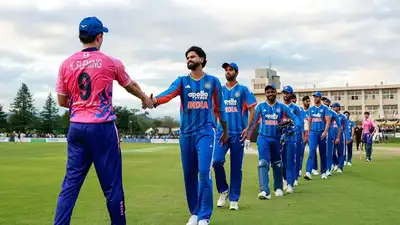
India survive Japan scare in five-over contest
Axar did, conceding only seven runs, and Japan finished on 30-3, two short of India’s modest 32-4. All 10 overs were bowled by a spinner. Iyer alone managed a double-digit score, making 16 off 12. Charlie Hara-Hinze, the 17-year-old left-arm spinner, took 2-17, while the entire attack exploited a surface on which timing the ball cleanly seemed almost impossible. Join conversation Share your thoughts in the comments Be respectful · TOI community guidelines At 8-2 after two overs, the game appeared to be slipping away. They took 10 from Ravi Bishnoi’s over and seven from Washington Sundar’s, setting up the extraordinary finish. SCORES: Ind 32/4 in 5 overs (Iyer 16, Hara-Hinze 2-17) bt Jap 30/3 (Washington 2-13) by 2 runs. Stay updated with the latest Asian Games 2026 news , check the Asian Games medal tally and complete Asian Games schedule .
A bizarre wide call, an intervention from the square-leg umpire and a two-run escape. India’s rain-shortened T20I against Japan had all the ingredients of a far more dramatic contest than a five-over game had any right to produce. With Japan needing eight runs in the final over, Alexander Shirai-Patmore attempted a reverse hit against Axar Patel off the over’s third ball. He was beaten. Japanese umpire Chris Thurgate called it a wide. The next ball produced an identical attempt and, again, wide was signalled. Wide-ball drama Suddenly, Japan needed only five from four balls. India’s players were visibly unhappy. Then New Zealand’s Chris Brown , the square-leg umpire and a member of the ICC Elite Panel, intervened. After speaking to Thurgate, the decision was overturned and Japan’s equation was restored to six from four. It was the right call. Under the ICC’s guidelines, once a batter attempts a reverse or switch hit, both sides of the wicket are deemed off side for the purpose of judging wides. India still had to survive the over. After two days of heavy rain and a long wait for the ground to become playable in Sano, Japan, India ended up owning an enviable record — the lowest total successfully defended in a five-over T20 — and Japan wondering just how close they had come to one of the biggest upsets in their cricketing history. The conditions had made a mockery of conventional T20 logic. The surface was sticky and slow. The outfield was sluggish. There were just four boundaries across the entire game. India, asked to bat first, discovered the difficulty immediately. Abhishek Sharma was out first ball attempting a shovel sweep. The rest of India’s top order struggled. Hara-Hinze makes his mark Japan’s bowlers had done their job. Japan’s chase began badly. Axar conceded only two in his opening over, and Ishan’s direct hit from deep square leg accounted for Lachlan Yamamoto-Lake. But Japan refused to be overawed. Get the latest Sports News and Live updates. Download the TOI app.