
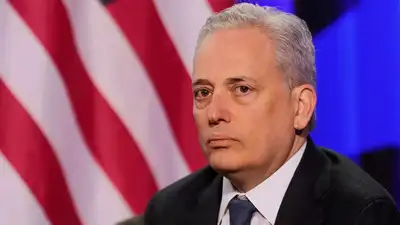
David Sacks has warned that the US risks losing the global AI competition to China due to excessive negativity and overregulation around the technology.
During a conversation with Salesforce CEO Marc Benioff at the World Economic Forum in Davos, the technology investor, who US President Donald Trump appointed as his AI and crypto czar, cautioned about a mentality that he calls the ” AI doomer mindset “. This belief that unconstrained AI will harm humanity or cause societal collapse represents a “self-inflicted injury” for America. He expressed concern that a “fit of pessimism” could lead to overly restrictive policies, citing Senator Bernie Sanders’ recent call for a moratorium on data centre construction as an example.
In his conversation with Benioff, Sacks cited recent research on global AI optimism rates, published in 2025 by Stanford University’s Institute for Human-Centered Artificial Intelligence. Optimism was high in China, where 83% of survey respondents saw AI as more beneficial than harmful. To compare, in the US, only 39% felt as optimistic.
“If we have 1,200 different AI laws in the states, you know, clamping down on innovation, I worry that we could lose the AI race,” Sacks told Benioff. He pointed out that “we generally see that in Western countries, the AI optimism is a lot lower,” especially in the US, compared to other parts of the world, as indicated by the 2025 Edelman Trust Barometer. Speaking to CNBC, he called the plan a potentially “scary direction” of state overreach. In November, Anthropic CEO Dario Amodei said on 60 Minutes that he was ” deeply uncomfortable” with how AI companies were now being tasked with self-governing, saying he preferred “responsible and thoughtful regulation of the technology.
Sacks is one of several wealthy California residents who have criticised the proposal and decided to leave the state, including Google founders Larry Page and Sergey Brin. Even some AI leaders are concerned. Supporters tend to justify reduced regulation as necessary to keep pace with AI competitors in China. China’s AI research is rapidly closing the gap with the US, as some models, particularly those developed by the Hangzhou-based startup DeepSeek, are matching or even exceeding Western models’ performance in specific reasoning tasks.