
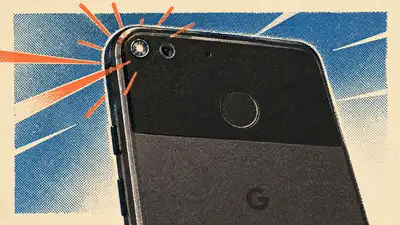
Google’s Pixel taught phones how a photo should look.
A good part of it was built by a phone Google introduced in October 2016, with one camera on the back and a good deal of nerve, and the decade since has made the question it raised much louder. Every night photo on a modern phone looks a little brighter than the night it was taken in. Nobody complains, me included. We’ve grown so used to cameras that see more than our eyes can that a dark, grainy, faithful picture of a dark street now reads as a failure, something to delete and shoot again. That expectation didn’t arrive on its own. What is a phone photo supposed to look like?
When software went a little too far
The first Pixel was not a remarkable-looking phone, and on paper its camera wasn’t remarkable either: a 12.3-megapixel Sony sensor behind an f/2.0 lens, and no optical image stabilisation in a year when rivals considered it basic equipment. Apple put two lenses on the iPhone 7 Plus that same autumn. Google turned up to a hardware fight with a fairly regular camera, and kept much the same 12-megapixel sensor for its next four phones, betting that software could learn to do what the hardware couldn’t. I wasn’t old enough to need a phone of my own when that first Pixel showed up, and it took me until 2020 to get my first. The Pixel 2 took that argument somewhere more provocative. Portrait mode needed two cameras everywhere else in 2017, Apple included. Google was sure enough of that to hold off on a second rear camera until the Pixel 4 in 2019, by which point most rival flagships carried three. My Pixel 2, already three years old by the time I got it, never had a second lens, and I never once wished it did. Night Sight, which arrived in late 2018 with the Pixel 3, is where most people felt the shift for themselves. It’s also why my Pixel 2 still held its own after dark right up to 2023, when phones around it were carrying three and even four lenses. On this year’s Pixel 11 Pro, the wait is all but gone. Google had put a Night Sight shot beside a rival’s on stage when it unveiled the Pixel 3, starting a ritual that hasn’t let up since, and within a year the trick belonged to everyone. Apple answered with its own night mode and Deep Fusion on the iPhone 11, and Samsung’s flagships were stacking frames for nearly every shot. The Pixel 6 arrived in 2021 with a large 50-megapixel sensor and Google’s own Tensor chip, but the feature that probably mattered most barely made headlines. With the Pixel 6, Google gave its camera Magic Eraser, and the drift Night Sight had raised as a worry became a feature. Best Take built group shots where everyone happened to be smiling at once, and the Pixel 10 Pro’s zoom started drawing in detail its lens could not resolve. Magic Editor swaps in a new sky, Reimagine adds whatever you type, Add Me drops the person holding the phone into a group shot they were never in, and on the Pixel 10 you can just ask the Photos app to edit the picture for you. I have three years of Pixel 2 photos that look exactly like that, and I didn’t think twice about any of them. Google’s answer arrived this year as Camera Looks on the Pixel 11, and the difference is how far it lets you go. Apple got there first, answering years of complaints about over-processed iPhone photos with Photographic Styles in 2021, and it’s the only other phone maker that hands over this much control.
Huawei had shipped a handheld night mode earlier that year, to be fair, but Google pushed Night Sight to older Pixels through a software update, which said plenty about where the camera now lived. Tensor, Google said, was what made it possible, though the same eraser later ran happily on phones without one. Then people started using it. It wasn’t AI in the sense anyone uses the word now, just a great deal of very clever maths. Press the shutter and the Pixel took a quick burst of deliberately dark frames, lined them up, and merged them into one image with clean shadows and a sky that hadn’t burned out to white. You never saw any of that happen. You saw a friend in front of a bright window, and for once both the friend and the window looked right. Shot after shot came out that way, shadows lifted, highlights held, everything a touch contrasty, and before long people simply called it the Pixel look. That was enough to put a phone with an unremarkable sensor at the top of the camera rankings that year. The conversation had been about aperture numbers and pixel sizes for years, and here was a phone arguing, fairly convincingly, that what happened after the click mattered more. Machine learning took on more of that work with every Pixel that followed, years before anyone could text a chatbot asking how to handle their situationship. Google did it with one, splitting each pixel on the sensor in two for a sliver of depth information and letting a machine learning model work out where a person ended and the background began. Stray hair went soft. Glasses occasionally dissolved into the blur. None of it stopped the point from landing: depth, once a property of glass and distance, could now be calculated. The photographer in me, the one with a big camera and a long lens, still bristles at software blur a little. Blur from a real lens is a consequence of physics. On the Pixel it became a decision the phone made for you, and most of the time it decided well. Point the phone at a dim restaurant table, hold still for a few seconds, and it produced something your eyes hadn’t quite registered. Colours you couldn’t make out. Faces you could barely read. The complaints were reasonable too. Some night shots looked like overcast afternoons, and Google spent the following years tuning shadow back in and shaving down the wait. Every one of them now faced the question Google had wrestled with first: how far a photo could drift from the moment before it stopped being that moment. What they borrowed most was the look. Shadows opened up, skies held their colour, faces stayed evenly lit against bright windows, and soon that HDR finish was simply what a good phone photo looked like, whoever made the phone. The borrowers didn’t stop there. Google had shown that software could rescue a small sensor, and its rivals were happy to show what the same thinking could do with a big one. Google followed eventually. Real Tone set out to render darker skin accurately instead of washing it out, and got a fraction of the attention Night Sight had. Software that can calculate depth and pull colour out of the dark will, sooner or later, be asked to do more. Until then, everything the camera did worked on light that had actually reached the sensor. Now the stranger behind you on the beach could vanish, replaced by sand nobody had photographed. Each Pixel since has pushed further. I’ve yet to need a 100x photo of anything. It’s the same confidence that once let one camera stand in for a portrait lens, now pointed at what’s in the picture instead of how it’s lit. The rest followed, not always gracefully. Huawei and Samsung both had to answer for moon shots that looked suspiciously better than their lenses allowed, Honor built a zoom that fills in what its telephoto can’t see, and even Apple ships an eraser now. And don’t even get me started on the generative tools. Google hands plenty of it to other Android phones and iPhones too. Somewhere around there, I stop being sure what a picture even is any more. Still, every one of those edits waits for you to ask, and they’re a sliver of what anyone actually shoots. The birthday cake, the commute, the dog asleep on the sofa never get erased or reimagined; they just get processed, thousands of times over, with that same lifted, contrasty finish. That’s AI too, just the quiet kind nobody bothers to call AI. That’s where the Pixel’s influence runs deepest, and for years it was the part people thought about least. Then, slowly, they started to tire of it. Somewhere along the way, the look Google made famous turned into a uniform. By the end of the decade nearly every phone turned out the same evenly lit, shadowless, slightly too sharp picture by default. Line up the flagships I reviewed in any given month and you could have swapped their camera rolls without anyone noticing. That left phone makers with an awkward problem. If every camera’s photos look alike, how do you sell yours? The Chinese went to the old names of photography, Huawei and later Xiaomi to Leica, Vivo to Zeiss, OnePlus and Oppo to Hasselblad, though what they hand you is mostly a fixed look picked from a menu. Google took longer, and by the time it moved, plenty of people had gone looking for character elsewhere, pulling cheap 2000s digicams out of drawers and chasing blown highlights and harsh flash through film presets. Even Levoy, now at Adobe, built Project Indigo to dial the processing back. You pick a style before you shoot, Shadows for deeper contrast or Vanilla for something warmer, then pull warmth, highlights and saturation around until it’s yours, and the image processor builds it into the shot instead of laying a filter over it. Google can’t take all the credit, though. As for Google, even the name gives the game away. Camera Looks is aimed squarely at everyone who spent years grumbling about the Pixel look, and the plural is Google admitting there should never have been just one. A company that spent ten years deciding what your photos should look like is finally asking you. So what is a phone photo supposed to look like now? Ten years ago, Google’s answer was the scene in front of you, rescued from a sensor too small to see it properly. Over a decade that slid into the scene as you’d have liked it, polished to a finish every phone maker copied until most people’s photos stopped looking like their own. Generative AI is already pushing the answer somewhere new, into what belongs in the frame at all, but that’s an argument for another day. On how a photo looks, every phone camera still makes most of the call for you, in milliseconds, before you’ve even looked at the screen. The Pixel is the reason they all do. Ten years on, it’s also the phone handing a good part of that call back, letting a photo look warmer, moodier or a little worse if that’s how you want it. For the phone that taught everyone to look past the sensor, I can’t think of a better way to turn ten. You use AI every day. Now get your AI Quotient. Take the AIQ test.
The trick was HDR+, which Google had been refining since its Nexus phones in a team led by Marc Levoy, a Stanford professor who had taught computational photography long before the phrase meant much outside a lab. Huawei paired its processing with a periscope zoom on the P30 Pro, Xiaomi and Vivo moved to one-inch-type sensors, Vivo and Oppo built dedicated imaging chips, and Apple pushed its merging earlier in the pipeline with the Photonic Engine.
For most of the history of cameras, the answer was simple. Whatever was in front of the lens. Google has spent ten years rewriting that answer, and the rest of the industry has rewritten it right alongside.