
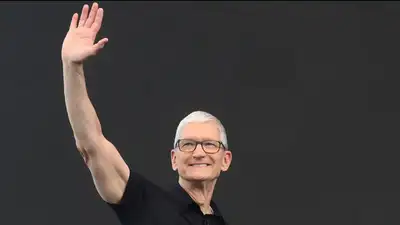
From $108 billion to $416 billion: Tim Cook’s 15 years at Apple
Tim Cook took over Apple in August 2011, weeks before Steve Jobs died, and hands it to John Ternus tomorrow, September 1, after fifteen years in the job. Apple closed the financial year Cook inherited with $108 billion in revenue and $26 billion in earnings. It closed last year with $416.16 billion and $112 billion in profit, then did $254.9 billion in the first half of this financial year alone. The first stretch was pure iPhone, peaking when Apple sold 74.5 million of them in the December 2014 quarter and booked $74.6 billion in a single three-month period. Revenue slipped in 2016, and by the December 2018 quarter iPhone revenue had fallen 15 per cent year on year, mostly on weak China demand. everything else grew 19 per cent While the iPhone fell 15 per cent. Apple stopped publishing unit sales after 2018 and began reporting how many devices were in active use instead, a number that was 1.5 billion in early 2020 and is over 2.5 billion today. Cook oversaw every iPhone from the 4S to the 17, and Apple shipped 3.1 billion of them on his watch, including 247.8 million in 2025, more than any other manufacturer sold that year. The phone brought in $209.59 billion last financial year, 50.4 per cent of everything Apple made. It was 52.5 per cent the year before, and roughly the same a decade ago. Roughly a quarter of the world’s iPhones are assembled here, about 55 million units in 2025, up 53 per cent in a year, by Foxconn, Tata Electronics and Pegatron. The entire iPhone 17 line was built in India before launch. Exports crossed $12.8 billion in calendar 2024, and India shipped a record $10 billion worth of iPhones in the first six months of FY26 alone. The first two stores opened in Mumbai and Delhi in April 2023, and there are six today after Bengaluru, Pune, Noida and Borivali. Apple holds close to 10 per cent of the Indian smartphone market by volume, and revenue here hit a record of about $9 billion in FY25. Greater China brought in $64.4 billion last year, 15.5 per cent of Apple’s revenue, down from nearly 19 per cent two years earlier. That is a market Apple has become measurably less dependent on, and demand there has recovered anyway, with $25.5 billion in the December quarter and the best iPhone quarter Apple has ever recorded in that market. About 90 per cent of Apple’s suppliers were building at least partly in China or Taiwan before the company stopped publishing that list in 2024. When the US announced global tariffs in April last year, Apple lost $638 billion of market value in three days. Services revenue was $32.7 billion in 2017, $46.3 billion in 2019, $96.2 billion in 2024 and $109.16 billion last year, the first time it crossed $100 billion. Apple announced Apple Intelligence in mid-2024 and shipped part of it that autumn. Apple was worth about $350 billion when Cook started and is worth roughly $4.67 trillion today. The shares are up more than 2,000 per cent, over $1 trillion has gone back to shareholders since he began buybacks in 2012, headcount went from about 60,000 to 166,000, and the store count passed 500 across 27 countries.
Because of the DMA standoff, a company that spent two decades insisting it built its own core technology now pays Google for the intelligence inside its assistant, and that version still is not available across much of Europe. The answer was announced in January and shown in June at Cook’s final developer conference: a rebuilt Siri running on a Google Gemini model, arriving as a standalone app. He took the job as the man who ran the factories, at a moment when nobody believed Apple could survive without the man who imagined the products. Fifteen years later the company is worth thirteen times more, and he leaves it at the top of everything it does. Here is the fifteen years, counted. The line was never straight. Then it stalled. That quarter reshaped the company. The strategy from then on was not to sell more phones. It was to sell more things to the people who already had one. Fifteen years of building other businesses barely moved that share. The iPhone is now the country’s single largest export item. Selling took longer than making. The manufacturing side did not move with the sales. India carries a growing share of the load, not the bulk of it, and that gap is what Ternus inherits. The App Store, iCloud, Apple Music, Apple Pay, AppleCare and advertising were a rounding error when Cook took over. The feature it had led with, a Siri that could actually act across your apps, did not arrive. It slipped by nearly two years. Cook removed the executive running AI and reassigned the one running Siri. rivals were committing hundreds of billions to data centres and models While that played out. Apple spent almost nothing by comparison and never landed a significant AI acquisition either.
Services run at 75.4 per cent gross margin against 36.8 per cent on hardware, so roughly a quarter of Apple’s revenue produces close to half its gross profit. The Apple Watch in 2015, AirPods in 2016, HomePod in 2018, AirTag in 2021 and the Vision Pro in 2024. He also killed the iPod, shut down a decade-long car project in 2024, and moved the Mac to Apple’s own chips. Wearables, home and accessories brought in $12.8 billion in 2017, $17.4 billion in 2018 and $24.5 billion in 2019, by which point the segment had already passed the iPad. Last year it did $35.69 billion, ahead of the Mac at $33.7 billion and the iPad at $28 billion, on roughly 80 million AirPods and 33.3 million Watches sold in 2025. The Vision Pro arrived in 2024 at $3,499, and Cook talked about it as the device that would eventually do to computing what the iPhone did to the phone. A rebuilt version is not expected before the end of 2028. The Mac looks much as it did in 2011. Apple’s company-wide gross margin was around 40 per cent when Cook took over. It hit 50.1 per cent in the June quarter this year. Revenue in that quarter was a June-quarter record $10.4 billion, up 29 per cent, on the MacBook Neo and MacBook Pro, which makes a category the industry had written off as flat Apple’s fastest-growing hardware line right now.
Size is not what makes it the most profitable part of Apple. Margin is. Every dollar here is worth about two from a device. Cook put plenty of new hardware on Apple’s shelves. Two of those landed, and one of them turned out to be the biggest surprise. Accessories to the iPhone now outsell the computer the company was named for. The segment has also declined three years running, which makes it one of the first problems on Ternus’s desk. Two years on it has no revenue line of its own, sitting inside that same wearables segment. Apple has since cut jobs across the group that builds it, including people working on device security, audio, testing and the operating system it runs on. The executive who ran the headset and smart glasses division left for OpenAI in June. Two of Cook’s three hardware bets were accessories, priced as an easy second purchase for people who already had an iPhone. The third was meant to become a category in its own right and has not, and that is where Ternus starts. What runs it does not. Dropping Intel for Apple’s own silicon changed the cost of every machine the company builds, and the effect shows up across the whole business, not just the Mac. That is the single biggest reason profit has grown faster than revenue for most of his tenure. The Mac got a second life out of it too. Cook’s final week in the job brought two new Macs with two new chips for them, and that can very well be the measure of what happened to the Mac under him, at a company that spent years fielding questions about whether it still cared about computers.
Unit growth stopped being the lever and price took over. iPhone revenue rose 22 per cent in the June quarter this year to $54.25 billion, and Apple credited Pro models specifically. In India, more than 60 per cent of every phone sold above Rs 50,000 is now an iPhone. What did change is where the money comes from inside that number. The company still rises and falls on one product line. When Cook took the job, India had no Apple store and no Apple factory.
It has both today, and the factories carry global weight.
Paid subscriptions crossed 1.5 billion this June. The App Store handled more than $1.4 trillion in developer billings and sales in 2025 and draws over 850 million users a week across 175 countries. The EU ordered Apple to pay $14.4 billion in back taxes over its Irish arrangements in 2016, and competition regulators have levied about $4 billion in antitrust fines since 2011, including €500 million in April 2025 for failing to comply with the Digital Markets Act. Apple has had to allow rival app stores in the EU since March 2024, US developers can link out to their own payment systems at zero commission after the Epic contempt ruling, and take rates have been cut in several markets. Every one of those decisions comes out of the 75 per cent margin business above. The US Department of Justice also sued Apple over smartphone monopoly claims in 2024, and that case is still live. For all of that, Cook was paid $880 million across fifteen years and holds 0.02 per cent of the company he turned into the second most valuable on earth. Not a founder and not an inventor, but the best operator the industry has produced, leaving behind 2.5 billion devices in use, the highest margins in Apple’s history, and a product line that turns nineteen next year.
What he has to prove is that Apple can still add a number to this list with something new, which Cook tried once and never managed, and his first attempt comes nine days later at an event Apple has called “Surprise and Shine”. The scale underneath it is the installed base. This is also the business regulators keep cutting into, which is why every app store ruling gets treated as front-page news. The bigger Apple got, the more of it ended up in court, and Europe has been the expensive room. The rulings cost more than the fines. The figures describe what he actually was. The surprise is the harder half. Get the latest technology news and updates. Download the TOI App.
Ternus gets all of it from tomorrow.
Pingback: On his last day as Apple CEO, Tim Cook sends memo to employees: The wider industry impact
Pingback: When Steve Jobs convinced a 37-year-old Tim Cook to join: The wider industry impact
Pingback: Tim Cook's quote explains how he read Steve Jobs' inheritance: The wider industry impact
Pingback: Tim Cook hands Apple to John Ternus after 15 years, with the hard: The wider industry