
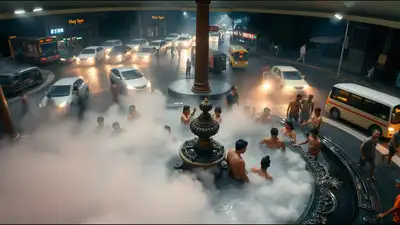
Representative Image of a vibrant public bath in a traffic roundabout, complete with steam rooms and cold-water basins (AI Generated Image)
The climate reason behind a bath in a traffic roundabout
Called Round About Baths, the installation was designed by Leopold Banchini Architects for the 2025 edition of the Concéntrico architecture and design festival. The installation operated from June 19 to 24, 2025, before the temporary structure was removed. It says the installation revealed the hidden potential of a car-dominated environment by temporarily repurposing street equipment and changing how people perceived a forgotten space.
The prize’s official project description calls Round About Baths a temporary public bath and “climate refuge” for cases of extreme heat, saying that it challenges the meaning of road infrastructure by turning space intended for vehicles into a place where people can meet at a human scale. In Logroño, Spain, a traffic roundabout was temporarily transformed into a public bath, turning a space normally dominated by passing cars into a place for bathing and gathering. Built around an existing fountain at the roundabout at Plaza Salón, on Gran Vía, the project added changing rooms, a steam room and cold-water basins behind timber walls. Its unusual setting was part of the point: the project challenged the conventional role of road infrastructure by temporarily turning a car-dominated space into a place for people. The project’s official European Prize for Urban Public Space profile also describes it as a temporary climate refuge for cases of extreme heat. The project’s climate dimension becomes clearer in its later recognition by the European Prize for Urban Public Space. That framing does not mean the installation was presented as a permanent solution to extreme heat. It was an ephemeral architectural project that operated for only a few days. Instead, its climate function was tied to the way water and bathing could temporarily change how people experienced an urban space during periods of heat. The design also made use of an existing piece of infrastructure rather than requiring an entirely new site. High timber walls provided privacy from the surrounding traffic, while the steam room and cold-water basins created spaces for heating and cooling within the temporary structure. The festival’s own description also emphasises the project’s broader urban argument.
The fountain, which had previously been visible but inaccessible, became part of a functioning public bath.