
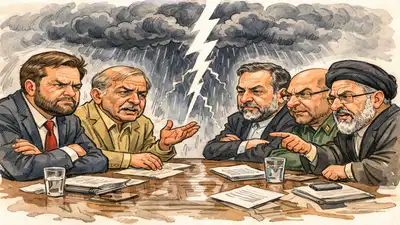
The much-anticipated Iran–United States negotiations in Islamabad ended without a breakthrough after nearly 21 hours of intense deliberations, exposing deep-rooted strategic divides and casting uncertainty over the fragile ceasefire that had briefly paused a six-week-long conflict. What was billed as a rare diplomatic opening — the first direct engagement between Washington and Tehran in over a decade — instead concluded in stalemate, with both sides walking away and blaming each other for the collapse.
The talks, held in Pakistan ’s capital on April 11–12, were seen as a last-ditch effort to stabilise a conflict that has already killed thousands, disrupted global energy markets, and heightened fears of a wider regional war.
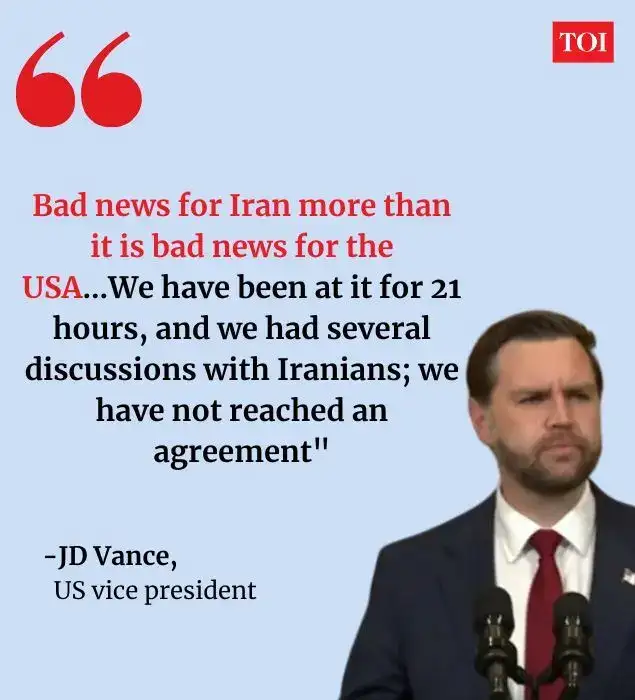
“The bad news is that we have not reached an agreement, and I think that’s bad news for Iran much more than it’s bad news for the United States of America,” he said shortly before departing Islamabad. . Vance repeatedly stressed that Washington had drawn clear “red lines” — particularly on nuclear issues — and that Tehran had refused to accept them. Yet, despite marathon negotiations and active mediation by Pakistan’s top leadership, the two sides failed to bridge differences on core issues, particularly Iran’s nuclear programme and control over the Strait of Hormuz. At the centre of the negotiations was US Vice President JD Vance, who led the American delegation. Emerging from the talks, Vance struck a firm tone, making it clear that Washington believed Tehran had failed to meet its expectations. His remarks reflected a broader US position that the burden of compromise lay primarily with Iran. “So we go back to the United States having not come to an agreement. We’ve made very clear what our red lines are.”
The narrow waterway, through which roughly 20% of global oil supplies pass, has become a powerful lever in Iran’s strategic calculus. Vance revealed that he had been in constant communication with Trump during the negotiations, speaking to him multiple times over the 21-hour period. “We were talking to the president consistently… a half dozen times, a dozen times over the past 21 hours. The Islamabad talks took place against the backdrop of a devastating conflict that began on February 28, when US and Israeli forces launched airstrikes on Iran. For the United States, the extensive military campaign — reportedly involving over 13,000 strikes — is seen as evidence of dominance.
Because of the Pakistanis, who did an amazing job, uS Vice President Vance, too, acknowledged Pakistan’s efforts, saying: “Whatever shortcomings of the negotiation, it wasn’t. Because we’ve won, whether we make a deal or not makes no difference to me,.
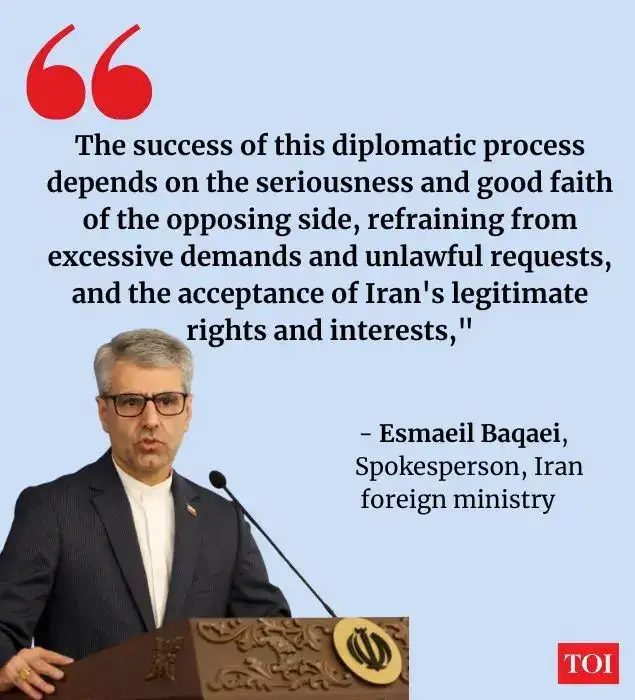
Washington’s demand was unequivocal: a long-term, verifiable commitment from Iran not to pursue nuclear weapons, according to Vance. Iran’s response to the US negotiating position was sharp and unequivocal, with officials and state media repeatedly describing Washington’s terms as “excessive” and unrealistic, reflecting not just tactical disagreements but a deeper structural mistrust that has long defined relations between the two sides. Washington pushed for sweeping commitments, including long-term restrictions on Iran’s nuclear programme, guarantees around the Strait of Hormuz, and broader strategic concessions that Tehran views as an infringement on its rights, according to Iranian accounts. definitive commitments, Iran viewed the process as the beginning of a longer negotiation cycle, expecting phased concessions and reciprocal steps While the United States approached the talks with what it described as a “final offer” and sought immediate. “The success of this diplomatic process depends on the seriousness and good faith of the opposing side, refraining from excessive demands and unlawful requests, and the acceptance of Iran’s legitimate rights and interests,” he wrote on X. He added that discussions during the talks covered a wide range of contentious issues, stating, “Discussions were held over the past 24 hours on various aspects of the main issues of the negotiations, including the Strait of Hormuz, the nuclear issue, war reparations, the lifting of sanctions, and the complete end of the war against Iran and in the region. ” Emphasising Iran’s broader approach, Baqaei said the country was “determined to use all means, including diplomacy, to secure national interests and safeguard the country’s interests”. A Pakistani source described “mood swings” and fluctuating tensions during the talks, indicating that discussions were volatile and emotionally charged. China’s “quiet diplomacy” may have influenced Iran’s negotiating stance, encouraging resistance to US demands and reinforcing a longer-term strategic outlook rather than immediate concessions.
This framing signals that the US entered the talks not as an equal negotiator seeking mutual concessions, but as a party expecting compliance after what it considers a position of strength following weeks of military action. The central sticking point in Islamabad was Iran’s nuclear programme — an issue that has defined US -Iran tensions for decades. “We need to see an affirmative commitment that they will not seek a nuclear weapon and they will not seek the tools that would enable them to quickly achieve a nuclear weapon. He added that the US was not satisfied with temporary assurances or partial limitations. “Do we see a fundamental commitment of will for the Iranians not to develop a nuclear weapon, not just now, not just two years from now, but for the long term? We haven’t seen that yet. From Tehran’s perspective, however, this demand crosses a red line of its own. Iran has consistently maintained that its nuclear programme is peaceful and that it retains the right to enrich uranium under international law. Iranian officials reportedly offered limited concessions — including temporary suspension of certain activities — but stopped short of permanently dismantling their capabilities. This fundamental disagreement — between permanent dismantlement and conditional limitation — proved impossible to reconcile in a single negotiating session. For Iran, these demands were seen less as negotiation points and more as ultimatums — reinforcing a perception that the United States was seeking capitulation rather than a balanced agreement. Iranian media, including the semi-official Tasnim news agency, pointed to disagreements over the nuclear programme and control of the Strait of Hormuz as the principal reasons behind the collapse of the Islamabad talks. . Beyond the specifics, the negotiations were overshadowed by entrenched distrust. This mistrust translated into demands for sanctions relief, war reparations, and security assurances, which Washington appeared unwilling to fully accommodate. The divergence was also procedural. This mismatch in expectations meant that even areas of partial convergence failed to translate into a broader agreement. Reinforcing Tehran’s position, Iranian foreign ministry spokesperson Esmaeil Baqaei publicly underscored the conditions required for any meaningful breakthrough. Beyond the nuclear issue, control over the Strait of Hormuz emerged as another major fault line. Tehran has blocked the strait since the conflict began, triggering sharp spikes in global oil prices and disrupting energy markets worldwide. During the Islamabad talks, Iran reportedly demanded not only reopening negotiations on the strait but also asserting greater control over it, including the right to collect transit fees. For the United States, this was unacceptable. Ensuring free navigation through the strait is a core strategic priority, both for economic stability and for maintaining its global leadership role. Interestingly, despite the ongoing dispute, some movement was observed during the ceasefire. Shipping data indicated that three fully laden supertankers passed through the strait — the first such movement since hostilities began — offering a brief glimmer of hope. However, hundreds of vessels remain stranded in the Gulf, awaiting clarity. The Islamabad talks were facilitated by Pakistan, with Prime Minister Shehbaz Sharif playing a key role in bringing both sides to the table. Pakistan foreign minister Ishaq Dar and military chief Field Marshal Asim Munir were also actively involved in mediating discussions. Dar emphasised the importance of maintaining the ceasefire despite the breakdown in talks. “It is imperative that the parties continue to uphold their commitment to ceasefire. He also struck a hopeful tone about future engagement, stating that Pakistan would “continue to play its role to facilitate engagement and dialogue. However, the outcome underscores the limitations of third-party mediation when the core issues involve existential strategic concerns for both sides. Accounts from inside the negotiations suggest that the atmosphere was far from smooth. “There were mood swings from the two sides and the temperature went up and down during the meeting. One particularly contentious issue was the potential release of Iranian frozen assets held in foreign banks. American officials denied any such commitment While Iranian sources suggested that the US had agreed to release some of these funds. This disagreement points to a broader issue: a lack of trust and conflicting narratives about what was actually on the table. The role of US President Donald Trump loomed large throughout the talks. Yet Trump’s own public statements appeared to undercut the urgency of reaching a deal. “We’re negotiating. This stance may have influenced the US negotiating posture, reinforcing a perception that Washington was less interested in compromise and more focused on securing unilateral concessions. Without a diplomatic breakthrough, the risk of renewed hostilities remains high. Complicating matters further is the ongoing conflict in Lebanon, where Israel continues to target Iran-backed Hezbollah militants. Iran has insisted that any broader agreement must include a ceasefire in Lebanon — a demand rejected by Israel. One of the most striking aspects of the failed talks is that both sides appear to believe they are negotiating from a position of strength. For Iran, simply enduring the assault without capitulating is framed as a victory. This mutual perception of strength reduces the incentive for compromise, making future negotiations even more challenging. China looms as a critical, if understated, factor in the broader geopolitical equation While not directly present at the Islamabad talks. Beijing has maintained close ties with Tehran and has positioned itself as a potential alternative power broker in the region. Its economic and strategic partnerships with Iran — particularly in energy and infrastructure — give it significant leverage. Moreover, China stands to benefit from prolonged instability that challenges US dominance, particularly in global energy markets and regional influence.
Instead, it sought a permanent guarantee — something Iran has historically resisted. Iranian officials indicated that the American demands went far beyond the scope of a ceasefire framework, touching upon core sovereign and strategic concerns that Tehran has historically refused to compromise on. Iranian officials cited past experiences — including sanctions, military escalation, and the breakdown of earlier agreements — as reasons for their reluctance to accept U.S. assurances without concrete guarantees. Since then, the war has escalated rapidly, with significant casualties and widespread destruction. its future now hangs in the balance Although a two-week ceasefire was agreed earlier in the week.
Stalemate in Islamabad: Risks and Uncertainties Ahead
The recent talks in Islamabad between the US and Iran have ended in a deadlock, leaving the future of their negotiations uncertain. The Trump administration now faces critical choices: it can either resume military operations, continue with prolonged negotiations, or accept a partial agreement that may not hold up under scrutiny.
Each of these options carries significant risks. Renewed military conflict could destabilize global markets and potentially escalate into a wider war. On the other hand, extended negotiations might lead to a protracted stalemate without a resolution. A weak agreement could fail to address key issues, leaving both parties dissatisfied.
For Iran, the situation is equally precarious. While resisting US demands may help maintain its strategic independence, it also risks increased economic isolation and military pressure.
The collapse of the talks signifies more than just a failed negotiation; it underscores deep-rooted tensions and a lack of trust that cannot be resolved quickly. Despite Pakistan’s mediating efforts, both sides remain far apart on critical issues.
As the ceasefire deadline approaches and global stakes rise, the failure to reach an agreement may lead to prolonged instability rather than peace. Additionally, China’s quiet involvement in the region complicates an already intricate geopolitical landscape, transforming a regional issue into one with global ramifications.