
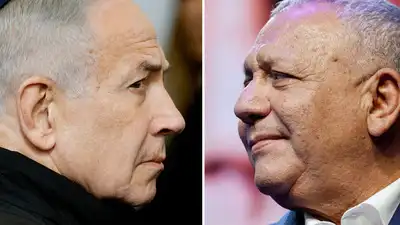
Benjamin Netanyahu’s (left) Likud party faces Gadi Eisenkot’s Yashar party.
In the elections of 2021 and 2022, around half of its voters chose Likud, compared with about a quarter nationwide. Most recent polls projected his Yashar party at 20 to 23 of the 120 Knesset seats, ahead of Likud. Neither Netanyahu’s bloc nor the anti-Netanyahu bloc appear on course for the 61 seats needed for a majority, so deadlock remains possible.
Yinon Magal, a prominent television host widely seen as a mouthpiece for Netanyahu, called Eisenkot a “monkey” of “a Mizrahi-Moroccan” heritage managed by “Ashkenazi elites”. Magal later said he had not meant to mock Eisenkot’s ethnic origins. He said he was using an underworld term for a frontman who is controlled from behind the scenes.
Will Mizrahi Jews, long the backbone of Benjamin Netanyahu ’s Likud party, stay loyal this time? If even a modest share drift away, it could tip the balance towards his challenger, Gadi Eisenkot, who comes from the Mizrahi community. Over the decades, many Mizrahi families came to identify with the right and with Likud in particular. Voting for the party became a matter of identity as much as ideology. That history gives this election an unusual edge as Israel has never had a Mizrahi prime minister. In the final days of the campaign, his background was pushed into the open. Even Netanyahu, not known for contrition, condemned the remarks. For a prime minister who relies on Mizrahi loyalty, that was a sign of how sensitive the subject has become. The real test lies in places such as Qiryat Shemona, Israel’s northernmost city. Disillusion with Netanyahu does not automatically mean votes for Eisenkot. Nimrod Nir, who directs Agam Labs, expects most frustrated Likud voters to move to hardline parties such as Otzma Yehudit and the Religious Zionist Party. Those parties would probably back Netanyahu as prime minister, but they would hold greater power inside his coalition. Eisenkot’s position is strong but not decisive.