
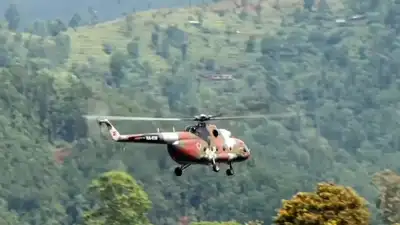
File photo: A helicopter conducts a rescue operation to bought floods affected people to safe places, in Trishuli on Friday.
TRISHULI BAZAAR (NUWAKOT, NEPAL): Death toll from the Bhote Koshi-Trishuli disaster rose to 675 in Nepal on Saturday evening, with 2,426 people still missing as rescuers continued searching mud-filled valleys, riverbanks and hydropower tunnels three days after the catastrophic flood. National Disaster Risk Reduction and Management Authority (NDRRMA) said 2,498 people had been rescued, 219 were injured and more than 18,700 personnel deployed for search and rescue. Indian authorities revised down the number of Indian nationals unaccounted for in Nepal to 287 on Saturday evening from 320 a day earlier as more people were traced. Ministry of external affairs (MEA) said another 128 of Indian origin who held other nationalities remained uncontactable.
No confirmed figure for Indian deaths has been announced by MEA.
The ministry said 88 Indian nationals had been rescued, including four workers brought out from a hydropower project in Rasuwa on Saturday. MEA said 120 Indians crossed from Tibet into Nepal Saturday. A day earlier, India had said around 400 Indians, many of them Kailash-Mansarovar pilgrims, had been located on the Chinese side and were safe. In Gyirong, Chinese authorities said 554 people remained missing after the glacier-triggered mudslide devastated the border port. China had evacuated 555 tourists and moved 499 villagers and construction workers to safer locations, while professional rescue teams continued searches in mud that was more than 1.5m deep in parts of the core disaster zone.
With India having sent relief in three military transport aircraft, Nepal finance minister Swarnim Wagle said, “PM Modi and MEA have been very positive about expressing their solidarity and pledging any amount of support that Nepal needs… Nepal tourism board said 261 foreign nationals and tourists had been rescued by 6pm Saturday, including 167 Indians and 40 Chinese, while 320 foreign nationals remained “out of communication”. By Saturday, Chinese hydrological teams said one major debris-dammed lake had largely begun draining naturally, reducing the immediate threat of a catastrophic breach, though authorities continued monitoring unstable debris and surrounding slopes for fresh landslides or mudslides.
They are expected to reach Kathmandu soon. Nepalese tourism authorities maintained a separate and broader rescue database. The difference between Indian and Nepalese figures reflected separate lists being maintained by tourism, diplomatic and rescue agencies as names continued to be reconciled.India was also working to bring back nationals stranded on the Chinese side of the border. Rescue operations were repeatedly complicated by unstable slopes and concern over barrier lakes formed after the glacier collapse.