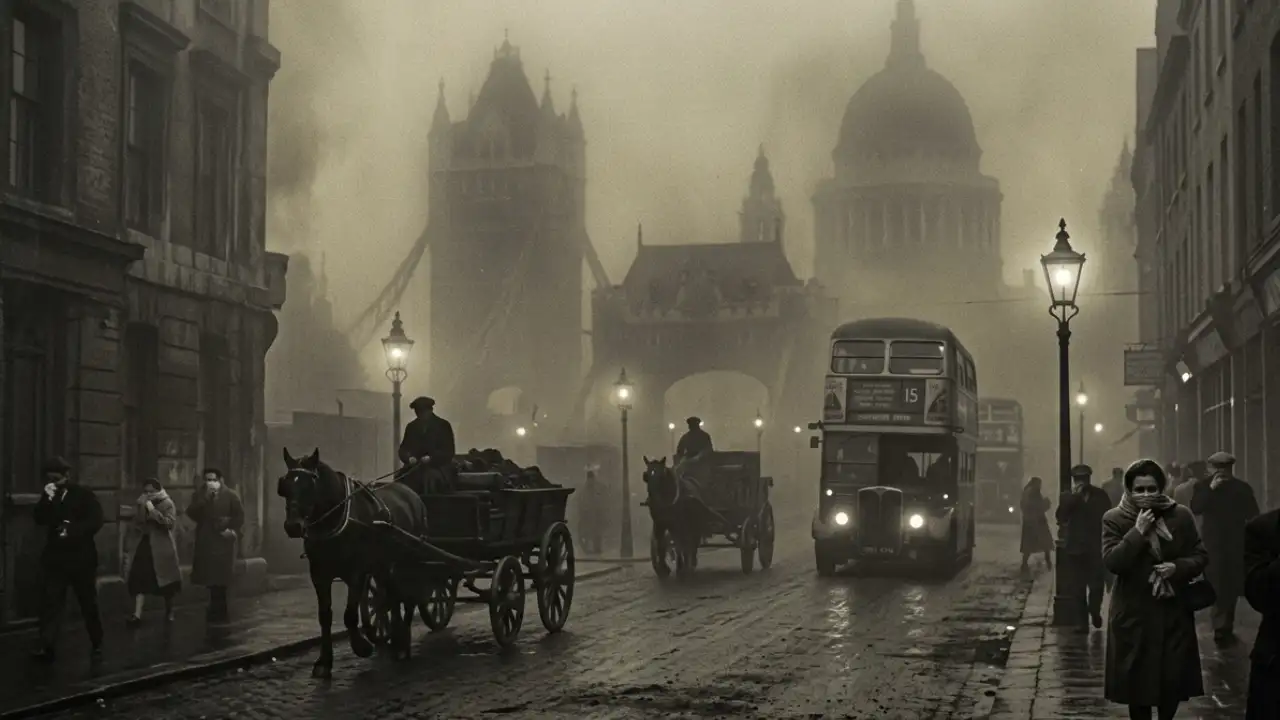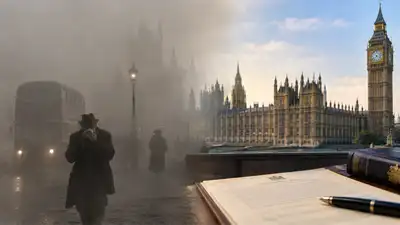
On a December morning in 1952, London disappeared beneath a blanket of dirty yellow fog. As reported by the Met Office, the smog lingered from 5 to 9 December, turning a familiar winter nuisance into a public health disaster. About 4,000 deaths were initially linked to the episode, although later estimates put the toll considerably higher. Four years later, Parliament passed the Clean Air Act 1956, introducing measures that began to change how smoke and coal burning were controlled in Britain’s towns and cities.
Visibility fell to only a few metres in places, public transport struggled and familiar streets became difficult to navigate. The air was not simply damp and murky. It was loaded with smoke, gases and particles from thousands of chimneys, trapped close to the ground by an unusual weather pattern.
A particularly thick smog was reported in London in December 1813, while a fog in December 1873 was followed by a 40% rise in London’s death rate. The morning of 5 December began with clear skies, light winds and moist air near the ground. PC: AI Generated The fog was not especially dense during the daytime on 5 December. Each day, around 1,000 tonnes of smoke particles entered the atmosphere, along with 2,000 tonnes of carbon dioxide, 140 tonnes of hydrochloric acid and 14 tonnes of fluorine compounds. Around 370 tonnes were released during each day of the fog, with an estimated 800 tonnes of sulphuric acid ultimately formed from it. The Great Smog finally lifted on 9 December. About 4,000 deaths were initially attributed to the episode. The Clean Air Act of 1956 introduced measures intended to reduce the amount of smoke released into Britain’s towns and cities. Smoky fogs were still occurring after the 1956 Act. In 1962, another London fog was associated with around 750 deaths. A further Clean Air Act followed in 1968, extending the restrictions on smoke and helping to continue the shift away from the conditions that had produced London’s notorious smog. The 1952 episode showed what could happen when those ingredients were combined with stagnant weather.
The quantities of pollution released during the episode were considerable. The Met Office reported, sulphur dioxide was also present in large quantities.
Culture and Medicine, titled ‘ London Fog as Food: From Pabulum to Poison ’, by 1952, London’s thick, polluted fogs were already widely associated with the term “pea-souper”, according to the research published in The Life of Breath in Literature. Fog was nothing new to Londoners by the middle of the 20th century. Industrialisation had made the capital’s traditional mists far dirtier, as coal burning and factory emissions filled the atmosphere with particles and gases. The problem had been building for generations. Similar increases were recorded after several other major fogs during the late 19th and early 20th centuries. The East End was often particularly badly affected. It contained a dense mixture of homes and factories and was relatively low-lying, conditions that made it harder for polluted air to disperse. But the conditions that developed that December were on a different scale. London households were burning large amounts of coal to keep their homes warm, sending smoke upwards through thousands of chimneys. Normally, that smoke would gradually rise and disperse. The weather in early December prevented that from happening. An area of high pressure had settled over the region, producing what is known as a temperature inversion. Instead of becoming cooler with height, the air above the surface was warmer. The colder air remained close to the ground, effectively holding smoke and other pollutants beneath it. There was little wind to break up the stagnant layer. Pollution from London’s homes and factories accumulated alongside material carried into the capital from industrial areas on the continent. As the surface cooled, the moisture condensed into fog. Beneath the temperature inversion, that fog became mixed with the smoke coming from London’s chimneys. After darkness fell, however, conditions deteriorated rapidly. Visibility in some places dropped to only a few metres. The following day, the low winter sun was not strong enough to disperse the fog, and it thickened again after nightfall. The same pattern continued into Sunday and Monday. For people walking through London, even streets they knew well became difficult to negotiate. In the Isle of Dogs, the fog was reportedly so dense that people could not see their own feet. The disruption reached far beyond pedestrians. Travel was badly affected for several days, while the polluted air caused breathing difficulties among many people. Its effects did not end with the return of clearer skies. The eventual death toll was found to be much higher as the longer-term consequences became clearer. Many people developed serious respiratory problems during and after the smog. There were also contemporary reports of livestock being affected. Press reports claimed that cattle at Smithfield had been asphyxiated by the polluted air, although the circumstances surrounding those reports were not as firmly established as the wider evidence of the smog’s effect on human health. The response was not immediate, but the Great Smog helped push air pollution higher up the political agenda. Among other changes, it restricted the emission of black smoke and encouraged the use of smokeless fuels. Urban households and industrial operators were given time to adjust to the new requirements rather than being forced to change their heating and production methods overnight. The legislation marked an important change in Britain’s approach to coal smoke. The familiar urban fogs did not disappear immediately, though. The Great Smog became a turning point in the history of British air pollution. London’s famous dirty fogs had been developing for more than a century, shaped by industrialisation, widespread coal burning and the city’s particular geography. The subsequent clean-air laws, together with changes in domestic heating and other developments, gradually removed many of the conditions that had allowed such severe pollution to build up over the capital. You use AI every day. Now get your AI Quotient. Take the AIQ test.
The weeks before the Great Smog had been unusually cold, with heavy snow in the region. The number was devastating, but the episode was nowhere near the scale of what had happened a decade earlier.