
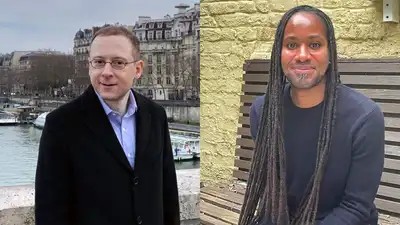
Nathan Cofnas (left), Jason Arday (right)
In March 2023, Jason Arday was appointed professor of sociology of education at the University of Cambridge, becoming the institution’s youngest Black professor, and his appointment attracted widespread positive coverage. He said he had been diagnosed with autism, global developmental delay, mutism, deafness and dyscalculia, had remained non-verbal until the age of 11 and had only learned to read and write at 18.
Nathan Cofnas, the American researcher who first publicly detailed extensive plagiarism allegations against Cambridge University’s youngest Black professor, Jason Arday, has said he bore no personal animosity towards the late academic. In his first detailed comments to VRT NWS after Arday’s death, Cofnas stated that he “had zero interest” in Arday as an individual and “no ill will towards him”. Arday played only a supporting role in it,” Cofnas said. He added that he had wanted Arday to remain a professor and “live his best life”. Arday’s biography at Jesus College, Cambridge, stated that he had held visiting professorships at Ohio State University and the University of Glasgow, but Ohio State said he had never been employed there, while Glasgow also denied that he had held the claimed visiting professorship. His biography also described him as an honorary professor at Durham University, although the university said he no longer held any role there. Arday had further stated that he completed a master’s degree in psychodynamic practices at Birkbeck, University of London, and subsequently became a fully qualified counsellor, but Birkbeck told The Guardian that it could not find a record of a student named Jason Arday having studied there. In mid-July 2026, Nathan Cofnas, a postdoctoral researcher at Ghent University who describes himself as a “racial realist” and critic of DEI policies, published a Substack article titled “DEI Fraud and Cover-Up at Cambridge”.
He insisted the controversy was fundamentally about diversity, equality and inclusion (DEI) policies at Cambridge and similar institutions. “I set in motion a series of events that led to a tragic outcome, but this was about diversity policy and Cambridge. Central to that coverage was Arday’s account of overcoming extraordinary challenges in his youth. He also spoke publicly about surviving epilepsy, testicular cancer and a brain tumour. His story of overcoming these difficulties and rising into academia was widely presented as an example of exceptional resilience. However, subsequent scrutiny by The Guardian found that questions extended beyond the allegations concerning his research. Several claims about his academic career and qualifications could not be substantiated. Using plagiarism-detection software, Cofnas argued that numerous passages in Arday’s doctoral thesis and later academic work had been taken from other sources with minimal alteration. He presented the case as evidence of deeper problems with how universities prioritise identity in appointments.
He has previously argued that genetic factors play a non-trivial role in average group differences in intelligence, views that contributed to the end of his association with Emmanuel College, Cambridge, in 2024.
In the same VRT interview, Cofnas characterised an earlier on-camera remark about heading a future “Department of Eugenics and Race Science at Harvard” as a joke based on his belief that universities should study race and hereditary influences more openly. Cofnas remains a polarising figure. Supporters see his work on Arday as a necessary defence of academic standards; critics describe it as racially motivated.
“You have to be able to criticise such people, even if there is a risk that they will misunderstand it or feel very bad about it,” he said. Shortly after Arday’s death, Ghent University suspended Cofnas preventively and opened a preliminary disciplinary investigation, stating that it took his public statements “very seriously”. Speaking to VRT NWS, Cofnas acknowledged that his actions set events in motion that ended tragically. He argued, however, that powerful people must remain open to criticism even when it risks causing personal distress.
Pingback: St Mary's University — Late professor Jason Arday/Image: The wider industry impact