
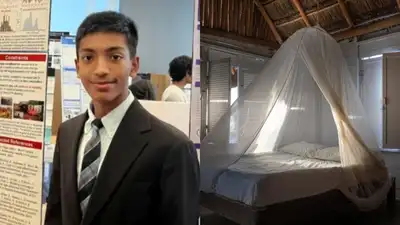
Because the mesh was available when conventional fishing equipment was not, for Mandal, the idea began with footage showing fishermen using donated mosquito nets as fishing material.
At 16, Rajarshi Mandal is already tackling a problem that has challenged public-health systems for decades: how to make limited malaria-prevention resources go further. The Lexington High School student built a mathematical model designed to determine where insecticide-treated mosquito nets could have the greatest impact, and his work earned him a $50,000 Davidson Fellows Scholarship, states an online report by the Davidson Institute. Because allocation decisions produced noisy results and the benefits of those decisions could be delayed, making it difficult for the system to settle on reliable value estimates, states the report, but the model struggled.
He points to the everyday consequences of malaria infections, including missed school, lost work and disruptions to farming and family responsibilities. The report adds that Mandal, a rising junior from Lexington, Massachusetts, developed an ordinary differential equation model that simulates malaria transmission under conditions that more closely resemble the real world. His approach considers factors that standard population-based distribution can miss, including insecticide resistance, seasonal changes in transmission and the gradual deterioration of mosquito nets. Scroll down to read the details of his innovation. His first attempt used a Deep Q Network, a type of machine-learning system. Mandal eventually developed a different architecture that directly scored possible allocations, avoiding the instability he encountered with his original approach. Mandal’s interest in the project extends beyond improving a statistic. The project also exposed him to the realities of delivering public-health interventions. A photograph of a transport truck overturned in the Democratic Republic of Congo, with mosquito nets scattered around it, underscored how easily logistical problems can interfere with even carefully designed programs, adds the report. For Mandal, the lesson is that mathematical modeling cannot eliminate every obstacle. It can, however, help make better decisions with the resources that reach their intended destinations.