
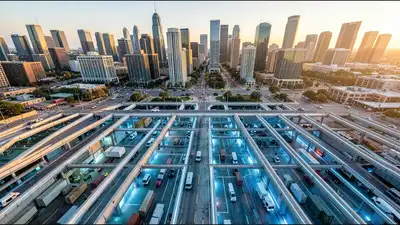
Representative Image of an aerial view of Dallas, illustrating underground freight tunnels beneath the bustling downtown streets (AI-generated image)
Construction began in 1924, according to the City of Dallas’s historic preservation record for Santa Fe Building No. 1. With passenger services consolidated, the Gulf, Colorado and Santa Fe Railway developed a new freight complex on adjoining downtown blocks. The complex was designed to centralise the railroad’s transfer and warehousing operations while removing the need for an extensive network of surface tracks. The buildings combined offices, warehouses and freight-related facilities. Designed by Dallas architect Lloyd R. Whitson, the buildings served businesses that relied on rail transport to receive, store and distribute merchandise. The project reflected Dallas’s role as a major commercial centre in the Southwest.
One Main Place, built between 1965 and 1968, was the only building completed from the proposed three-phase development. Because of a lack of financing, according to the City of Dallas’s landmark record and its One Main Place landmark nomination, the remaining phases were abandoned. In the 1960s, developers pursued a more ambitious vision for downtown Dallas through the Main Place superblock project. It was a private development rather than a municipal tunnel proposal. The project was initially conceived by Columbia University’s School of Architecture and refined into a buildable design by Skidmore, Owings & Merrill. Its plans envisioned a large development combining office buildings, retail areas, pedestrian connections, freight facilities, roadways and plazas.
3, which housed cold-storage facilities, was demolished in 1988, according to accounts of the Santa Fe complex. 4, the smallest of the four structures, was left abandoned for years before being converted into an Aloft hotel in 2009, according to published accounts of the complex. The underground freight operation did not remain in service indefinitely. The One Main Place landmark nomination prepared for the Dallas Landmark Commission states that the Santa Fe terminals fell into disuse after World War II. Construction of the Dallas Convention Centre eventually severed the tunnels from the main rail line, leaving the underground freight system disconnected from the railway network it had served. The nomination is available through the City of Dallas’s historic preservation records. The buildings subsequently followed different paths. Building No. Other surviving buildings have been adapted for new uses, while remnants of the underground railway remain associated with the surviving structures.