REPRESENTATIVE IMAGE: A four-lane divided highway, shown as a representative image for the Minnesota recycled-asphalt road project | ChatGPT
Minnesota used recycled asphalt that contained 50% reclaimed asphalt pavement (RAP) to reconstruct a four-lane urban highway in 1976, and engineers examined pavement cores and visually inspected the road fifteen years later, before a planned milling and overlay project. A four-lane highway became a recycling test In the 1976 project, the original pavement had to be removed and the road had to be rebuilt with recycled hot-mix asphalt. The new pavement structure included a 175-millimetre (6.9-inch) recycled asphalt base, a 40-mm (1.6-inch) binder course and a 20-mm (0.75-inch) surface wearing course. The recycled asphalt mixture contained 50% RAP, which came from existing asphalt pavement that had been removed and incorporated into the new mix. Engineers examined the road after 15 years The first structural measurements came in 1977, after one year of service, and engineers used a Benkelman beam to measure pavement deflection under load, which is a test that helps in assessing how a pavement structure responds to traffic. The longer-term assessment took place in 1991, when the pavement sections were examined before a milling and overlay project.
Workers placed the recycled base on the eastbound roadway in three layers, while the westbound base went down in a single layer, and engineers could therefore examine differences in pavement response as well as compare recycled and conventional asphalt. But the difference between the recycled sections was that the base that was placed in one layer had a higher average deflection than the base installed in three layers, and the early measurements therefore indicated that construction technique could affect how the pavement responded even when the material contained the same proportion of reclaimed asphalt. The project was built in Maplewood, Minnesota, and was among the early US efforts that tested whether old road material could be reused in new pavement without compromising its performance. Engineers reused the old material in the reconstructed pavement rather than sending it to disposal. The project also included a control section built with conventional hot-mix asphalt, and that comparison allowed engineers to assess the recycled pavement against a road section that was made with the help of standard materials. The FHWA’s technical account records the project as Minnesota’s first recycled hot-mix asphalt installation, and its findings were later included in the agency’s review of performance data from early recycling projects across several states. The measurements showed similar deflection values for the recycled and conventional asphalt sections, which could be analysed as evidence that the two pavement structures had comparable structural strength.
The inspection found that the recycled mixture had a service life that could be compared to the conventional hot-mix asphalt control section, and the finding covered the 15-year period between the original construction and the 1991 evaluation. Minnesota’s early project provided a long-term comparison between recycled and conventional pavement under actual road conditions, and the 1991 inspection found no service-life disadvantage for the recycled mixture in that test section. The experiment also distinguished between the percentage of reclaimed material in the asphalt mix and the performance of the finished road, since a mixture that contained 50% RAP still required appropriate layer thicknesses, construction methods and engineering evaluation. The Maplewood project began in 1976, when asphalt recycling was still being tested, and by the time engineers examined the pavement in 1991, it had completed 15 years of service.
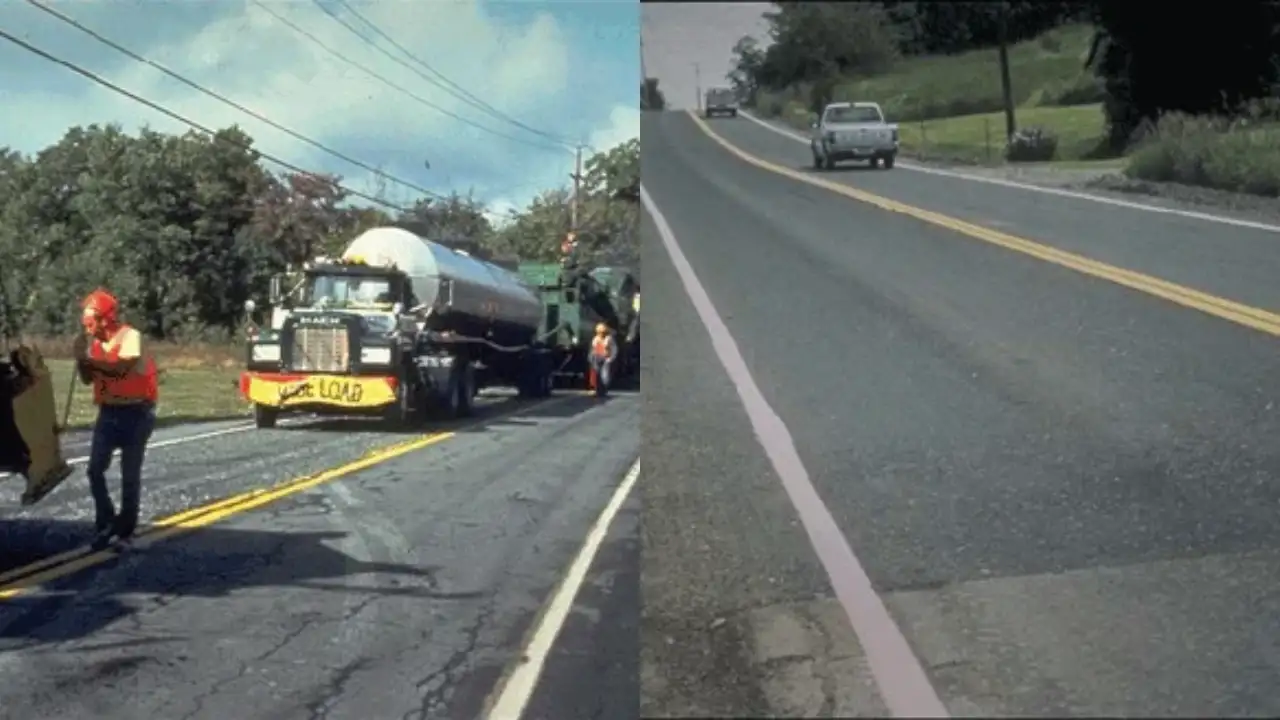
The Minnesota highway before and after cold in-place recycling (CIR), showing the pavement condition before treatment and the reconstructed surface afterward | Federal Highway Administration (FHWA), “Pavement Recycling Case Study,” U.S. The result documented the performance of a specific pavement project that used a particular mix design and construction method. Department of Transportation Reusing old asphalt became standard roadwork Contractors can mill or remove existing pavement, process the material and blend it into new hot-mix asphalt, which shows how reclaimed asphalt pavement is now widely used in asphalt production. The FHWA explains that recycled asphalt mixtures can perform comparably to conventional pavement when they are properly designed and produced, and also notes that the appropriate RAP content depends on mixture design, material properties and project requirements. You use AI every day. Now get your AI Quotient. Take the AIQ test.