
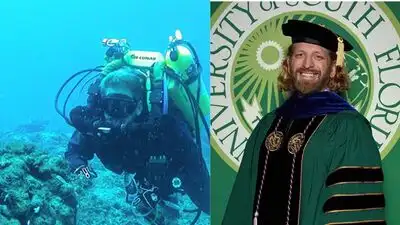
PC: University of South Florida
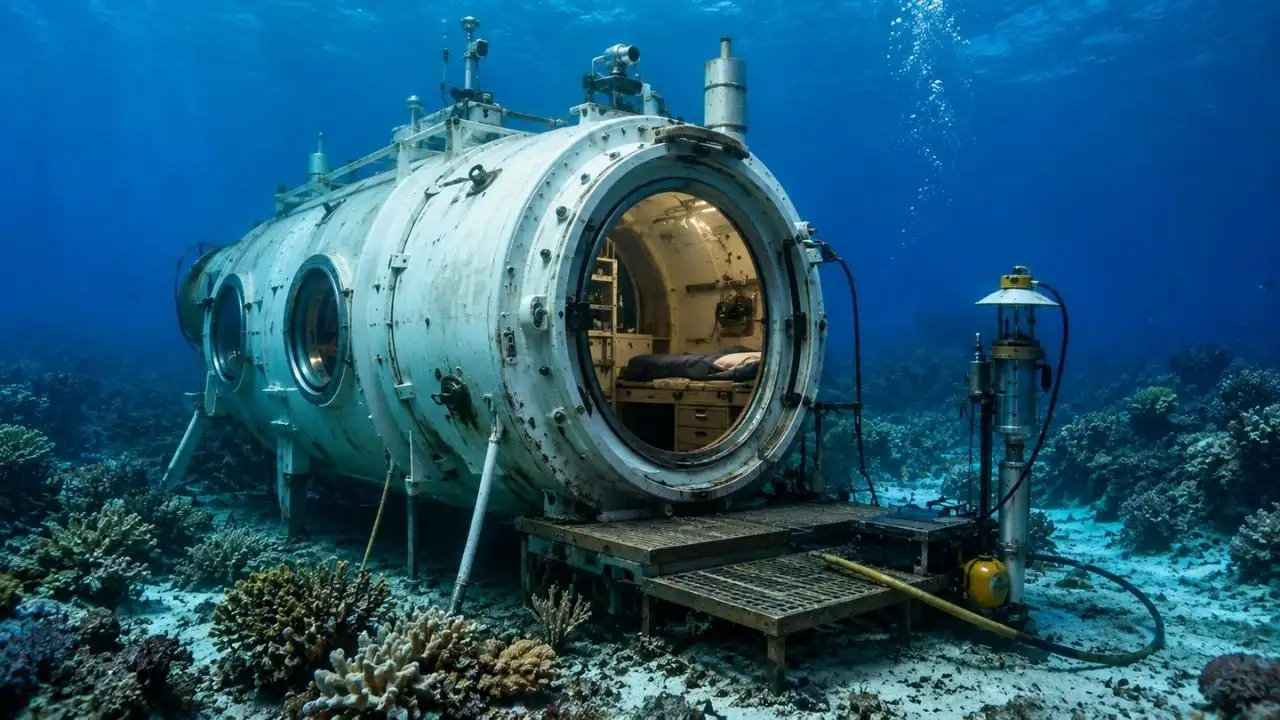
In 2023, Joseph Dituri made an unusual decision: instead of spending his days above the surface, he would live 22 feet underwater for 100 days. His home was Jules’ Undersea Lodge in Key Largo, a cramped 100-square-foot habitat that would serve as his bedroom, workplace, classroom and laboratory. Dituri’s underwater home was Jules’ Undersea Lodge in Key Largo, a habitat positioned roughly 22 feet beneath the water, according to the University of South Florida. The living space covered about 100 square feet, making it a very different environment from the homes and offices where most people spend their days.
He was building on earlier research in which cells exposed to elevated pressure were reported to have doubled over a five-day period.
He wondered whether sustained pressure could produce beneficial changes in the body, raising the playful possibility that he might eventually emerge “super-human”. The USF scientist was not simply attempting to endure an extreme living arrangement. His time underwater was part of a research project examining how prolonged exposure to pressure could affect the human body. Doctors planned regular visits to monitor his health, while blood tests, ultrasounds and electrocardiograms would track changes throughout the experiment. Dituri also continued teaching online and took part in other research activities while beneath the sea. His most intriguing hypothesis concerned pressure and biology. One of the ideas Dituri wanted to investigate involved the effect of pressure on cells. From that observation came a testable question: could sustained pressure produce measurable changes in a person’s biology?
Reportedly, long before the underwater experiment, Dituri had spent 28 years in the US Navy. The 100-day stay was therefore connected to a much wider research interest rather than being simply an endurance attempt. His students would therefore have a rather unusual setting from which to receive lessons.
He was not simply going underwater and remaining there without supervision. A medical team was scheduled to make regular dives to the habitat to assess his condition. Measurements would be taken before, during and after the experiment, with the researchers tracking physical changes as well as possible psychological effects. Blood tests, ultrasounds and electrocardiograms were among the planned medical assessments. The programme also included stem cell testing, while psychologists and psychiatrists would monitor Dituri’s experience of remaining isolated in a confined space for an unusually long period. He worked as a saturation diving officer, an occupation that exposed him to the technical and physiological demands of working under pressure. His background in hyperbaric medicine shaped the questions behind the underwater project. Dituri was interested in how increased pressure affects blood flow to the brain and whether mechanisms associated with hyperbaric treatment might eventually have applications beyond the conditions for which the treatment is already used. The measurements were intended to provide something more useful than a dramatic before-and-after comparison. By collecting data throughout the project and again after Dituri returned to the surface, the team could examine how his body changed over time. Dituri, an associate professor in biomedical engineering, planned to continue teaching his class online while living below the surface. The project included other research activities, too. Among them was testing an artificial intelligence system developed by a colleague. The tool was designed to examine the human body for signs of illness and help determine whether medication might be appropriate.
He retired from the Navy in 2012 with the rank of commander. Adults and children, accompanied by chaperones, were expected to have the opportunity to spend 24 hours underwater. Because of the injuries suffered by fellow members of the military, at USF, he pursued a doctoral degree with a particular interest in traumatic brain injuries, partly. Those discussions were due to be streamed through his YouTube channel, turning parts of the experiment into a public-facing science project rather than keeping the work entirely inside the research team.
His more playful description of the expected outcome was that he might emerge “super-human”. His next direction was academic research. Dituri expected the experiment to provide evidence either way. He described improved health as his working hypothesis, while stressing that his body would be closely monitored throughout the stay. The phrase was his own shorthand for the possibility of beneficial physiological changes, rather than a scientific conclusion about what the experiment would produce. Other scientists were expected to visit Dituri underwater for conversations about marine conservation. Dituri also wanted the habitat to serve as a place where people could experience scientific research at close range. The idea was to let visitors see the marine environment while also getting a sense of what research involves. For Dituri, the ocean represented more than the setting for his experiment. His interest in marine organisms was tied to the possibility that some could contain biological compounds with medical uses that have yet to be identified. Catch the latest World News and Live updates. Download the TOI app.