
By Alex Wilcox Cheek – commons.wikimedia.org
The Katama Meadows project in Edgartown proposed 52 homes across 54 acres, including 26 below-market lots intended for moderate-income residents and municipal workers, alongside 19 market-rate homes that could have sold for around $5 million each. After seven lengthy meetings, the Martha’s Vineyard Commission voted 10 to 3, with one abstention, to deny the project. The decision leaves the land, purchased by Utah developers Richard Matthews and Douglas Anderson for $6.6 million in 2017, undeveloped for now. It included 52 homesite lots, with 26 described as attainable or affordable homes for moderate-income earners and municipal workers. Twelve lots were to be sold for $225,000 each, while 14 were to be donated to the town of Edgartown. Their earlier plan, called Meetinghouse Place, proposed 24 market-rate homes and was denied by the commission in 2020. Commissioners noted that the 19 market-rate lots, each larger than 4,000 square feet, could support homes priced around $5 million and marketed to seasonal or year-round buyers.
Because the parcel functions as a wildlife corridor, tisbury commissioner Ben Robinson said the location was wrong for development. The fourth version added donated and income-restricted lots, a change that won support from the Edgartown Select Board, the town’s Affordable Housing Committee and the fire department.
Commissioners said the parcel will remain as it is unless the developers submit a new plan, though they indicated during the final session that another proposal is likely, according to The Martha’s Vineyard Times (MVTimes). Its supporters argued that it would create much-needed “missing middle” housing for people such as police officers, teachers, firefighters and emergency medical workers, who often earn too much to qualify for traditional affordable housing but cannot afford the island’s high market-rate prices. West Tisbury commissioner Linda Sibley called the income-segregated design offensive, while Chilmark commissioner Joan Malkin questioned whether the island should pursue more “missing middle” housing at the expense of affordable homes.
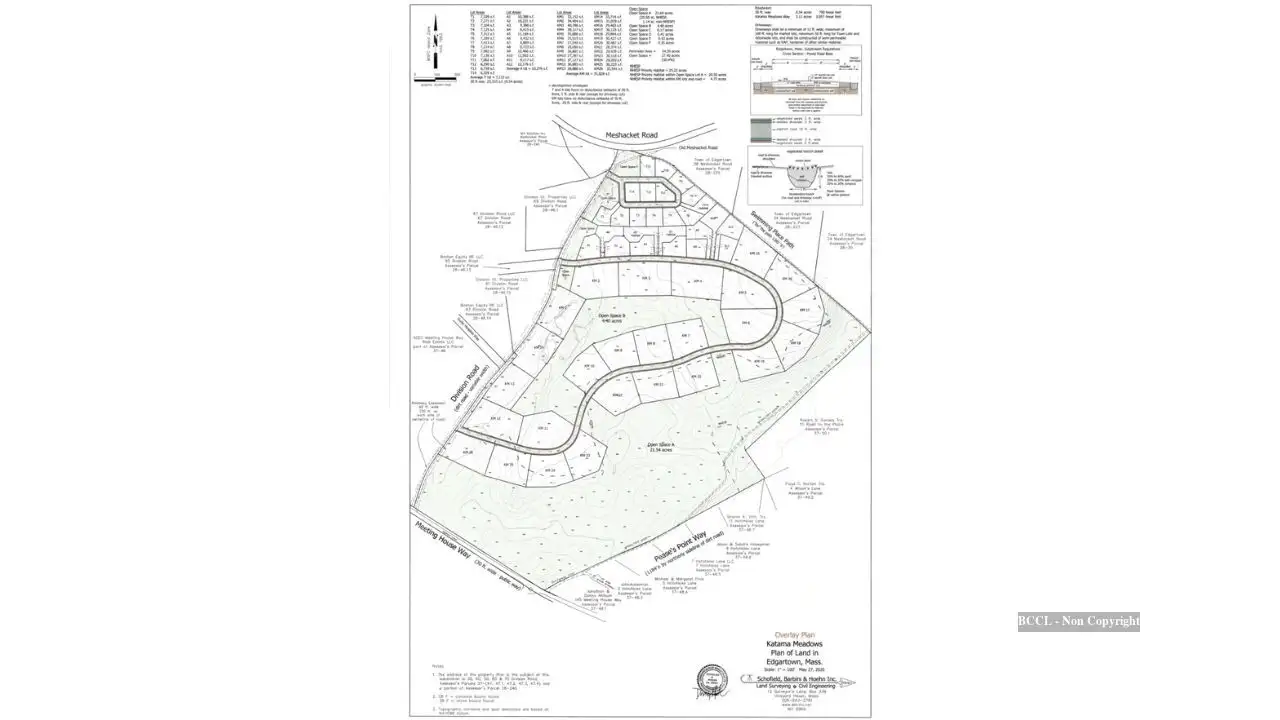
Martha’s Vineyard has rejected one of the largest housing proposals ever considered by its regional planning body. Read more details about this, as per MVTimes here: Katama Meadows was designed as a mixed-income subdivision off Meshacket Way and Division Road in Edgartown. The plan also set aside lots for Habitat for Humanity. The developers had already revised the proposal several times. Photo courtesy: Martha’s Vineyard Commission Despite that local support, the project faced strong opposition from residents, conservationists and several commissioners. The land borders Edgartown Great Pond, a watershed already impaired by nitrogen pollution. Commissioners were concerned that new homes and septic systems would add nitrogen to the pond, even if the development connected to town sewer lines and included mitigation measures. Nitrogen pollution can contribute to eutrophication, a process that reduces oxygen in ponds and can create conditions harmful to fish, wildlife and the broader ecosystem. The commission ultimately designated Katama Meadows a full detriment to the environment, citing both water-quality concerns and the loss of carbon sequestration from clearing woodland. Other commissioners argued that the island’s environmental limits must shape housing policy, even when the need for homes is urgent. The market-rate portion of the proposal also drew criticism. Critics worried that such homes would add to the island’s stock of luxury properties without solving the housing shortage for year-round residents. Commissioners also objected to the separation of income-restricted and market-rate lots within the subdivision. The decision also leaves unresolved the question of how the island will house its essential workers. Katama Meadows offered one possible answer, but commissioners concluded that its environmental cost, luxury-market component and design did not meet the island’s needs. The debate over where and how to build is likely to continue. You use AI every day. Now get your AI Quotient. Take the AIQ test.
More than 60 percent of Martha’s Vineyard’s housing stock is used for two months or less each year, according to figures cited during the hearings. For now, the 54-acre site remains undeveloped. The outcome reflects a broader dilemma facing resort and coastal communities: how to provide housing for the workers who keep local services running without allowing development that worsens environmental damage or increases seasonal luxury ownership. Aquinnah commissioner Jannette Vanderhoop argued that the island’s housing crisis is not simply a shortage of homes but a lack of access. That view shaped the commission’s conclusion that Katama Meadows, despite its affordable component, was not the right solution for the island at this location. The developers still own the land and may return with a revised application, but the commission’s rejection sets a significant precedent for how Martha’s Vineyard evaluates large housing projects.
Commissioner Doug Sederholm argued that securing homes for 26 island families and preserving about 32 acres of woodland was worth accepting 19 luxury homes for off-island buyers. Supporters countered that the trade-off was necessary. He warned that rejecting the project could lead to a worse proposal in the future. The vote came after what The Martha’s Vineyard Times described as the longest final deliberation in the commission’s history. Commissioners weighed environmental impact, housing need, traffic, health and safety, night lighting, the local economy, social development and recreation before reaching their final decision.