
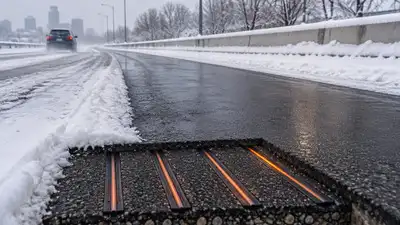
AI Representation: New Jersey researchers tested self-heating asphalt embedded with conductive strips. Image credits: Chatgpt
Rowan announced the full-scale results in November 2023, after the paper appeared in Transportation Research Record that year. The paper, Full-Scale Evaluation of Electrically Conductive Asphalt Pavements for Deicing Applications , covered the winters of 2021 and 2022. Rowan University announced the full-scale test results on November 29, 2023. The research paper appeared in Transportation Research Record , volume 2679, issue 1, in January 2025. The paper says the team built three 30-by-15-foot full-scale strips at Rowan University’s Accelerated Pavement Testing Facility: one control lane and two electrically conductive sections. The lowest-power result appears in a doctoral dissertation by Ashith Marath, Development of Electrically Conductive Asphalt Pavements for Deicing Applications in Cold Regions , approved at Rowan on September 26, 2024. The abstract of the dissertation says the conductive asphalt test strips could maintain a snow-free pavement surface with a thermal power output as low as 6 watts per square foot (65 watts per square meter) under winter conditions in New Jersey. The abstract of Marath’s laboratory study says mixtures with 30% graphite had electrical resistivity similar to those with 15% graphite and 2% carbon fiber.
The research comes from the Center for Research and Education in Advanced Transportation Engineering Systems (CREATES), part of Rowan University’s Henry M. Rowan College of Engineering. The center is housed at the South Jersey Technology Park on Rowan University’s West Campus in New Jersey. The team worked with the U.S. Army Engineer Research and Development Center’s Cold Regions Research and Engineering Laboratory. Accelerated truck loading using a Heavy Vehicle Simulator found that the heated strips worked about as well as regular asphalt.
The second design used a 0.4-inch conductive layer with steel electrodes spaced 6 and 12 inches apart. The third used a 1-inch conductive layer with electrodes spaced 12 inches apart in one section and 6 inches apart in the other. The New Jersey field tests were conducted during the winters of 2021 and 2022, according to Rowan University’s announcement.
The first one was the control strip without any electrodes.