
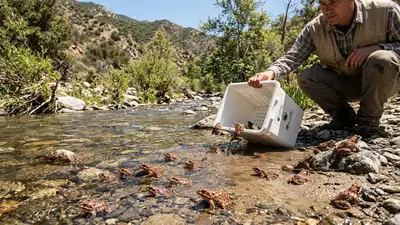
In the streams of Southern California’s mountains, the southern mountain yellow-legged frog has had a difficult few decades. The species was once far more widespread, with historic accounts describing streams where frogs were so numerous that people could scarcely move without stepping around them. Finding them in the wild is a very different proposition; their remaining populations are scattered across parts of the San Gabriel, San Bernardino and San Jacinto mountains.
Conservation teams released 653 captive-bred frogs into streams in the San Gabriel Mountains. On 19 August, 338 southern mountain yellow-legged frogs were taken to streams in the San Gabriel Mountains and released into their native environment. A further 315 followed on 27 August, bringing the total to 653. Of those, 227 had been raised in a new bio-secure amphibian headstarting facility at the zoo, a development that has expanded the number of young frogs that can be raised under controlled conditions before being returned to the mountains. The release also takes the number of Los Angeles Zoo-bred frogs returned to the wild since the Southern Mountain Yellow-legged Frog Recovery Program began to nearly 7,000. For the 227 frogs raised in the new facility, that process provided an expanded route from breeding and hatching to release. They are relatively small, generally measuring between about 1.5 and 3.25 inches as adults.
About 112 tadpoles bred at the zoo were also due to be transferred to the Santa Ana Zoo later in September for continued care. They can then be released at a stage when they are better equipped to deal with predators and the other hazards found in natural streams.
The release happened in two stages, according to the Association of Zoos & Aquarium (AZAs). Byron Wusstig, curator of ectotherms at the Los Angeles Zoo said, “Seeing our new headstarting facility transition from a concept to a fully operational reality is a monumental milestone for the recovery of the southern mountain yellow-legged frog. The release is part of a longer recovery effort that has already returned thousands of Los Angeles Zoo-bred frogs to native habitat. Every frog in this release was bred at the Los Angeles Zoo. The new facility occupies a renovated section of the Los Angeles Zoo’s Children’s Discovery Center. It contains specialised tanks and life-support equipment designed to maintain suitable water conditions for the amphibians as they develop. Tadpoles can be vulnerable during their early development, so keeping them in a carefully controlled setting allows zoo staff to raise them until they are larger and more developed. The work is not confined to Los Angeles. Southern mountain yellow-legged frogs are adapted to perennial streams in parts of Southern California’s mountain ranges. Brown and yellow are common colours, although individuals may also appear grey, reddish or greenish-brown. Dark spots and irregular markings help them blend into surfaces around their habitat, sometimes resembling moss or lichen. The yellow or pale orange colouring on the underside of the legs is the feature behind the species’ common name. Their present distribution is a shadow of the species’ former presence. Historical descriptions indicate that the frogs could once occur in large numbers along Southern California mountain streams, to the point where people moving through their habitat might have struggled to avoid stepping on them. The change has been severe enough for the International Union for Conservation of Nature to classify the southern mountain yellow-legged frog as Endangered. The releases are being carried out through a partnership led by the US Geological Survey. The programme brings together the Los Angeles Zoo, San Diego Zoo Wildlife Alliance, Omaha’s Henry Doorly Zoo and Aquarium, the US Forest Service, the US Fish and Wildlife Service and the California Department of Fish and Wildlife.
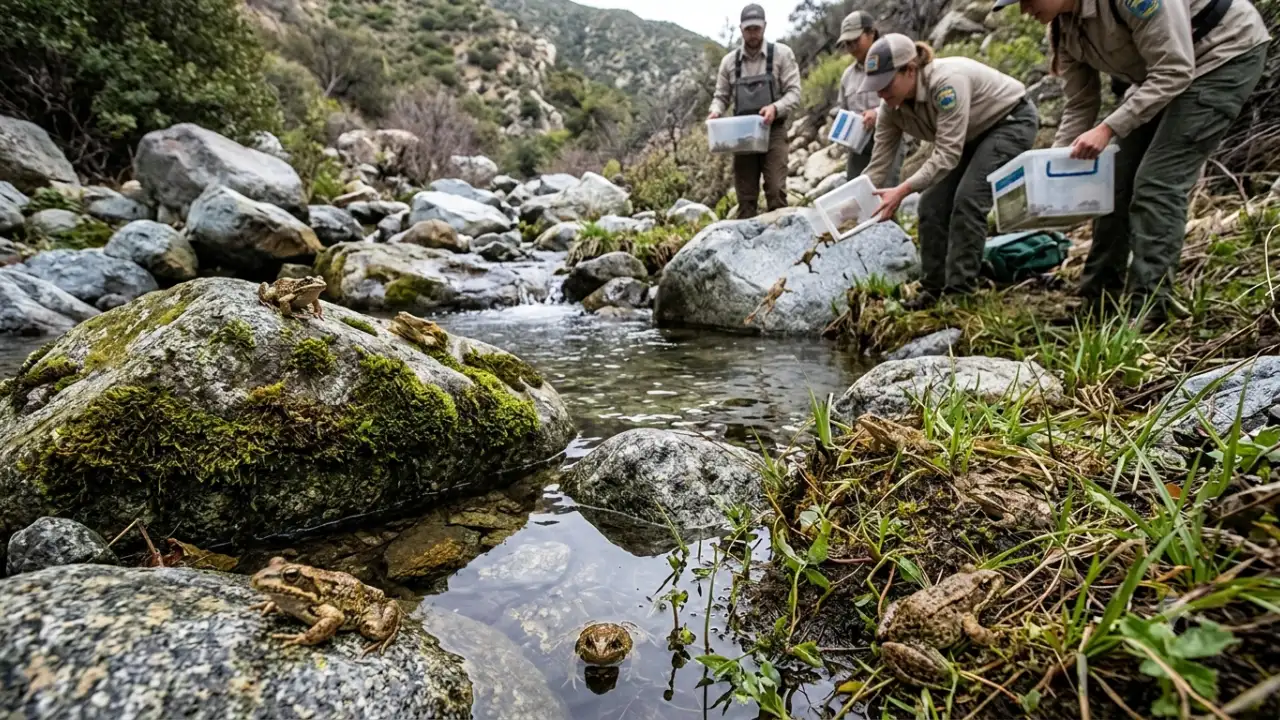
The 653 frogs released in August are not being treated as a standalone conservation event. The Los Angeles Zoo has now contributed almost 7,000 captive-bred frogs to releases in the wild since the recovery programme began. Other organisations have since joined the effort, including the Aquarium of the Pacific, Santa Ana Zoo, Big Bear Alpine Zoo and Birch Aquarium at Scripps. The network is expected to expand further. For the southern mountain yellow-legged frog, the San Gabriel Mountains are one of the places where that work is now taking place. They form part of an ongoing attempt to rebuild populations of a species that has become much less common across its former range. The new headstarting facility gives the zoo another way to increase that contribution, particularly by allowing tadpoles to remain under controlled care until they reach a more suitable stage for release. The species can still be seen by visitors at the Los Angeles Zoo, where southern mountain yellow-legged frogs are displayed in the Living Amphibian, Invertebrate, and Reptile exhibit. You use AI every day. Now get your AI Quotient. Take the AIQ test.