
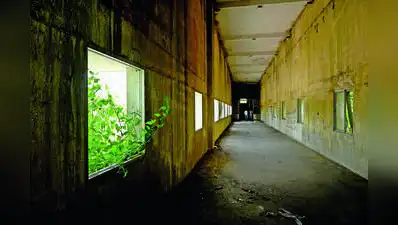
The corridor of the discarded Coca-Cola factory is a preferred spot of art directors of films
The latest one was Aadu-3, a popular hit comic franchise with Pinky, the goat, as a central character. He later approached the state revenue department which gave an approval, charging a user fee of Rs 75 per cent per day. “During a shooting schedule of around 50 days, a crew spends around Rs 50,000 on fuel every day. The hotel bill comes to around Rs 75,000 to Rs 1 lakh a day. Around Rs 2 crore to Rs 3 crore will be spent in the local area within 45-50 days,” says K Chenthamara, who was in charge of canteen operations of Coca-Cola factory but now works at Sree Petroleum at Vandithavalam near Plachimada. Perumatty Panchayat has now submitted a proposal to the state govt to set up an agricultural produce processing centre along with a film city on the 34-acre premises. A high-power committee constituted by govt to assess the extent of damages caused by excessive groundwater extraction and contamination put the monetary value of the loss at Rs 216 crore. “Around 900 families were affected by the groundwater exploitation and contamination.
“Many scenes of Aadu-3, were shot here,” says Vijayan, a location manager pointing to the goats merrily strolling down the road leading to the vacant verandah. Vijayan says he got an approval after first taking representatives of Perumatty Panchayat — who were in the forefront of the Coca-Cola agitation — into confidence. “The entire scenes of the Vinayakan-Vedika song in the movie were shot inside the factory buildings,” says Anees Nadodi, art director. A few other movies like “Vala” and “Kalante Thankakkudam” were also shot here, and this location is slowly becoming a popular destination for movie makers, as it has both resplendent nature and yet is barricaded from all sides. The village, which otherwise wears a deserted look, becomes active,” says Sheela Suresh, who runs a small restaurant near the factory. The minister has agreed to consider the proposal after holding discussions at the govt level,” says Shibu Suseelan, joint secretary, Film Employees Federation of Kerala (Fefka), the apex body of technicians and workers in Mollywood. If govt plans a film city, it can be run by a body formed by the victims,” says environmentalist S Faizi, who has been in the forefront of the agitation.
This splendid isolation seems to have come as a boon as the premises is turning into a popular location for shooting movies. Inside the high-ceiling plant, a palace set was created for the movie and the corridor was transformed into a tunnel. The conveyor, where coke bottles were loaded, became a bridge from where a ‘contractor’ was thrown into a graphically created river in the movie. The film shootings have now revived the rural economy as local hotels are booked. Even homestays and catering services have received good responses. “During the days of film shootings, it’s like a festival for us. A lot of people will come to our restaurant. When a movie is shot on the premises, a lot of money gets rotated locally. The film fraternity too has started discussions with govt regarding setting up a film city on the factory premises. “We met the minister for cultural affairs, P C Vishnunadh, and submitted a proposal to set up a film city. The place is close to Coimbatore airport and several shooting locations around the area, making it ideal for a film city. Most of them are tribal families. Govt should allot the land to the victims to set up enterprises for a livelihood. The goats of Plachimada seem to have scripted a positive story finally.