
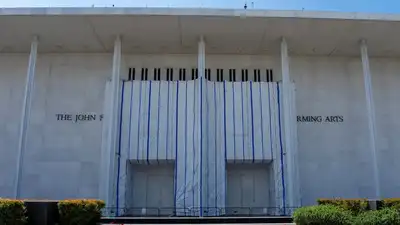
There are buildings we admire for their architecture, institutions we respect for their history, and then there are places that acquire something far more difficult to define.
Because it belongs to the collective human experience, the result is something that no individual can claim as his or her own. I had the privilege of experiencing that energy firsthand through UTSAV, a festival that we produced for several years at the Kennedy Center to introduce Western audiences to some of India’s greatest treasures of classical music and dance. Watching these artists perform at the Kennedy Center, I began to appreciate something that many artists who have performed there have expressed in their own way: there is a feeling associated with that stage that is difficult to replicate anywhere else. It is not simply the acoustics or the architecture, and it cannot be explained by the prestige of the institution alone. There is a sense that the artist is entering a space that has already been touched by generations of extraordinary human beings who devoted their lives to their craft. What distinguishes these places is the collective energy created by the artists who have performed there and the audiences who have shared those experiences. A musician brings the accumulated discipline of a lifetime to the stage. A dancer brings years of physical sacrifice and mastery. A singer brings not only a voice but a lifetime of emotion and inspiration .. Each performance adds another layer to the history of the space. Its sacredness does not come from any individual associated with it. It comes from the cumulative contribution of thousands of artists and millions of audience members who have participated in its history. It comes from the young performer who spent a lifetime dreaming of standing on that stage, from the established artist who arrived carrying decades of experience, and from the audience member who sat quietly in the dark and was moved by something that could not have been communicated in any other way. When we brought Indian classical artists to the Kennedy Center through UTSAV, the purpose was never simply to put performances on a prestigious stage. We wanted to create a bridge between cultures and allow Western audiences to experience traditions that had evolved thousands of miles away. The Kennedy Center provided the setting in which those traditions could meet a new audience, and for a few hours, music and dance became a language that required no translation. We should instead ask what we want that legacy to mean for the generations that follow us. I hope a young dancer from India, a violinist from Japan, an opera singer from Italy or a young American actor can look toward the Kennedy Center and see a place where their own aspirations are possible. I hope artists from cultures that have never before been represented there can imagine bringing their traditions to that stage. And I hope audiences continue to enter those halls and encounter something that reminds them, despite all of our differences, of the extraordinary things human beings share. The Kennedy Center has accumulated decades of that energy. Every artist who has performed there has contributed something to its spirit, and every audience that has gathered to experience those performances has become part of its story.