

Lignite costs have climbed to Rs 4,500 during. The price of H-acid, a key dye intermediate, has nearly tripled to Rs 800-900 per kg, while dyes have become costlier by 50-60%
Gujarat Textiles Industry Faces Margin Pressure Amid Recovery Signs
Gujarat’s textiles sector is showing initial signs of recovery in production, exports, and order inquiries. However, a significant increase in raw material, fuel, and chemical costs is constraining profit margins across the value chain. Capacity utilization has improved from approximately 60% to 80%, yet manufacturers remain cautious as higher input costs inflate working capital and limit profitability.
Akash Sharma, director of a textile processing unit, reported that the price of imported coal rose from Rs 7,000 per tonne in January to Rs 9,500 in July, resulting in a nearly 30% increase in working capital requirements. Many processors have reduced production due to the inability to finance higher inventories. Domestic and international demand is estimated to be 20-30% below previous levels.
In Surat, the hub for man-made fabrics (MMF), rising yarn prices have become a pressing concern for the entire textile supply chain, affecting yarn dealers, weavers, processors, and traders. The South Gujarat Textile Processors Association (SGTPA) plans to raise processing charges by up to 15% due to increased input costs, a move opposed by the Federation of Surat Trade and Textile Associations (FOSTTA), which has threatened to halt orders. Processors attribute the price hike to escalating coal costs and warn of further increases if fuel prices continue to rise.
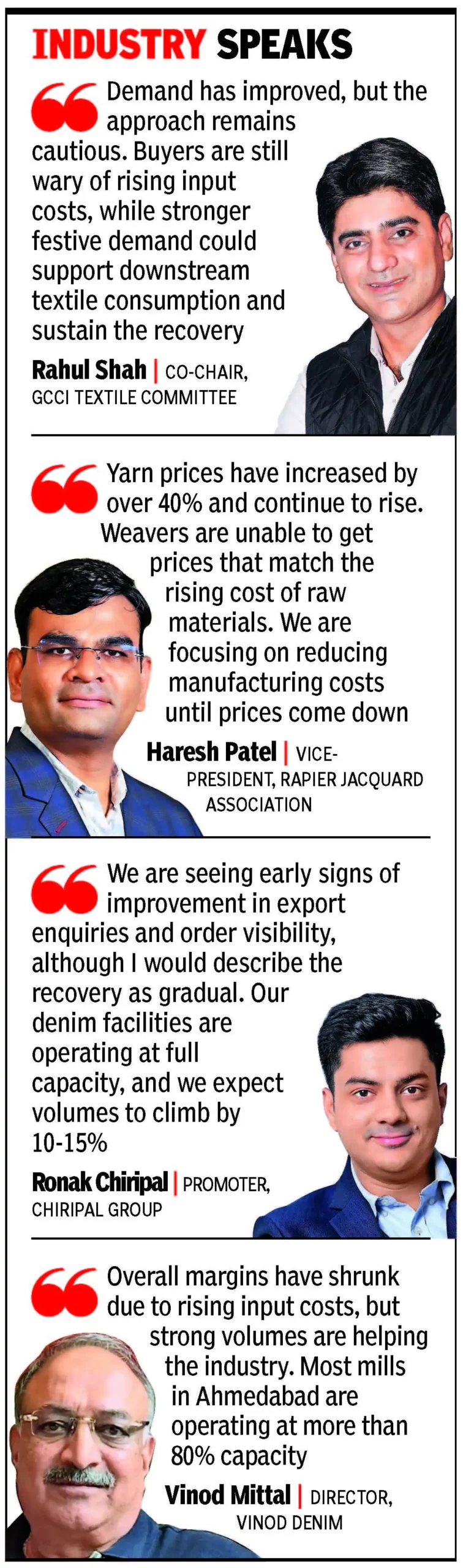
Chiripal, a key player in the denim market, indicated that its facilities are operating at full capacity, with a potential volume increase of 10-15% as demand strengthens. However, ordering patterns are inconsistent across regions. Rahul Shah, co-chair of the GCCI textile committee, noted improved demand as pipeline inventories shrink, but buyers remain cautious due to elevated input costs. Yarn prices have surged by approximately 30% over the last three to five months, alongside rising costs for dyes, chemicals, and freight. Although denim fabric prices have increased by about 10%, manufacturers report that this rise has not fully compensated for higher production expenses.
Arvind Ltd’s Q1 FY27 results highlight an increase in volumes, with denim volumes climbing 34% year-on-year to 17.5 million meters, marking the company’s highest performance in 16 of the last 17 quarters. Export volumes rose to 12.3 million meters from 7.6 million meters a year earlier, and denim revenue grew by 37% to Rs 450 crore.
Despite these gains, currency fluctuations have provided limited relief to exporters. Mittal emphasized that the rupee’s depreciation against the dollar has not translated into margin growth, as buyers negotiate aggressively in response to currency devaluation. While strong volumes are beneficial, overall margins have been squeezed by rising input costs.
Processing units depend heavily on coal and lignite to operate boilers and thermic fluid heaters, with fuel accounting for nearly 25% of processing costs, according to NTIEM.
SGCCI said the polyester value chain had witnessed an artificial escalation in prices that was not commensurate with underlying cost movements. “We are seeing early signs of improvement in export enquiries and order visibility, although I would term the recovery as gradual rather than broad-based,” said Ronak Chiripal, promoter, Chiripal Group. The price revisions have made it increasingly difficult for processors to quote competitive rates while maintaining margins. Southern Gujarat Chamber of Commerce and Industry (SGCCI) has separately raised concerns over polyester raw material prices. It has submitted a technical letter and data analysis to Union textile minister Giriraj Singh, highlighting a sharp rise in domestic prices of polyester melt (MELT) and partially oriented yarn (POY) following Centre’s withdrawal of the basic customs duty exemption on mono ethylene glycol and pure terephthalic acid. It warned that the surge was disrupting procurement cycles and squeezing margins for downstream textile units, particularly in Surat. Denim exports show signs of recovery Despite the cost pressures, Gujarat’s denim sector is seeing improved export enquiries after months of muted orders and inventory correction.
Crude is touching $100 — this might touch margins. Processors say Gujarat Mineral Development Corporation (GMDC) lignite prices have also climbed from Rs 2,800-3,000 per tonne to around Rs 4,500 during the same period. The price of H-acid, a key dye intermediate, has nearly tripled from about Rs 300 per kg to Rs 800-900 per kg, while dyes have become costlier by 50-60%. Grey knitted fabric, which earlier cost Rs 240-250 a kg, is now Rs 320-330 a kg. Narol Textile Infrastructure & Enviro Management (NTIEM) has sought relief from GMDC after seven successive coal and lignite price revisions between Jan and July pushed fuel prices up by about 60%. However, textile EBITDA margin slipped to 8% from 8.4% a year earlier. The company cited an additional raw-material cost impact of about Rs 19 crore during the quarter.
As a result, yarn prices have risen by up to 50%,” said Lucky Singhi, vice-president of the United Gujarat Yarn Dealer Association.
Chintan Thaker, chairperson, Assocham Gujarat State Council, said, “FTA has had a good impact but rising crude and other input costs remain a concern. We are still not sure which trajectory the market will take,” said Suketu Shah, secretary, Denim Manufacturers’ Association of India (DMAI). Shah said high inventories with brands and retailers were holding back fresh orders, while delayed payments were aggravating liquidity crunch. Liquidity has been under stress as businesses have accepted higher-cost inventories but are unable to realise payments on time,” he said. International buyers remain cautious Manufacturers said the improvement in overseas demand is not uniform. Vinod Mittal, director of Vinod Denim, said denim usage is growing across fashion categories globally as well as in India. There is strong demand from Bangladesh, Vietnam and Latin American markets,” he said. Mittal added that while yarn, chemicals and freight costs have risen sharply, demand has held up and “most of the mills are running at more than 80% capacity in Ahmedabad”.
Thaker noted that overall, a robust demand scenario is coming up. The increase has extended to dyes and chemicals. Liquidity stress, thin profit margins Recovery remains fragile, with manufacturers struggling to pass on the higher costs to buyers. “There is a lot of turbulence and the cost of raw materials remains high. “Across the industry, profitability has been marginal or many units have reached break-even. The pressure is particularly severe for textile processors for whom fuel is a major production cost. Yarn prices have risen sharply in recent months, while downstream units are struggling to secure corresponding increases in fabric and processing prices. “The impact of the war is not as significant now, but supply is still insufficient to meet demand. Buyers remain reluctant to build inventories and are increasingly placing staggered orders. “Worldwide there is increasing usage of denim fabric in fashion. The trend is similar in the domestic market too.
Experts are banking on a positive outlook riding on increasing orders You Can Also Check: Gold Rate in Ahmedabad | Silver Rate in Ahmedabad | Bank Holidays in Ahmedabad | Public Holidays in Ahmedabad | Ahmedabad AQI | Weather in Ahmedabad | Petrol Price in Ahmedabad | Diesel Price in Ahmedabad | CNG Price in Ahmedabad | LPG Price in Ahmedabad Stay updated with the latest Ahmedabad news. The outlook is nevertheless positive. The industry is expecting festive demand and improving export enquiries to support volumes. Download the TOI App.