
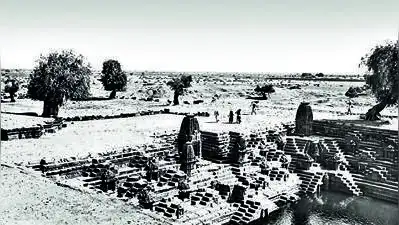
An old image of Surya Kund at Modhera used in 1967 book by Klaus Herdeg
Ahmedabad : The Sun Temple of Modhera has no shortage of stories to tell. Legend has it that its main idol of Lord Surya was crafted from pure gold, with a large diamond set in its forehead that caught the sun’s first rays during the equinox and illuminated the entire shrine. Together, these legends and architectural marvels, including a stepped tank, have drawn thousands of visitors from across the world to this small Gujarat town.
The idol is missing today, but the story lives on — much like the temple’s remarkable design, believed to be linked to the Tropic of Cancer.
Though its stones are difficult to date precisely, an inscription reading ‘Vikram Samvat 1083’ offers a broad date of around 1026-27 CE. If that estimate holds, 2026-27 could mark 1,000 years of the monument. The researchers have also highlighted an observation made by Burgess in 1870. Satellite images from 1965 and 1985 also appear to show signs of fortification around the settlement, according to the researchers. The Archaeological Survey of India conducted investigations at the site in 1965-66 and found evidence of an earlier brick structure beneath the Sun Temple complex.
You Can Also Check: Gold Rate in Ahmedabad | Silver Rate in Ahmedabad | Bank Holidays in Ahmedabad | Public Holidays in Ahmedabad | Ahmedabad AQI | Weather in Ahmedabad | Petrol Price in Ahmedabad | Diesel Price in Ahmedabad | CNG Price in Ahmedabad | LPG Price in Ahmedabad Stay updated with the latest Ahmedabad news.
The study, titled ‘Revisiting Modhera (Ancient Moherakpura), Gujarat, Using Old Maps and Geospatial Analysis’, appears as a chapter in Springer’s book “Spatial Narratives of India’s Heritage: Integrating Geospatial Analysis in the Humanities”. One of the earliest recorded accounts of Modhera came from Colonel Monier Williams and Captain R M Grindlay in the 1820s, according to the study. They described the Sun Temple as the “finest specimen of ancient Hindu architecture”. Later, Forbes, writing in 1924, and Cousens, in 1926, described Modhera as “a place of importance”. He described “the artificial nature of the ground near the river and the area surrounding the temple, consisting of solid brickwork of considerably early antiquity with unusual brick sizes”. Researchers said the remains were interpreted as traces of an earlier settlement, including a possible residential area.
Now, the temple may have another reason to make history. Experts such as M A Dhaky have highlighted the temple’s Maru-Gurjara architecture, visible in its ornate pillars and carefully designed complex. Historians also regard it as a lasting symbol of the region’s sun-worship tradition. A recent study by IIT Gandhinagar has now brought together accounts by early explorers and archaeologists, old maps and satellite images to place Modhera in the context of the Solanki era. It has been authored by Shikha Rai, a post-doctoral fellow at IIT Gandhinagar’s Archaeological Science Centre, and Prof V N Prabhakar, coordinator of the centre. Forbes observed that Modhera appeared to have been built on a mound formed by the debris of brick buildings rising from an otherwise level plain. He even speculated that the settlement may have been linked to a port, citing saltwater creeks extending from Little Rann of Kutch. The findings suggest that the temple may have been built over or near an older settlement, adding another layer to Modhera’s history. Download the TOI App.