
Recurring problem
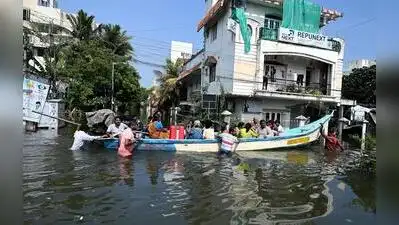
Despite ₹47.5 crore spent on stormwater drains covering 32.6 km of the locality’s 38 km road network, the low-lying neighbourhood continues to face inundation, exposing gaps in drainage maintenance, sewage management and the protection of natural waterways. Residents of AGS Colony, Bhuvaneswari Nagar and Ram Nagar report water stagnating up to 2–3 ft after heavy rain. The 3.8 km-long waterway is a crucial link in the city’s flood drainage system, but garbage, silt and encroachments obstruct its flow; however, only around 1.5 km has been properly desilted. The corporation has deployed five 100-HP motors and nine tractor-mounted motors, with two to three workers stationed in each affected street.
Once spread across more than 150 acres, the lake has been reduced to around 55 acres due to encroachments. You Can Also Check: Gold Rate in Chennai | Silver Rate in Chennai | Bank Holidays in Chennai | Public Holidays in Chennai | Chennai AQI | Weather in Chennai | Petrol Price in Chennai | Diesel Price in Chennai | CNG Price in Chennai | LPG Price in Chennai Stay updated with the latest Chennai news.
Geetha Ganesh, secretary of AGS Colony Residents Welfare Association, said, “even last Sunday, after heavy rain, water stagnated to a height of two to three feet in some areas. Balakrishnan, general secretary of TANSI Nagar Residents Welfare Association, said encroachments along the six-vent canal near Vijayanagar bus terminus and Perungudi railway station restricted water flow. He said a proposed pond near the canal lacked sluice gates to regulate water movement. Urban planner S Naveen Kumar said, “making Velachery flood-resilient requires more than adding drains. A basin-wide plan, with clear departmental accountability and regular maintenance, is essential to prevent water from backing up into residential streets. ” GCC Commissioner G S Sameeran said, “Low-lying areas in Velachery, including Chokalingam Nagar, Kalki Nagar, Kuberan Nagar and Srinivasa Nagar, face water stagnation due to poor natural drainage and dependence on Veerangal Odai as the main outlet. The height of Veerangal Odai has been raised by 1m on either side along a 3.6km stretch to improve its carrying capacity. ” He also said, “Desilting of drains and culverts is also under way, planned drainage projects are expected to improve water flow towards the sea.
Chennai: Every monsoon, residents of Velachery brace for the familiar cycle of waterlogged streets, overflowing manholes and homes threatened by rising floodwater. With at least two lakh people living in and around Velachery, three major issues continue to undermine flood mitigation efforts. The first is clogged stormwater drains. Sewage from illegal connections made by high-rise apartments, residential buildings and commercial establishments flows into the network, blocking silt catch pits and underground pipelines. Though the pipelines, measuring around 2X2m, can carry substantial volumes of rainwater, blockages restrict their capacity, causing water to backflow and manholes to overflow. The second is the neglect of Veerangal Odai, a natural waterway that carries runoff from Velachery, Adambakkam, Puzhuthivakkam and Madipakkam towards Pallikaranai marsh. From there, water flows through Okkiyam Maduvu into Buckingham Canal. The third is the shrinking Velachery lake. Water hyacinth and sewage pollution further undermine its role as a natural reservoir that could store excess rainwater and support non-potable uses after treatment. Even during summer, sewage overflows from manholes and silt catch pits. The corporation and Metro Water must coordinate to resolve this interdepartmental issue. Authorities must restore the entire drainage chain, remove encroachments, desilt Veerangal Odai and the connecting culverts, stop sewage inflow and restore the lake’s storage capacity. Download the TOI App.