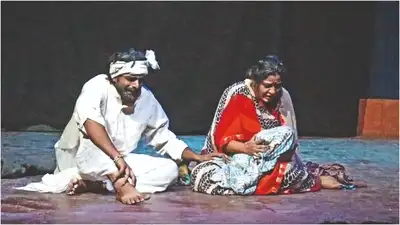
A still from the play
Bhagat’s son dies on the way back home. It was Bhagat and his wife’s seventh and only child. The other six too had passed away, after having fallen prey to various diseases. When the wife hears the news, she goes through the five stages of grief, ably embodied by the actor. The first couple of stages of anger and denial are done in such a raw and realistic manner, that for a moment, one forgets that this in fact, is not a movie, but a live performance. Life had come full circle for Chaddha, who had once shown no mercy to a pleading father. Now Chaddha was on his knees and the news had reached Bhagat, who had a deep knowledge of the occult. This moment, when Bhagat had to decide whether he wanted to show compassion to another helpless father like himself or carry the heavy burden of resentment and anger until he lived, is where director Mannu Singh Rawat’s play becomes most effective in showing that the ties of pain and fury bind us all together. That life has the ability to turn tables at any moment. The stage, though big, relied little on props, lighting and especially music. The drama was driven entirely by Premchand ’s endlessly relevant writing and performances. However, the narration between the scenes felt unnecessary. One of the highlights of the drama was the visually striking chanting sequence.