
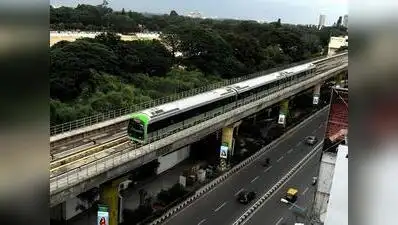
Despite the Metro’s expansion, its daily ridership of around 10 lakh remains a fraction of the 47 lakh passengers carried by BMTC
Bengaluru : Namma Metro marked 15 years of operations on Oct 20, having grown from a 6.7km stretch between MG Road and Baiyappanahalli to a 96km network spanning 83 stations. Daily ridership has climbed from around 25,000 to 10 lakh, reflecting the growing role of the Metro in the city’s transport system. Yet, as Namma Metro completes 15 years, a fundamental question remains: has its expansion delivered the transformation in urban mobility that Bengaluru desperately needs? Delhi Metro had commissioned around 230km during its first 15 years and now operates a network of about 416km While Namma Metro has taken 15 years to build 96km of operational lines. Bengalureans continue to grapple with congestion in a city where the number of vehicles has crossed 1.3 crore. Despite the Metro’s expansion, its daily ridership of around 10 lakh remains a fraction of the 47 lakh passengers carried by BMTC. It is also well below the 30 lakh daily ridership projected in BMRCL’s detailed project reports (DPRs).
Building a Metro network in a city notorious for traffic gridlocks has been a formidable challenge. Tunnelling through Bengaluru’s congested core areas, navigating difficult geological conditions to build a tunnel network and working within restricted construction hours have tested Bangalore Metro Rail Corporation Ltd (BMRCL). The agency has opened Purple, Green and Yellow lines in phases, with successive inaugurations marking the expansion of the network. The contrast with Delhi Metro is striking.
The steep fare revision in Feb 2025 also made Namma Metro one of the country’s most expensive systems.
Prof Ashish Verma, IISc Sustainable Transportation Lab, said, “BMRCL is far behind the impact it should have made on Bengaluru’s mobility. Urban mobility experts attribute this gap partly to policy failures by successive govts and the lack of coordination among civic agencies. Poor first- and last-mile connectivity, inadequate footpaths leading to stations and weak integration with other public transport modes have restricted the Metro’s reach. Every corridor has been commissioned after considerable delays, while ongoing projects are taking years to complete. The focus should have been on decongesting the core areas first, but corridors such as the Inner Ring Road Metro have not been taken up. Instead, authorities have proposed double-decker projects that risk undermining the very purpose of improving Metro connectivity. ” He also flagged planning gaps in future corridors. Platforms on upcoming lines continue to be designed for six-coach trains, raising questions about whether capacity will be adequate as the city grows. Multimodal integration, meanwhile, is often treated as an afterthought rather than being incorporated at the planning stage. 100km milestone in sight
After taking 15 years to build a 96km operational network, Namma Metro is poised to cross the 100km mark. The 7.5km elevated section of Pink Line, between Kalena Agrahara and Tavarekere on Bannerghatta Road, is expected to open shortly, with BMRCL awaiting authorisation from the Commissioner of Metro Railway Safety (CMRS). BMRCL had taken up construction of Pink Line in 2017.
You Can Also Check: Gold Rate in Bengaluru | Silver Rate in Bengaluru | Bank Holidays in Bengaluru | Public Holidays in Bengaluru | Bengaluru AQI | Weather in Bengaluru | Petrol Price in Bengaluru | Diesel Price in Bengaluru | CNG Price in Bengaluru | LPG Price in Bengaluru Stay updated with the latest Bengaluru news. The remaining 13km underground section between Dairy Circle and Nagawara is expected to open next year. Over the next two years, the 58km Blue Line, connecting Silk Board to Kempegowda International Airport (KIA), is expected to open in phases, providing a crucial link to the airport and Outer Ring Road’s tech corridor. Beyond these projects, however, Bengaluru faces a longer wait for fresh Metro connectivity. BMRCL has not taken up construction of a new line for more than four-and-a-half years. The proposed 45km Orange Line, covering Kempapura–JP Nagar along Outer Ring Road and Hosahalli–Kadabagere on Magadi Road, remains held up amid controversies over the double-decker plan. BMRCL is now in the process of floating fresh tenders for the project. The 37km Sarjapur–Hebbal corridor is still awaiting final approval from Union govt. Proposals to extend the network to Hoskote, Nelamangala, Bidadi, Devanahalli, Harohalli and other satellite towns remain at the study stage. Download the TOI App.