
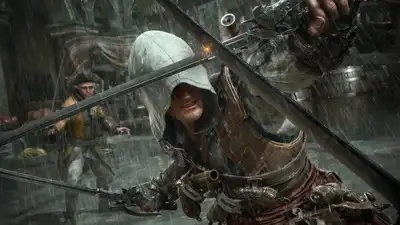
Edward Kenway always said he answered to nobody. Black Flag Resynced finally agrees
That was a strange thing to build a game on in 2013 and it’s still the best decision the series ever made. Because it looks expensive, and goes to sell the man’s secrets to whoever’s buying, edward Kenway kills an assassin on a beach, takes his coat. Because there’s money in it, he walks into one.
Black Flag was always about a man who refused to be told what to do. It was also, for about forty hours, a game that told you what to do constantly. You crouched where the level said you could crouch.
There’s a man in Havana I’m supposed to follow. Stay close, stay unseen, don’t crowd him, don’t lose him, don’t let the meter fill. I know this mission. I have failed this mission. Thirteen years ago I failed it enough times to remember the exact stretch of street where it kept going wrong, past the tobacco stalls, where the crowd thins out and there’s nowhere to stand. So this time I don’t follow him. I go up onto a roof, take the long way round the district, and get to the courtyard before he does. Nothing stops me. No grey wash over the screen, no checkpoint two minutes back, no voice telling me I’ve broken the memory. The mission ends the way it was always going to end. That’s the whole change—bigger than the water and the lighting and the twelve thousand new lines of dialogue put together. Resynced is the version where those two things finally stop arguing. Every other lead in this series gets sworn in. Trained, mentored, handed a code and an enemy and a reason. He’s a Welsh privateer with a wife in Bristol he promised to come back rich for. He isn’t looking for a war. But the original never quite trusted it. You’d have Edward telling Blackbeard he answers to nobody, and then the game would put you on a rooftop with a yellow cone of vision and one correct path through it. Fail it and you’d get a screen telling you the memory had gone wrong. Not your plan. The memory. Resynced mostly stops doing that. Missions rarely auto-fail now. The tailing sequences that survive give you a second door: go and take the papers off the man instead of shadowing him for ten minutes, if that suits you better. It usually suited me. The diving bell you once had to save up and buy from a ship vendor can now just be stolen off a group of soldiers. Small thing. It tells you what the remake thinks Edward is. Here’s what stealth used to be in Black Flag. A bush. A patch of tall grass. A stalking zone, marked out for you, with the next stalking zone about eight metres away, and the bit in between covered by sprinting and hoping. It wasn’t sneaking. It was hopscotch.
I took a plantation on the south coast without killing anybody—went in low along the treeline, rope-darted one man up into the branches to clear the north path, and spent about twenty minutes doing something the 2013 version had no vocabulary for. Kris Kirkpatrick, who built it and also built it in 2013, told me that faithful water would have been a mistake. PS5 gives you the usual pick between a ray-traced 30 and a performance 60, and I’d been on the pretty one for about ten hours before that fight sent me to the smooth one for good.
Because you decided to, you duck behind a low wall. Because there’s weather over east, or because there’s a sail on the horizon flying colours you don’t like, you head east. I won it with heated shot, which leaves a weak point you can dig into with swivel guns, and swivel guns you now aim yourself instead of hitting a prompt.
You hold a sightline, wait out a patrol, move when you want to move instead of when the level design says the window is open. Engine architect Nicolas Lopez told me what he wanted most was for players to feel like a pirate without the game interrupting them to say so, and that’s where it lands. Now there’s a button. Guards take their time between noticing something and committing to it, which reads on paper like the game going soft and plays like the game giving you room. Half of Black Flag is walking into a compound and stabbing your way out. Now it’s walking into a compound. When it does come to a fight, the swordplay has been rebuilt along the same lines. The original was a metronome. Wait, counter, chain, everyone falls over. Now enemies have posture to break, a parry window that’s generous but real, dodges for the strikes you can’t turn aside, heavy finishers that change depending on which sword you’re carrying. They read your patterns and stop falling for them. There’s also a boot that puts men into the sea, and I have not got bored of it. Sync a viewpoint in the original and fifty icons bloomed across the region. There was your night—someone else’s list, handed over before you’d looked at anything yourself. Resynced holds it back. Points of interest don’t appear until you’ve been near them or spotted them from height. The minimap is gone. There’s a compass instead, so going somewhere means picking a direction and sticking with it rather than watching a small circle in the corner do the work. What that does to the sailing is the real point. You leave harbour and the sea is blank. Whatever you find, you found. It helps that the world doesn’t stop anymore. No load between water and shore, no break walking into a town. Havana to open water to somebody else’s deck, no seam. And the Caribbean is still small. Nassau to Great Inagua is minutes. Kingston and Havana are compact towns doing a convincing impression of cities. Fifty-five hours in and I never once opened the map with dread, which is not something I can say about anything else Ubisoft has shipped this decade. After ten years of worlds you could scroll through for a working week, that isn’t a limitation. Nobody feels free in a place they can’t cross. The water is where the money went. The swell runs on a wave simulation with its own physics rather than a pretty surface laid over a flat plane, graded against the Beaufort scale so a calm crossing and a bad one are different problems, not different textures. Real oceans are more repetitive than anyone thinks. So this one is art-directed. Shorelines stay flat. Open water builds. Storms cost you something. I found that out off Cape Bonavista. Visibility went, the Jackdaw started moving like an object with weight instead of a boat on rails, and a British frigate opened up on me from a direction I couldn’t confirm. Half of that fight was guesswork. All of it was mine.
Kenway’s Fleet no longer needs a phone app—the most 2013 sentence available. A few of the original missions still walk you from marker to marker in the way 2013 liked. Everything around the sailing widens the options rather than tightening them. Ammunition types with secondary modes. Officers you recruit who bring abilities that matter, including a brace timed to the instant of impact that can shrug off an entire broadside. Ships that fight each other whether you show up or not, Spanish against pirate against British, so you can sit on the edge of somebody else’s afternoon and decide whether to ruin it. Diving isn’t locked to set-pieces; the seabed is simply down there, wrecks and sharks and all. The shanties still start on their own. There’s a menu to pick them now. I left it alone. The story runs on the same fuel, which is why it holds up. Nassau is a few hundred people who agreed on what they were against and never worked out what they were for—no governor, no law, no plan, and for a while it works, and then it doesn’t. Thatch makes his exit. Vane comes apart on an island with nobody left to perform for. Rackham talks and talks into a room that stopped listening. With the modern-day interludes gone, the years now run into each other and that collapse builds properly instead of getting cut away from every few hours. Edward’s inside it and slower than anyone to notice. He’s after one payout that fixes everything. Matt Ryan plays the charm and the bill coming due without pushing either, back in the booth for the new material and sounding like he never left. The new content sits in without a seam: officer questlines with real shape, Lucy Baldwin’s revenge run, a Padre who brings an unlikely spaghetti-western streak to the Caribbean, a post-game chapter that goes back to what Blackbeard left behind, and a proper goodbye for Stede Bonnet after the original left him dangling. Not everything opens up. The officers finish their stories and then stand on the deck for thirty hours doing nothing. Old bones, showing through. Last night I was on my way somewhere with three things to do when I saw a Spanish brig running low in the water, which usually means she’s carrying something. She wasn’t on a list. Nobody had asked. I took her anyway, and stood on her deck afterwards going through crates of sugar and rum I had no use for, with the sun coming up and my own three markers still sitting there, untouched, on a map I hadn’t opened in an hour. Get the latest technology news and updates. Download the TOI App.