
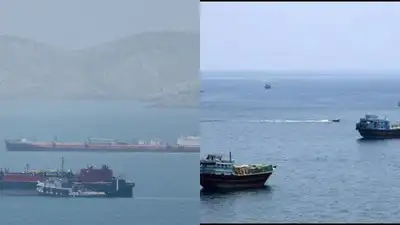
Robots first, divers next: How the US hunted Iranian mines beneath the Strait of Hormuz
The International Maritime Organization said in June that around 80 mines had been placed in vital shipping lanes. Before the war, Iran was estimated to possess about 5,000 to 6,000 sea mines, many produced domestically. Chatham House said only about 25 ships were transiting the Strait daily at the time of its assessment, compared with a pre-war average of roughly 125. Around 500 to 600 ships were still stranded in the Persian Gulf. On August 30, the US military struck Iranian rocket launchers that it said were preparing to fire sea mines into the Strait. Hamblet said rocket-fired mines could be significantly smaller than conventional mines deployed by ships and boats, potentially weighing about 50kg compared with mines weighing 500kg or 1,000kg.
Because they can interfere with the sonar systems used by minesweepers, according to Chatham House, the mines are particularly difficult to detect. Because it is believed to possess information about the location, types and settings of the mines it laid, iran could also have an important role. Any lasting reopening of the Strait would therefore require the US, Iran and regional and international maritime partners to maintain a sustained cessation of attacks.
The details of the mission were reported by the Financial Times, citing people familiar with the operation. However, no mine attacks have been independently confirmed by maritime authorities during the conflict. The only confirmed mine sighting in the Strait was reported by a Pakistani hydrographer in May.
US President Donald Trump last week said that “all mines” in the strait’s international waters had been removed or detonated, a claim subsequently confirmed by the US military. Iran has claimed it laid mines in international and Omani waters, while Tehran’s deputy foreign minister Kazem Gharibabadi said in late August that “no one except Iran knows the location of these mines”. “Mine-clearing forces are vulnerable because the operation is slow and their boats or helicopters lack defences,” said Clark. Iran has established a northern route closer to its coastline, while the US has directed ships towards a southern route hugging Oman’s coast, which Washington says ships can “freely and safely transit. “It’s hard to know what to believe,” said Ethan Connell, assistant director of Taiwan Security Monitor and an expert on mines. Iranian media has also claimed that at least two tankers struck mines in the past week, while an Iranian military spokesperson said Tehran had laid additional mines close to Oman. Analysts said satellite imagery had also failed to provide clear evidence supporting Iran’s claims. “It doesn’t take much to put a mine back in because there is a lot of small-boat traffic going across Hormuz every night”, a tanker industry executive said.
The US has spent four months conducting a covert and highly dangerous mine-clearance operation in the Strait of Hormuz, deploying Navy SEAL divers, robotic boats and specialised underwater craft to remove mines that have threatened one of the world’s most important shipping routes. The operation, carried out largely at night and underwater, involved small teams of US Navy divers locating suspected Iranian mines with the help of unmanned boats and submersibles before destroying the explosives. The operation highlights the extraordinary difficulty of reopening the strategically vital waterway, where the threat of mines has compounded missile and drone attacks and sharply reduced commercial shipping. However, maritime security experts and shipowners remain cautious about declaring the entire waterway safe. Traditional minesweeping is already a painstaking process in peacetime. Specialised vessels typically move repeatedly across designated areas, locating mines, cutting them from their moorings and destroying them once they surface. The US operation in Hormuz has relied instead on a smaller and more discreet force. The danger does not end once mines are located. Analysts also believe Tehran retains a large proportion of its small boats and minelaying vessels. With the main central shipping route effectively closed, vessels have been using two alternative passages. Both routes create problems. The alternative passages push ships towards the shallow edges of the Strait, increasing the risk of grounding. Their narrowness also limits traffic. Shipping cannot return to normal levels without reopening the main central channel. The problem is further complicated by ships switching off their automatic identification systems, or AIS, to avoid detection by Iranian forces. it also makes it harder for vessels to know where other ships are, raising the possibility of collisions While this can reduce the risk of attack. GPS jamming across the Gulf has added another layer of difficulty by disrupting navigation and AIS signals. Even if the current mines are successfully cleared, the US faces the possibility that Iran could lay new ones. “Iran is certainly trying to re-mine. “It’s always possible the [US] navy missed some. But the bigger and more pertinent issue, certainly the most annoying and expensive one, is the threat of re-mining. However, Tehran’s involvement would require political guarantees and international coordination. Demining is ultimately a political problem The technical challenge of finding and destroying mines may be formidable, but the larger obstacle is ensuring that mine-clearance teams can operate without becoming targets. Mine-clearing vessels need predictable operating conditions and protection from renewed hostilities. Chatham House has argued that mine clearance could itself become part of a wider diplomatic process. Iranian participation could demonstrate a commitment to de-escalation, while international involvement could provide transparency and reassurance to other countries. The central issue is not simply how quickly mines can be removed. It is whether the political conditions can prevent them from being laid again. Technology can locate and destroy the explosives, but keeping the Strait open will ultimately depend on whether Iran, the US and other stakeholders can establish enough trust to prevent Hormuz from becoming a battlefield again. Catch the latest World News and Live updates. Download the TOI app.
Bryan Clark, a demining expert at the Hudson Institute, said systems such as Britain’s SeaFox or the US AN/ASQ-235 Archerfish could be used for the task. Iran is believed to have thousands of Maham mines, including Maham 3 and Maham 7 variants. Insurance for some vessels has risen to as much as 10 times pre-war levels, potentially adding around $10mn to the cost of insuring a typical supertanker, according to the Financial Times. Oil prices initially fell about 5 per cent after Trump’s declaration that the mines had been cleared, although they subsequently recovered their losses as strikes resumed.
For Washington, the challenge is therefore not necessarily proving that every mine has been removed. No US casualties have been reported specifically in connection with the demining operation. Even without confirmed mines, the possibility that they remain in the water is enough to deter shipowners and drive up insurance costs.
US Navy divers used inflatable-hulled craft while robot boats and submersibles helped locate suspected Iranian mines, according to the Financial Times. “That is usually followed up by a navy diver who’s got to get in the water and approach the mine, and then put a charge on it and destroy it,” Bill Hamblet, a retired US Navy captain who often operated in the Gulf told FT. Hamblet described the operation as a “very small, lightweight kind of force” and said the US may have staged some operations from the USS Miguel Keith, an expeditionary mobile base attached to Gulf naval forces. Suspected minefields are believed to be located around the western entrance, the central eastbound shipping lane, the central westbound lane and the eastern exit towards the Gulf of Oman, according to Chatham House. Hamblet said: “The Iranians have realised that their strongest card is the perception that they control the Strait of Hormuz. Hamblet said: “The bigger game is on the information side. Chatham House said the US currently had only one mine-clearing ship available in the Middle East and has historically relied on NATO allies for specialist mine-countermeasure capabilities.
These systems can tow sonar arrays equipped with high-resolution, side-looking sensors capable of identifying objects on the seabed. The technology allows large areas to be searched while keeping personnel away from potentially explosive devices. But detection is only the beginning. Robotic underwater systems can also destroy mines by carrying explosives directly to them. The challenge is also complicated by the physical geography and traffic patterns of the Strait. Some are designed to detonate when struck by ships, while others can respond to changes in electromagnetic fields as vessels pass overhead. The uncertainty itself has become a strategic weapon. If they can convince the world that they can threaten the strait, that’s their strongest source of strategic leverage. It is convincing commercial operators that the route is safe enough to use. That is difficult when missile and drone attacks remain another threat to shipping. That may be as important, if not more important, than what’s actually happening in the water or on the bottom of the strait. The US has sophisticated drones, robotic systems and helicopters for detecting and destroying mines, but it cannot realistically clear the Strait alone. Britain, France, Germany, the Netherlands, Italy and other European partners have been identified as potential contributors to a multinational effort. Britain has also offered newer unmanned mine-warfare capabilities, while other European naval forces possess specialised mine-countermeasure equipment.