
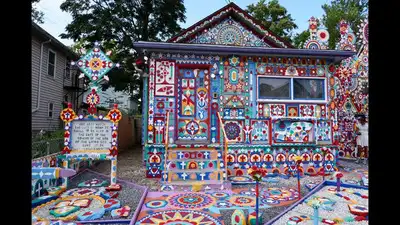
Carpenter Isaiah Robertson’s homePhoto: Discoverniagara.org
In 2005, Isaiah Henry Robertson, a Jamaican-born carpenter and devout Christian living in Niagara Falls, New York, began transforming his modest house into what he believed was a preparation site for the Second Coming of Jesus Christ. Convinced that God had told him the world would end in 2014, Robertson spent years covering nearly every surface of his home, inside and out, with intricate, brightly painted wooden religious art. After his death in 2020, the property was acquired by the Kohler Foundation, gifted to the Niagara Falls National Heritage Area, and preserved as a community landmark. At 24, Robertson moved to Canada and continued working in construction. In 2004, he relocated to Niagara Falls, New York, where he renovated and resold houses.
A carpenter guided by faith Isaiah Robertson was just twelve when his mother told him she had received a vision that he would do great things. He said God instructed him to use oak, and he purchased the wood with his entire life savings. Read on to learn more about this unusual incident, as described on the Niagara Falls National Heritage Area’s official pages about the house and its tours. Raised in Jamaica, he was taught to pray for salvation and, following what he saw as Jesus’ example, became a carpenter. He later claimed to have built his first house without formal training, relying instead on faith and practical skill. His church, Mount Erie Baptist Church, hired him to sheetrock and panel walls. Still, instead of standard materials, he used natural oak and covered the walls and cathedral ceiling with intricate, interlocking wood cutouts depicting religious imagery. Preparing for the end of the world
Today, visitors can explore ‘Prophet Isaiah’s Second Coming House’ on guided tours that highlight his faith-driven artistry and legacy.
He began by building a 25-foot kaleidoscopic cross near the driveway, decorated with hundreds of multichrome wooden armatures. At the front of the house, he mounted a 300-pound boulder from Three Sisters Island in Niagara Falls State Park, where he believed the Rapture would take place. From private vision to public landmark Isaiah Robertson passed away in January 2020 at the age of 72. In 2021, the Kohler Foundation purchased the house and gifted it to the Niagara Falls National Heritage Area (NFNHA). The 90-minute tour takes visitors through both the interior and exterior of the house, including areas not visible from the street, offering a close-up look at Robertson’s evolving masterpiece. Tours are priced at $15 for adults, with free admission for children under 18, and meet at 1308 Ontario Ave. in Niagara Falls, New York.
Because the end of the world was coming in 2014, in 2005, Robertson said God spoke to him again with a new directive: transform his own home. For him, the house was not just a home but a spiritual sanctuary and a signpost for the faithful and the lost alike.
Roadside America has described the house as “a spectacular piece of spiritual eye candy,” covered in thousands of bright-hued, hand-carved surfaces featuring multi-denominational religious symbols such as doves, trumpets, crescents, multi-pointed stars and “wheels within wheels. ” Robertson often said that God guided his hands as he worked, and he even interpreted an accidental brush stroke near the front door as an image of the Virgin Mary. Inside the spiritual sanctuary Inside, Robertson created a dedicated prayer room, covering the floors with candles and symbolic purple bead patterns that he said represented “the path to Salvation. Robertson’s vision was both personal and public. He believed that eternally damned souls flying past his house would see the cross and have one last chance to repent and be saved. Every available surface, be it walls, ceilings, doors and trim, was adorned with hand-carved and painted motifs drawn from Christian iconography and his own spiritual visions. The result is less a conventional house and more a three-dimensional devotional artwork, a physical expression of Robertson’s belief that Niagara Falls, one of the natural wonders of the world, would be the site of Christ’s return. Friends and neighbours remembered him as warm and welcoming, as well as a talented woodworker and artist whose faith shaped every aspect of his life. The organisation began the work of preserving the structure and restoring its art, with the long-term goal of transforming the site into a community space that tells Robertson’s story and inspires more community art through events and programs. Guides discuss intuitive art, religious symbolism, the challenges of preserving outdoor folk art, and what it means to leave a spiritual and creative legacy in the heart of a community. For many visitors, the house is more than a curiosity; it is a testament to one man’s unwavering belief that his art could serve a higher purpose. In a city known for its natural spectacle, Prophet Isaiah’s home adds another layer of wonder—a human-made shrine born of faith, craftsmanship and a vision of the end times that never came, yet left something enduring behind. Catch the latest World News and Live updates. Download the TOI app.
Visiting the house today Today, the property is known as Prophet Isaiah’s Second Coming House and is open to the public through guided tours run by the Niagara Falls National Heritage Area.