
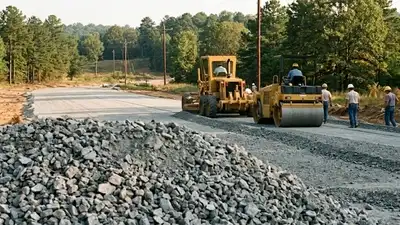
AI-generated representative image showing processed fly ash being crushed and used as aggregate in a road base during a highway project. Credits – Gemini
The Texas Transportation Institute completed a five-year research project on six test pavements in the Atlanta District, submitting its final report in October 2001. The work was performed for the Texas Department of Transportation under a research project from September 1996 to August 2001. The six pavement sections were built between 1993 and 1995, and the formal research project began in September 1996, with the first annual field evaluation conducted in spring 1997. That was also a limit of the 2001 study.
In its first annual assessment, the Texas Transportation Institute reported that most of the test pavements were performing very well, although two showed minor distress that might have been related to the fly ash base. Crushed fly ash, a byproduct of coal-fired power plants, served as the base for all of the pavements in the Atlanta District of northeast Texas. The conclusion was clear: the test pavements had done well based on visual surveys, deflection data, and core strengths. Its title was awkward but correct: durability of surface treatments applied to crushed fly ash and long-term performance of crushed fly ash as a flexible base. What was behind that term was a practical question. Could a waste material from the power sector be used as road aggregate and stand up to actual traffic and real weather? What was measured The researchers evaluated the pavements through visual surveys, falling-weight deflectometer testing and laboratory analysis of pavement cores. Visual surveys recorded cracking, rutting and other surface deterioration, while the deflectometer measured pavement stiffness. The first-year evaluation showed differences in stiffness between sites within the same sections. So the researchers weren’t investigating some general substance that behaved the same everywhere. They were testing a particular processed fly ash in a controlled construction environment. The six test sections provided a small sample of pavements that performed well during the monitored period, but the research did not establish how the material would perform over several decades or under every combination of traffic and weather.
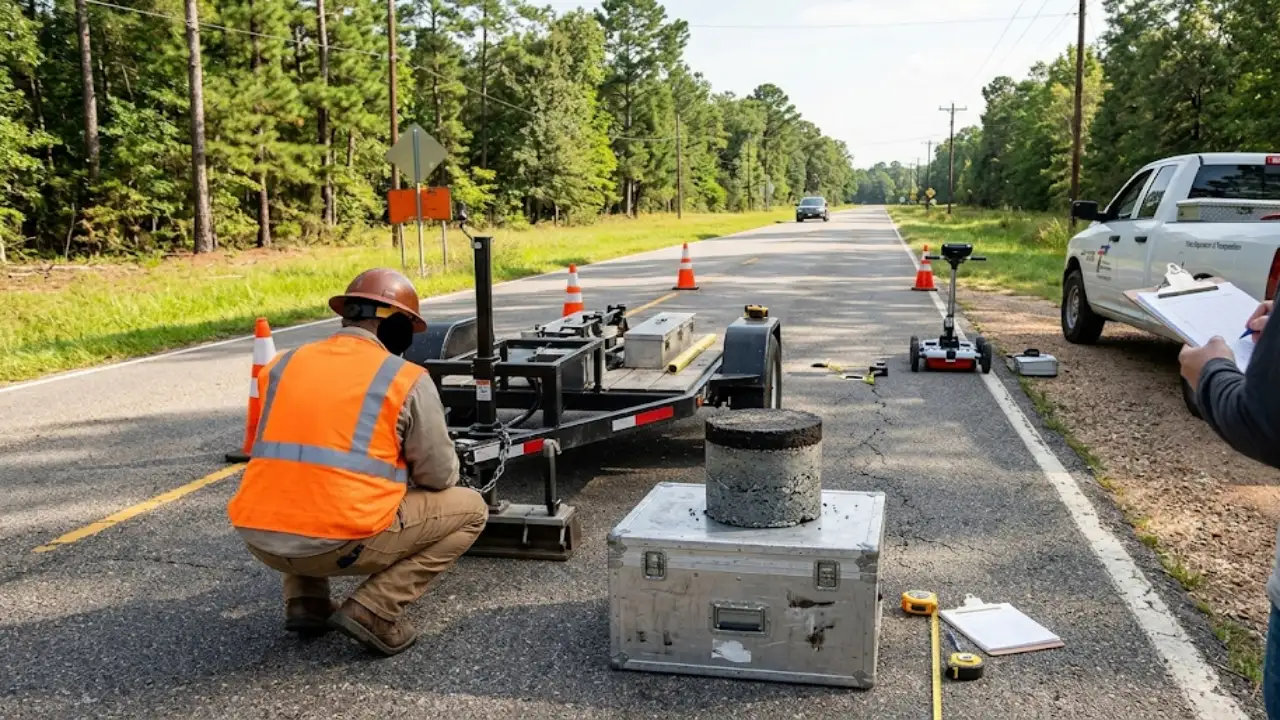
The Texas results show that a coal waste product, when properly cured, crushed and compacted, may be used as a flexible road base and continues to acquire strength after placement. Visual inspections, deflection tests and core-strength measurements were used to monitor the six test sections in the Atlanta District. The final assessment stated they performed well. The practical lessons are specific to road authorities: test the uniformity of the ash supply, control moisture during compaction, ensure the base is properly cured before applying a surface treatment, and monitor the pavement over several years rather than assuming an early result will continue. The Texas study did not show that other fly-ash bases will behave in the same way. It showed something more specific: when a suitable Class C ash was processed into a synthetic aggregate and used under controlled construction conditions, it could remain a functioning road base through at least five years of field monitoring.