
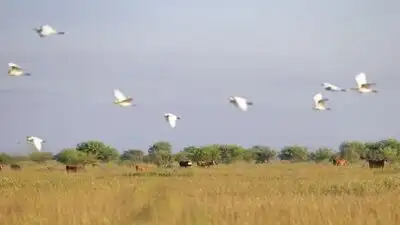
O’Connor ranching legacy began in 1834; 6,409 acres of Texas prairie protected 191 years later (Image Credit: Kenny Braun)
A Texas ranching legacy that began in 1834 is now tied to one of the state’s major private-land conservation efforts. An $8.863 million conservation easement has permanently protected approximately 6,409 acres of the historic T.M.
O’Connor Ranch in Goliad County, according to The Nature Conservancy (TNC). The agreement safeguards one of the largest remaining intact stretches of coastal prairie in Texas while allowing the O’Connor family to continue operating the property as a working cattle ranch. The deal was supported by federal RESTORE funding, along with private contributions, creating a model in which historic ranching and long-term habitat protection continue on the same land.
The conservation easement was purchased for $8.863 million, according to TNC. Of that amount, $7.6 million came through a grant administered by the Texas Commission on Environmental Quality (TCEQ) as the state’s representative to the Gulf Coast Ecosystem Restoration Council, or RESTORE Council. The federal programme uses money derived from civil penalties related to the 2010 Deepwater Horizon oil spill for projects involving ecological restoration, coastal protection, economic development and community resilience. The ranch provides habitat for more than 300 species and is among the most important areas in the United States for migrating, wintering and breeding shorebirds, according to TNC. These grasslands and marshes once covered about 6 million acres; today, less than 5% of the state’s coastal prairie remains.
Because it represents the first conservation easement approved by the RESTORE Council and the largest land-protection deal in the Gulf region funded through the RESTORE Act, according to TNC, the project is significant. Because it is found only in Refugio and Goliad counties in Texas, the Refugio rain lily is particularly notable. Protecting large, connected areas of prairie can therefore help retain habitat for species that depend on this increasingly limited ecosystem.
TNC says the property will remain a private working cattle ranch under the O’Connor family’s stewardship. TNC’s Texas annual report says the management plan includes collaboration with Texas A&M University’s Department of Rangeland, Wildlife and Fisheries Management and its Center for Grazinglands and Ranch Management, bringing research, guidance and monitoring to the long-term stewardship of the prairie. The conservation agreement does not transfer the ranch into public ownership. Instead, it places restrictions on future development and habitat fragmentation while allowing the family to retain ownership and continue ranching. TNC provided the remaining funds with support from the Knobloch Family Foundation, Frank Klein and H-E-B. The conservation easement covers a landscape that supports a variety of wildlife and plant species. The prairie also provides habitat for species of conservation concern, including the Attwater’s prairie chicken, black rail and Sprague’s pipit. Rare plants found in the wider landscape include the Refugio rain lily and Welder machaeranthera. Texas’ coastal prairies have declined dramatically over time. The ranch’s management will continue to incorporate conservation considerations.