
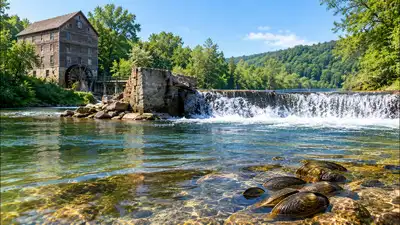
AI Representation: Virginia’s Little River Mill Dam, built between 1818 and 1834 to serve a five-story grain mill, was removed in 2024. Image credits: Chatgpt
A dam and five-story mill built between 1818 and 1834 on the Bowen family’s land The US Fish and Wildlife Service reported that the Bowen family has been tied to its land at Maiden Spring, Virginia, for about 250 years, or seven generations by the Service’s count. The Little River was dammed somewhere between 1818 and 1834, with a five-story mill being erected to process the grains produced at the settlement. The mill was later torn down, but the dam, 130 feet wide and 14 feet tall, survived. A river system with 46 mussel species, 20 of them endangered The Service describes the Clinch River system as one of the most ecologically valuable and diverse freshwater areas in North America, home to 100 fish species, five of them threatened or endangered and 46 freshwater mussel species, 20 of them endangered. Surveys found no mussels above the dam in the channel or within 200 meters of its base. Kanuckel named several species affected by the dam: the Cumberland moccasinshell and Tennessee clubshell, both at-risk species, the listed slabside pearlymussel and the Tennessee pigtoe, which the Service’s 2024 story says is proposed for the endangered species list. A $200,000 grant, a notching phase and more than 30 miles of stream The brothers accepted removal in exchange for a promise from the Service to restore the property in a better state and an added benefit that removal would reduce a hazard and liability. The US Fish and Wildlife Service awarded the Canaan Valley Institute $200,000 through the National Fish Passage Program, which received funding under the Bipartisan Infrastructure Law, for the Little River Dam removal project, according to the Service’s April 2024 story. Its project page is less consistent on mileage: the summary says over 30 miles, while the Quick Facts table lists 50 stream miles reconnected. A 2007 USGS report on host fish and mussels in the Neversink River A US Geological Survey report , Relations of Environmental Factors with Mussel-Species Richness in the Neversink River, New York , describes a 6-year study of seven mussel species. From 1997 to 2002, the team sampled 28 sites across the river and its tributaries, then built a model linking mussel richness to 10 environmental variables, including elevation, drainage area, channel width, sand content, velocity, shear stress, ANC and calcium, phosphorus and sulfate concentrations.
The Service’s April 2024 story said the removal was complete and had opened 30 miles of stream, with bank stabilization under way and due to finish in summer 2024. The Service also reported promising mussel bed development downstream. Old mill dams are easy to overlook on farmland. Often, they linger on private property long after the mill they were built for is gone. The people who live near them may never consider their effect on the river. In southwest Virginia, there was such a dam on one family’s farm. The mill it once powered had been long gone, but the dam and its effect on the river system remained. The ancestors first inhabited the area during the 1760s near a spring that feeds a creek into the Little River, which is a major tributary of the Clinch River. The family had long been good stewards of the land, planting native trees near the water and fencing cattle out of the river. However, the three Bowen brothers, who currently operate the family farm, were unaware of the fact that the disused dam was hindering certain fish and mussel species. The river also hosts the largest concentration of federally protected species in the United States. Corey Kanuckel, a Service biologist with the Partners for Fish and Wildlife office in Virginia, approached the brothers about the dam. Gravel was provided by the Service to make sure that heavily used sections of the land were stabilized, allowing farm lanes to remain accessible. Dam for the Versailles Mill. Image credits: Wikimedia Commons Notches were first cut into the dam to allow passage of water without bringing too much sediment, followed by the removal of the remaining dam and restoration of the streambank. The page does not explain the difference. It notes that mussel larvae develop in species-specific host fish, so impoundments that block those fish also limit where mussels can live. Removing the Cuddebackville Dam gave diadromous and other fish that host rare mussels access to habitat they could not reach before. The endangered dwarf wedgemussel and threatened swollen wedgemussel occurred alongside five other species. A four-year study of small dam removal on North Carolina’s Deep River
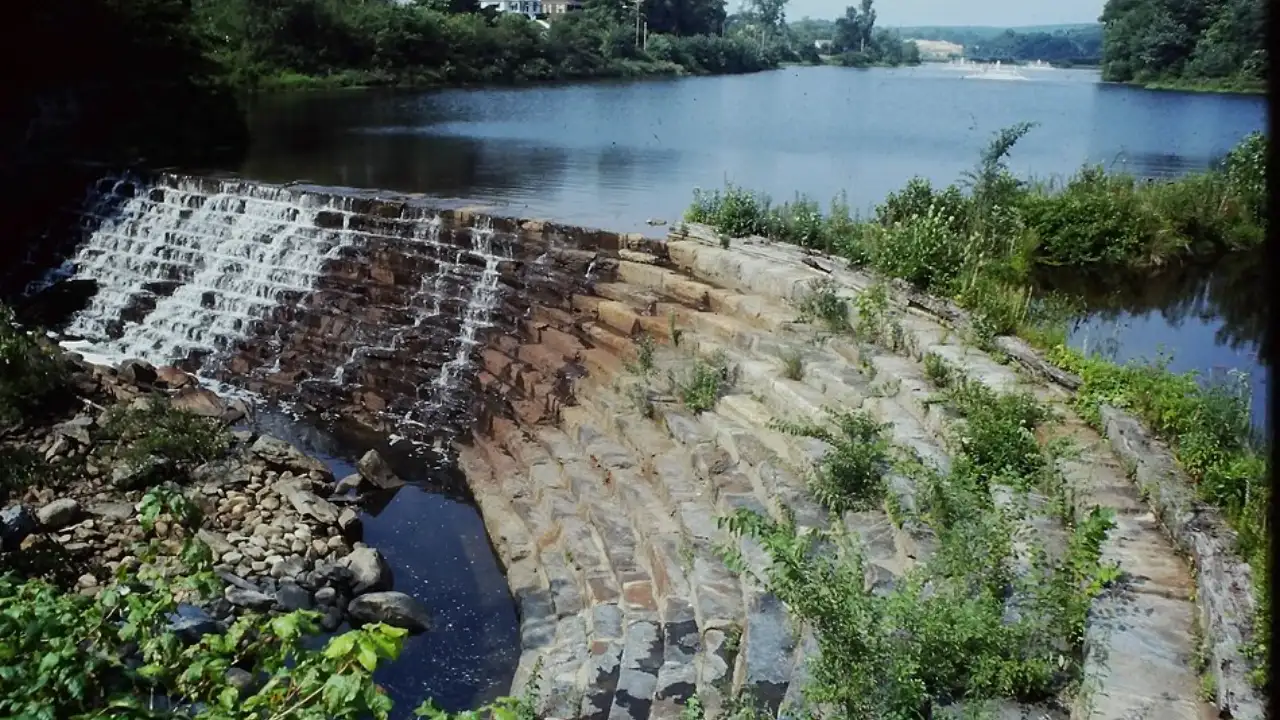
A 2013 paper in Walkerana , Short-term effects of small dam removal on freshwater mussel assemblage , tracked mussels for four years after a small hydropower dam came out of North Carolina’s Deep River in 2006.
The Service says the mussel beds downstream are still in an early stage of recovery. Its before-after-control-impact analyses showed no significant change in mussel density or species richness at the tailrace or the drained impoundment and stranding in the dewatered reservoir caused little mortality. The authors monitored two impact sites and two reference sites each year, using transect surveys and quadrat excavation to track density, richness and survival. Apparent annual survival of Eastern Elliptio at the tailrace did not differ from control sites. They concluded that careful planning, timing and method can limit short-term harm. Neither study looked at the Little River, but together they show why removing a dam matters for mussels and what removal can do to the mussels already living below it. You use AI every day. Now get your AI Quotient. Take the AIQ test.
Pingback: Idaho’s Red Ives Creek Dam, built in 1935 to provide hydroelectric: The wider industry