
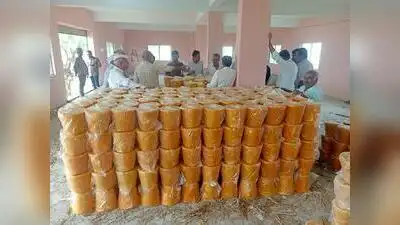
Jaggery witnesses highest ever price at Mahalingpur APMC market
Hubballi : With sugar touching Rs 75 per kg in the retail market, jaggery has become even costlier, crossing Rs 80 per kg. The sharp increase, which has nearly doubled prices in a month ahead of the festival season, has added to the burden on households. Market sources suspect that sugar, molasses and even ration rice are increasingly being used as feedstock for ethanol production, reducing availability for traditional consumption.
Mahalingpur jaggery was selling at Rs 65 per kg on Tuesday, though it had touched Rs 75 per kg just two to three days earlier,” they said. Sources at the Mahalingpur APMC said jaggery prices recorded an unprecedented jump of Rs 2,700 per quintal within four days. “The price rose from Rs 4,500 per quintal to Rs 7,200 per quintal by Sunday. Traders in Mahalingpur said jaggery exports that once averaged 15 to 20 truckloads a day to other states have now fallen to just one or two. He noted that the ethanol blending target has increased from 5% to 20%, encouraging more factories to enter the sector. With over 100 applications for ethanol units pending before the Karnataka govt, he warned that rice prices too could come under pressure if foodgrain diversion continues.
Stay updated with the latest Hubballi news.
Somashekhar Hadli and Rudresh Harakuni, traders and office-bearers of the APMC Ahara Dhanya Vartakara Sangh, Hubballi, told TOI that sugarcane scarcity has triggered a rise in sugar prices, which in turn has pushed up jaggery rates. Minor fluctuations are common during the festive season, but such a sharp rise has never been witnessed in the history of the market,” they said. “Several units were manufacturing jaggery using sugar, but many have halted production as sugar prices have surged,” traders said. Mallikarjun Heggalagi, former member of the Karnataka Sugar Industry High-Power Committee, said a growing shift towards ethanol production is affecting the availability of sugar and jaggery.
sources allege that both sugar products and ration rice are finding their way into the ethanol supply chain through the black market While subsidised public distribution system (PDS) rice is meant strictly for human consumption and cannot legally be diverted for fuel production. The resulting supply crunch has pushed up prices at a time when demand for essential commodities is expected to rise. “North Karnataka mainly depends on Mahalingpur jaggery, considered a premium product, while Mandya is the secondary source. With supply dwindling and demand rising, production has also suffered. He alleged that the growing focus on ethanol was undermining the availability of essential commodities and distorting the market. Download the TOI App.