
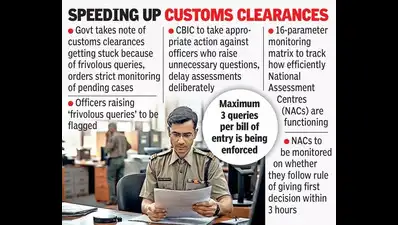
Hyderabad: The Union ministry of finance and the Central Board of Indirect Taxes and Customs (CBIC) has ordered tighter monitoring of pendencies and frivolous queries in the faceless customs assessment system, asking field formations across the country to ensure timely first decisions and bring uniformity in the nature of queries raised, sources in the ministry said. Documents accessed by TOI show the board also pushed for standardisation of frequently raised queries and a tighter review mechanism to curb delays that undermine trade facilitation.
Standard operating procedures (SOPs) are being developed for 50 identified commodities to improve transparency and consistency and ensure legally sound assessment practices, the document stated.
As part of administrative oversight, respective deputy/assistant commissioners were asked to strictly monitor assessments and ensure quality, while additional/joint commissioners were to carry out regular reviews of pendencies, according to the document. Sources said formations were directed to identify errant officers who raise frivolous queries or adopt delaying tactics and take appropriate action. Officers at all levels were to be sensitised and counselled on the impact of artificial delays, the document said. A key element is performance tracking through a 16-parameter matrix, under which National Assessment Centres (NACs) will be monitored, including compliance with the “first decision within three hours” rule, and monthly reports will be submitted, sources said. To prevent multiple or piecemeal queries, CBIC flagged query standardisation as critical, with the total number of queries on a single Bill of Entry restricted to three, sources said. NACs were asked to interact proactively to resolve challenges, and “review and remedy of divergent practices” is to be a compulsory agenda item in NAC meetings. DG Systems was tasked with improving data access and resolving technical issues that make MIS and pendency tracking “tedious and time-consuming,” sources said.
The document also calls for a single unified grievance redressal architecture to capture different types of grievances under one umbrella, and for zones to set up dedicated cells, submit monthly grievance reports, and conduct regular reviews.