
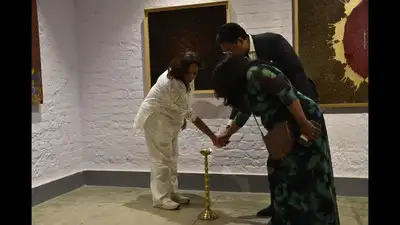
Can material hold time? That question lay at the heart of Temporal Materialities , an exhibition curated by Rashmee Pal Chouteau that brought together six artists whose practices engage with memory, process, transformation and the physicality of making.
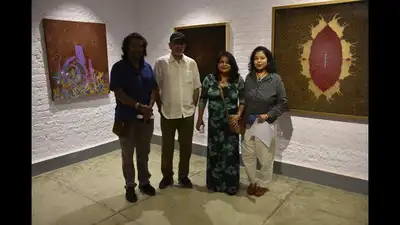
Across the exhibition, time was not presented as something linear or measurable. It lingered in a concealed layer, a repeated gesture, an erased mark or a fragment of a remembered place. Temporal Materialities ultimately suggested that an artwork is never entirely still or complete. Beneath its surface are traces of what came before — moments that continue to disappear, reappear and transform. Looking for trusted parenting advice? Follow TOI Parenting Circle on Instagram for expert guidance, relatable stories, and practical tips delivered every day.
Her works reflected on landscapes caught in cycles of construction and demolition, asking what is lost when development continuously reshapes familiar environments and gradually erases their histories. Featuring Debasish Mukherjee, Megha Joshi, Pooja Iranna, Ruchika Wason Singh, Samindranath Majumdar and Sheetal Gattani, the exhibition unfolded through surfaces that were layered, marked, scraped, erased and rebuilt. Here, material was not merely a medium. It became an active participant, carrying traces of gestures, histories, labour and lived experience. Memory and the changing nature of place emerged prominently in Debasish Mukherjee’s practice. Drawing from his return to Chhapra, Bihar, where the railway colony of his childhood had been altered by development, his works became abstract maps of remembered routes and vanished structures. What remained was not a fixed geography, but a shifting terrain shaped by recognition, absence and loss. Megha Joshi’s use of cotton wicks, or diya bati , brought ritual and repetition into conversation with questions of gender and labour. The painstaking process of making became integral to the work, while the ritualistic material itself was removed from its conventional associations and used to question the structures embedded within tradition. The idea of transformation took another form in Pooja Iranna’s engagement with the contemporary city. For Ruchika Wason Singh, accumulated marks and scratches created surfaces where different temporalities appeared to overlap. Forms emerged, disappeared and returned, allowing the past, present and imagined futures to exist simultaneously. Process was equally central to Samindranath Majumdar and Sheetal Gattani. Majumdar’s layered surfaces became records of alteration and struggle, negotiating both personal and environmental tensions. Gattani’s slow process of applying, scraping and revealing colour allowed the surface to visibly register the duration of its own making.