
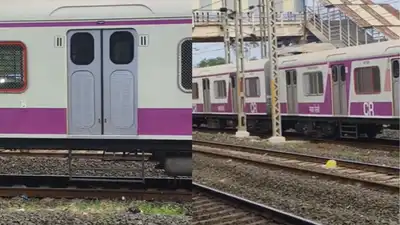
Mumbai has introduced its first non-AC local train with automatic doors
The 12-coach rake will now undergo trials on different sections of the Mumbai suburban network before Central Railway decides on its introduction into passenger services. The move follows the June 9, 2025, accident between Diva and Mumbra stations, in which five commuters died and nine others fell from a moving train. Following the accident, Railway Minister Ashwini Vaishnaw had announced plans to introduce non-AC local trains with automatic doors in Mumbai, with an initial target of operationalising them by 2026. A senior railway official said the 12-coach rake would undergo trials on various sections of the suburban network. The train had earlier undergone trials on the 63-km Khajuraho-Mahoba section. In 2019, Western Railway retrofitted selected compartments of a 15-coach local train, including first-class, general, ladies’ and differently abled compartments, with automatic doors. The work was undertaken at its Mahalaxmi workshop at a cost of Rs 75 lakh.
You Can Also Check: Gold Rate in Mumbai | Silver Rate in Mumbai | Bank Holidays in Mumbai | Public Holidays in Mumbai | Mumbai AQI | Weather in Mumbai | Petrol Price in Mumbai | Diesel Price in Mumbai | CNG Price in Mumbai | LPG Price in Mumbai Stay updated with the latest Mumbai news. MUMBAI: Mumbai’s first non-AC local train with automatic doors has arrived in the city, nearly a year and a half after the Mumbra train accident brought the safety of open-door suburban travel under renewed scrutiny. A five-member committee constituted to examine the incident identified overcrowding and open doors as key contributing factors and recommended introducing closed-door systems similar to those used in Metro trains. However, with the year nearing its end, the project remains at the trial stage. Based on the trial reports, the rake would be submitted for a fitness certificate before being cleared for passenger operations. Built by the Integral Coach Factory (ICF) in Chennai, the non-AC rake has undergone modifications to ensure ventilation even when the doors remain closed. The doors feature louvred panels to allow natural airflow, while roof-mounted ventilators are designed to improve air circulation. Vestibule connections between coaches will also allow passengers to move from one coach to another, helping distribute crowding. The introduction of automatic doors in non-AC locals marks a major shift for Mumbai’s suburban railway system, where the technology has so far been restricted to AC local trains. However, the new system could also pose operational challenges, particularly during peak hours. Each station halt may require additional time for the doors to open and close fully, potentially affecting punctuality. Passengers unfamiliar with automatic doors may also take longer to board or alight during the initial phase. Heavy rush near doorways could delay passenger movement, while sensors may trigger the doors to reopen if passengers or baggage obstruct them. Automatic-door trains are being considered as a measure to prevent fatalities caused by passengers falling from moving local trains. The Bombay High Court has also suggested that the railway administration introduce closed-door trains while hearing cases related to railway accidents. This is not the first attempt to introduce automatic doors on non-AC suburban trains. However, the experiment did not progress to regular passenger operations, with ventilation emerging as one of the key concerns. Download the TOI App.