
PC; Committee for the History of the Post Office (CHP)
The administration later introduced steam-powered machinery in 1871 and gradually extended its use across the network from 1879, according to the CHP’s historical account.
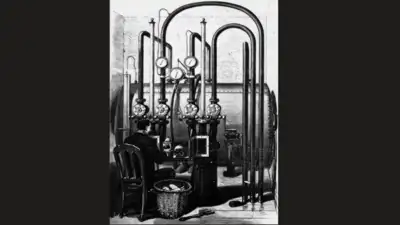
The pneumatic postal network used compressed air to move containers carrying messages through underground tubes, according to the Committee for the History of the Post Office (CHP). These containers, known as cursors, travelled between connected postal and telegraph offices. The Paris system initially relied on water-powered equipment to produce compressed air, rather than the vacuum-based method used in London. The system was subsequently improved through changes to its machinery, tubes and terminals to accommodate increasing numbers of dispatches.
A major development came on January 25, 1879, when the administration established a public pneumatic postal service. Following this decision, members of the public could send open or closed forms through the service, while express letters were introduced in 1898. By 1933, the Paris pneumatic postal network had reached 427 kilometres of underground tubes, making it the largest network of its kind in the world. By 1983, slightly more than half of the lines could no longer operate.
Delivery to recipients generally took approximately two hours, making the service particularly useful for businesses, government offices and people who needed messages delivered quickly, according to the CHP publication. The service was profitable at the time and employed specialised staff responsible for loading, transmitting and distributing dispatches, as well as maintaining the machinery, according to the CHP publication. Blockages involving the moving containers became more frequent, while maintenance problems left large sections of the network unusable, according to the CHP publication.
Until then, the network had primarily supported the transmission of telegrams. The network was extended across the Paris districts, and additional staff were employed to manage the growing volume of correspondence. It connected postal offices across the capital and supported the movement of messages through a system of interconnected routes. The network was not limited to a small number of central offices; it had become an established part of the city’s communications infrastructure. The decline of the pneumatic postal network became increasingly apparent during the 1970s and early 1980s. In areas where the underground system was unavailable, correspondence had to be transported above ground using cyclists or motorcyclists. The cost of maintaining and renewing the extensive infrastructure also became increasingly difficult to justify as the volume of mail carried by the network declined.