
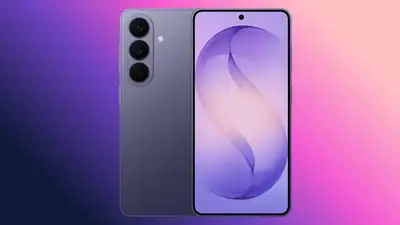
Samsung’s Galaxy S26 is the same, but better
The chassis is barely changed, the hardware is incrementally better at best—the 6.3-inch AMOLED display is brighter, the Exynos 2600 is a meaningful step up in chip performance, the 4,300mAh battery is larger—and the triple cameras, a 50MP main, 12MP ultrawide, and 10MP telephoto, are the same ones it’s had since the S22. All of this at Rs 1,08,999—Rs 8,000 more than the S25. The bezels around the display have also tightened up, which is where the extra 0.1 inches of screen real estate comes from without the phone actually getting any bigger. The 6.3-inch Dynamic AMOLED 2X display is one of the S26’s cleaner wins. It’s a touch larger than the S25’s 6.2-inch panel — the tighter bezels at work—and runs at FHD+ (2340 x 1080 pixels), which at 409 ppi is sharp enough that you’re never going to find yourself squinting at text or wishing for more detail. The Galaxy S26 you get here in India and a few other regions runs on the Exynos 2600, Samsung’s in-house chip, while the US gets the Snapdragon 8 Elite Gen 5. The 2600 is Samsung’s attempt to put that reputation to rest.
Samsung has been running this playbook for a few years now— incremental design, familiar hardware, software doing progressively more of the heavy lifting—and the S26 follows it faithfully. The software, though, has grown considerably smarter, with more AI tricks up its sleeve than ever. It’s a price that asks a fair question: what exactly changed? And that’s exactly what we’re here for. What Samsung has changed is the camera island. The three rear lenses now sit together in a unified circular housing rather than individual floating rings—it’s a cleaner, more deliberate look, and a better one. The 120Hz adaptive refresh rate, scaling down to 1Hz when the display is static, keeps the interface feeling fluid without unnecessarily draining the battery. What the S26 doesn’t get is Samsung’s new Privacy Display — an electrochromic layer exclusive to the S26 Ultra this year that makes the screen unreadable from the side, essentially eliminating shoulder-surfing. Fair enough; that’s a flagship differentiator Samsung is entitled to hold back. Less easy to defend is the missing anti-reflective coating, which has been an Ultra exclusive for two years now. The electrochromic layer is new technology—keeping that on the Ultra makes sense. The anti-reflective coating isn’t, and at this point, putting it on the standard S26 would have cost Samsung very little except a talking point. It’s a minor gripe on a display that otherwise gives you very little to complain about—and after a few weeks, even that fades into the background. If you’ve followed Samsung long enough, that sentence alone might make you wince. Exynos chips in Galaxy flagships have had a rough few years—running hotter than they should, draining faster than they ought to, and generally making you feel like the market you live in was an afterthought. And to its credit, it largely does. It’s Samsung’s first 2nm chip, and living with it for a few weeks, I kept waiting for the other shoe to drop—for the phone to warm up during a gaming session, for the battery to take a suspicious nosedive by afternoon, for some tell-tale sign that this was still the lesser version. It never really came. The S26 handled everything I used it for without complaint: long camera sessions, hours of navigation, games running at high settings, the kind of aggressive multitasking that comes from never closing apps. The bigger addition is Horizontal Lock—a stabilisation mode that keeps footage level even when you’re walking fast, turning the phone, or moving in ways that would ruin any other phone’s video. I tried it out on a busy street, moving at a pace I’d normally never shoot at, and the output stayed steady and upright. It’s the kind of feature you’d expect to find on an action camera, not a flagship Android. The one frustration: it doesn’t stay on between sessions. Every time you switch back to video mode, you have to re-enable it manually. For a feature this useful, that’s an unnecessary friction. Photo Assist—Samsung’s AI suite for pictures, as the name very much implies—has added few new tricks. You can now describe an edit in plain language and the large language model attempts it—I asked for a cluttered background to be cleaned up and the exposure to be evened out on a shot I liked but didn’t love, and both landed on the first try. These edits happen in the Gallery after the fact, not in the camera app itself, but as a cleanup toolkit it’s moved well past gimmick territory. Photos altered by AI get a watermark identifying them as such—a small, responsible touch. Now, none of this really makes the S26 the most exciting camera phone at this price—but a dependable shooter with a cleanup toolkit that actually works is not a bad combination.
Galaxy AI is good. Which one, though?
The dimensions are 149.6 x 71.7 x 7.2mm, the weight is 167 grams—five more than the S25—and the overall silhouette is so close to last year’s model that setting them side by side is genuinely the only way to tell them apart at a glance. Peak brightness hits 2,600 nits, and I used this phone through some punishing afternoon sun without the screen ever becoming a problem. Browsing, reading, and scrolling just feels good—and I suspect the compact 6.3-inch size has something to do with that. That said, 6.3 inches is still 6.3 inches, and if media consumption is a big part of your day, the S26+ exists for a reason The one place the S26 and its Exynos 2600 leaves you wanting is battery efficiency. The 4,300mAh cell gets through a full day comfortably — that’s a genuine step up from the S25 — but on a brand new 2nm chip, you’d expect a little more headroom than that. Beyond all that artificial intelligence, One UI 8.5 has been quietly tidied up in ways that add up. The camera system on the S26 is: 50MP main at f/1.8, 12MP ultrawide at f/2.2, and a 10MP telephoto with 3x optical zoom. The Exynos 2600 is the most competitive Samsung chip in years. At Rs 87,999, it asks Rs 8,000 more than the S25 did—and earns most of it.
Because the show is still good, and because somewhere around the third episode something shifts just enough to remind you why you started watching in the first place, and yet you keep watching,. Features Samsung announced—like Perplexity working natively within Samsung’s own browser—isn’t available right now. Skin tones are accurate, portrait mode doesn’t obliterate backgrounds into mush, and the Object Aware Engine Samsung introduced this year does make a noticeable difference with hair rendering—less of that painted, smudged look at the edges.
Now Nudge is the extension of the Samsung’s “Now” AI features, and it’s one of those that you’d probably forget it exists—for the best. On the S25, I asked for a simple potato chip recipe and it came back with the recipe, plus an entirely invented dish called “fashion chips” that it defended with complete confidence when I pushed back. Let’s be honest: coming to the Galaxy S26 after the S25 feels a little like watching the second season of a show that didn’t change much but somehow got renewed anyway. You know the characters. You know the setting. The beats are familiar. The Galaxy S26 is a good-looking phone. It’s also a phone I and you have seen before, essentially. The rest is familiar in the best sense of the word. The aluminium frame has a matte finish that’s comfortable to grip and doesn’t collect fingerprints. The back glass is flat. Gorilla Armor sits on the front. IP68 dust and water resistance is standard. The phone feels solid and well-balanced—not the kind of solid that announces itself, just the kind you notice when you pick up something cheaper. Colour options are Cobalt Violet, Sky Blue, Black, White, Silver Shadow, and Pink Gold. I have the one in the Sky Blue colour—it’s a light, understated shade that doesn’t try too hard. Samsung has been drifting towards more muted palettes over the past couple of generations, and it suits the S26’s character well. This is a phone that carries itself quietly. One thing worth noting for anyone coming from an S24: the S26 is only marginally larger, and the one-handed usability that made the standard Galaxy S appealing in the first place is entirely intact. If the Ultra has always felt like too much phone, nothing has changed on that front. Colours are vivid and well-calibrated—Samsung has quietly dialled back the oversaturation that used to be a hallmark of its displays, and the S26 sits in a good place between punchy and accurate. It’s also a good screen to just sit back and watch something on. HDR looks rich, the AKG-tuned stereo speakers are solid, and sitting down with a show or a YouTube rabbit hole on this screen is a genuinely pleasant way to spend time. It’s good. It just feels like it should be better. Charging tops out at 25W wired and 15W wireless — a number Samsung has been comfortable with for far too long Storage, at least, is no longer a conversation. The base configuration now starts at 256GB, up from 128GB on the S25—and good riddance to that. There’s also 12GB of RAM across all configurations. The bones are good. The hardware does what it needs to and then gets out of the way. What actually kept me engaged with the S26 day to day was the software—which, coming from the S25, has moved further along than I expected. Take Now Brief. On the S25, it spent its first few weeks telling me the weather. Three times a day, without fail, as if I couldn’t just look out the window. On the S26, it was flagging a friend’s birthday I’d have otherwise forgotten within the first week, pulling in a booking confirmation from my messages, and putting together a morning summary that actually felt personal. It still works better with a Galaxy Watch feeding in data, and it still needs time to settle. But it no longer feels like a feature you have to convince yourself to care about. It watches what’s on your screen and surfaces a small prompt when it spots something actionable. A friend texted me about dinner at a place I hadn’t heard of—before I’d finished reading the message, a nudge had already pulled up directions. An email with a meeting date got a calendar shortcut before I’d thought to look for one. It doesn’t always fire, and it doesn’t try to. That’s exactly why it works. Gemini is still doing most of the heavy lifting—cross-app tasks, reminders, summaries—and it’s gotten more reliable since the S25. But it still has its moments. The S26’s Gemini is more measured, but I’d still verify anything important before acting on it. Bixby is no longer the part of this phone you roll your eyes at. Samsung has rebuilt its natural language understanding, and asking it to turn on Do Not Disturb or adjust a setting mid-conversation now just works—no carefully worded commands, no second attempt. It’s not the assistant you’d go to for anything complex, but for quick device-level tasks, it’s faster than spinning up Gemini. It finally knows what it’s for. And then there’s Perplexity—which adds a third AI assistant to a phone that was already juggling two. The idea isn’t bad: a search-native AI as your primary assistant, one that pulls sourced, current information better than Gemini. In practice, the integration is half-finished. Voice commands went unanswered. The S25 already had more AI than most people knew what to do with, and the S26 has added another one before fully sorting out the ones it already had. At some point that stops feeling like abundance and starts feeling like a question Samsung hasn’t answered yet—which AI is actually yours? Scam Detection is the feature that cuts through all of that cleanly. It runs entirely on-device, listens for suspicious patterns during a call, and alerts you with a haptic and audio cue—nothing stored, nothing sent anywhere. It’s not glamorous. It’s probably the most useful Galaxy AI feature on the phone. Quick settings now has vertical sliders for brightness and volume—small, but noticeably more natural to use one-handed. Animations are tighter. The lock screen has more clock styles and widget options. Notifications are better organised. None of it makes for exciting reading, but all of it makes the phone more pleasant to use day to day—which is ultimately the point. Samsung is promising seven years of OS and security updates. Given where Galaxy AI is right now and how quickly it’s moving, that promise is probably worth more than anything else on the spec sheet. If that sounds familiar, it should—these are the same sensors Samsung has been shipping since the S22. Four generations. The S26 Ultra, for context, has a 200MP main and a 50MP ultrawide. The gap is real, and it’s worth naming before anything else. And yet, I kept taking photos I was happy with. The main camera is consistent in a way that’s easy to take for granted—colours are punchy without sliding into the oversaturation that used to be Samsung’s signature, dynamic range holds up in tricky light, and it rarely needs more than one shot to get something usable. The ultrawide maintains the same colour science as the main sensor, which sounds like a small thing until you use a phone where it doesn’t. The 3x telephoto is dependable rather than impressive—good up to its optical limit, less convincing beyond it. Night photography is where the gap between the S26 and the Ultra is smallest. It’s not magic, but it’s consistent, and consistent is what you want at 11pm at a dinner table. The front camera is 12MP with autofocus, and it’s one of the better selfie cameras on an Android phone at this price. Video has also gotten a quiet but meaningful upgrade. Footage now looks more natural out of the camera, with better colour handling and less of the over-sharpened quality that made older Galaxy videos look slightly artificial. The Galaxy S26 doesn’t answer the question of what’s changed with a single big moment—it answers it across weeks of use, in small ways that quietly add up. Galaxy AI has some quirks but it’s catching up with the ambition Samsung has always claimed to have for it. The battery gets through a full day without you having to think about it. The screen is excellent in the way good screens should be. The cameras haven’t changed since the S22, and the photos are still good. Make of that what you will. Less easy to make peace with is the 25W charging that hasn’t budged in years. Same goes for the missing anti-reflective coating. Small frustrations that add up, but the S26 earns its keep in almost every other way.The experience of using the phone—as a whole—feels more polished. Coming from an S24 or older, the case is straightforward: faster chip, smarter AI, better battery, more storage out of the box. If you’re already on an S25, the needle doesn’t move enough. But for everyone else, if a new phone is on the cards, the S26 makes its argument the same way it does everything else. Not loudly. Just steadily, day after day.
Shots in low light come out clean and detailed, without the processing-heavy, slightly artificial look that plagued earlier Galaxy cameras.
Our rating: 4.5/5
Get the latest technology news and updates. Download the TOI App.
Pingback: Samsung has added the Galaxy S26 Ultra and Galaxy S26 to its: The wider industry impact